EcoFlow · Spec-based review
EcoFlow DELTA Pro: Serious Whole-Home Backup Power
A 3,600Wh LiFePO4 powerhouse for outages, demanding appliances and extended off-grid stays.
We may earn a commission from product links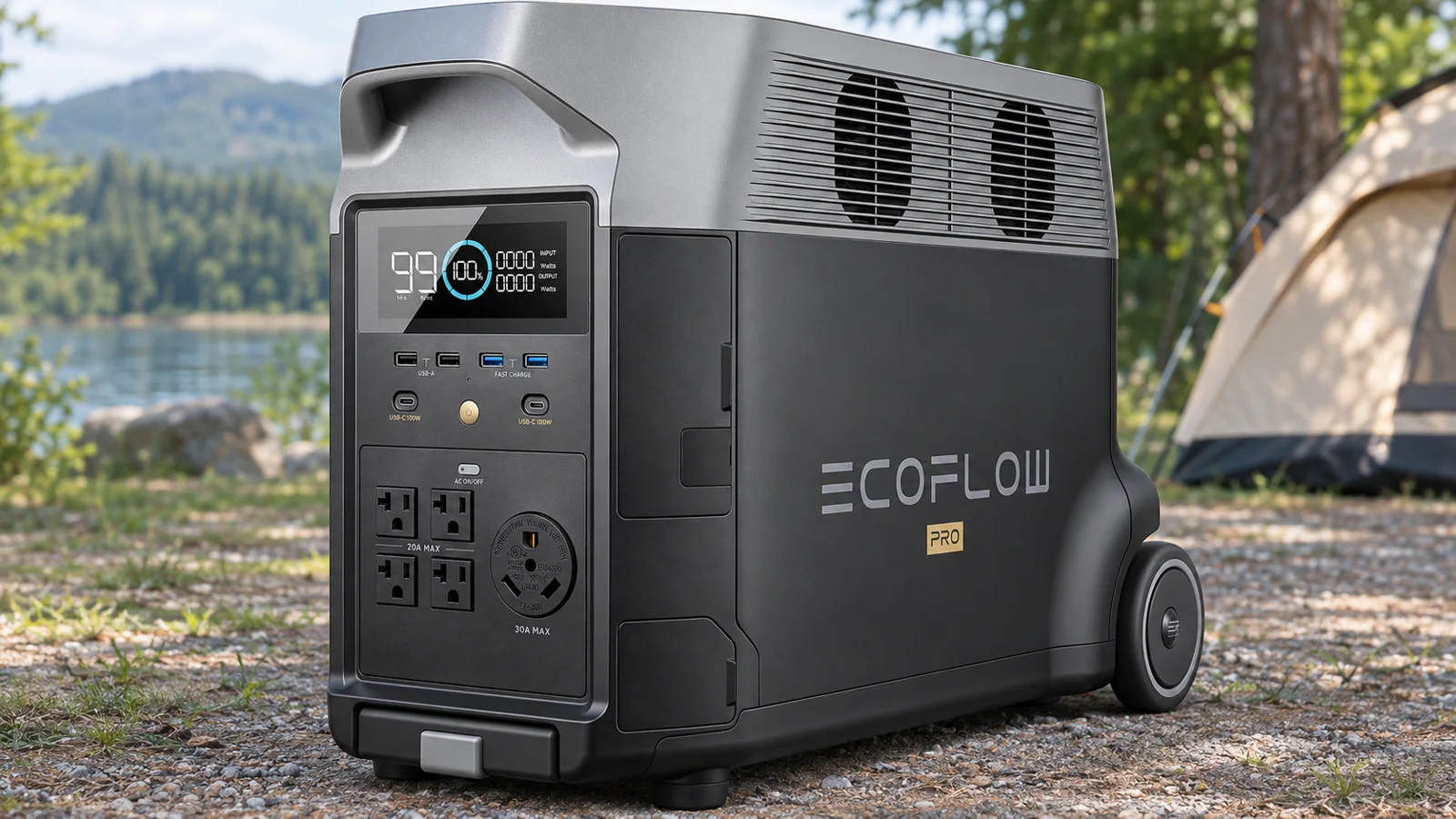

- Capacity
- 3,600 Wh
- Rated output
- 3,600 W
- Chemistry
- See listing
- Value for its size
- Fair value
- Amazon rating
- 4.6 / 5
- Buyer ratings
- 681
Specifications as stated in the Amazon listing. Check current details before buying.
How the score is calculated
This spec- and buyer-rating-based score is not a measure of independently measured performance. Value: Excellent 3, Good 2.2, Fair 1.4, Premium 0.6 points. Amazon rating: 4.0 earns 0, 5.0 earns 2.5, proportional in between. Rating volume: 1.5 × ln(1 + ratings) / ln(5,001), capped at 1.5. Output: 1.5 × rated W / Wh, capped at 1.5; unknown output earns 0.75. Stated LiFePO4: 1 point. Stated cycles, weight and solar input: 0.5/3 each, rounded together to three decimals. Missing value, rating, volume or listing details earn 0 for that criterion. The total is rounded to one decimal.
Read our full ranking methodologyThe short verdict
The EcoFlow DELTA Pro is built for buyers who need substantial stored energy and a full 3,600W AC output, not a lightweight weekend gadget. Its long runtime potential, flexible charging and app control are compelling, but its Fair value rating means you should compare capacity and features carefully before buying; check the current price on Amazon.
Pros
- Large 3,600Wh LiFePO4 battery for extended backup
- Strong 3,600W rated AC output
- X-Boost can raise output to 4,500W
- Five charging methods, including EV charging and solar
- Wi-Fi and Bluetooth app control with a 4.6/5 Amazon rating from 681 ratings
Cons
- Fair value for its 3,600Wh size class
- Its large capacity implies a substantial, less-portable form factor
- The published runtime figures are estimates and vary with real-world loads
Best for
- Homeowners who need quiet backup during outages
- Campers and van builders planning extended stays
- Job-site users running demanding AC equipment
Look elsewhere if
- Shoppers seeking a compact, easy-to-carry power station
- Buyers who only need occasional phone and laptop charging
Full specifications
| Capacity | 3,600 Wh |
|---|---|
| Rated AC output | 3,600 W |
| LiFePO4 stated | See listing |
| Charge cycles | See listing |
| Weight | See listing |
| Solar input | 400 W |
| Value for its size | Fair value |
Specifications as stated in the Amazon listing. Cycle-life conditions and solar compatibility vary; see the listing.
What can it power?
Choose your devices and daily run time. Battery capacity needed = watts × hours ÷ 0.85. Peak running watts assumes all selected devices run at once.
These are planning estimates, not measured runtimes. Appliance startup surges, fridge duty cycles, CPAP humidifiers and charging losses can change demand. Check your device label and the listing’s surge limit.
Runtime reference · 3,600 Wh at 85% usable energy
| Device | Running watts | Estimated hours |
|---|---|---|
| Phone | 15 W | 204.0 |
| Laptop | 60 W | 51.0 |
| Router | 40 W | 76.5 |
| CPAP | 45 W | 68.0 |
| Mini fridge | 50 W | 61.2 |
| Full fridge | 150 W | 20.4 |
| TV | 100 W | 30.6 |
| LED lights | 20 W | 153.0 |
| Coffee maker | 900 W | 3.4 |
| Microwave | 1000 W | 3.1 |
| Space heater | 750 W | 4.1 |
| E-bike charger | 500 W | 6.1 |
| Drill | 600 W | 5.1 |
Runtime estimates
Estimated usable energy is 85% of rated capacity. Actual runtime varies with load, temperature and battery age. See the device reference above for calculated estimates.
| Device | Estimated runtime |
|---|---|
| Phone charge (15 W) | 204 h |
| Laptop (60 W) | 51 h |
| LED lights + Wi-Fi router (40 W) | 76 h |
| CPAP, heated humidifier (45 W avg) | 68 h |
| Mini fridge/cooler (50 W avg) | 61 h |
| Full-size fridge (150 W avg) | 20 h |
| 55-inch TV (100 W) | 31 h |
| Drip coffee maker (900 W) | 3.4 h |
| Microwave (1,000 W) | 3.1 h |
| Space heater, low (750 W) | 4.1 h |
A blackout hits during dinner. The refrigerator needs to keep running, the Wi-Fi router matters for work, and a coffee maker or microwave would make the disruption far easier to manage. The EcoFlow DELTA Pro is aimed at that kind of practical backup—not just emergency phone charging.
This is a 3,600 Wh portable power station with a rated 3,600 W AC output and a LiFePO4 battery. That combination puts it in the heavy-duty class for home backup, extended camping, van builds and job sites. It also supports multiple charging routes and remote monitoring through the EcoFlow app. Check the current price on Amazon, then compare it with similarly sized alternatives before deciding.
Who the EcoFlow DELTA Pro Is Really For
The DELTA Pro makes sense when your power needs go beyond a few electronics. A 3,600 Wh battery can cover multiple days of modest loads or provide meaningful support for refrigerators, networking equipment, medical devices and kitchen appliances during an outage. It is also suited to extended campsites and van builds where repeated recharging may not be convenient.
The 3,600 W AC rating is equally important. It gives this unit the output class needed for many demanding household and work-site devices, while X-Boost can raise that figure to 4,500 W for compatible loads. Two units can be paired for 7,200 W, according to the listing. That is a serious expansion path, although buyers should confirm the exact setup and appliance compatibility on Amazon.
This is not the obvious choice for a quick day trip. A battery this large implies a substantial transport burden compared with compact stations, even though the manufacturer specifications provided here do not state a weight. For smaller needs, consider a lower-capacity model. For outages, refrigeration, CPAP nights or high-draw tools, the DELTA Pro has a much more convincing use case.
3,600Wh Capacity, 3,600W Output: What Can It Run?
The headline numbers are easy to understand: 3,600 Wh of stored energy and 3,600 W of rated AC output. Using an 85% usable-efficiency estimate, the expected runtimes below show why this station is better suited to sustained backup than short bursts. Actual results change with startup surges, cycling appliances and the device’s real draw.
| Load | Estimated runtime |
|---|---|
| Phone charge | 204 hours |
| Laptop | 51 hours |
| LED lights and Wi-Fi router | 76 hours |
| CPAP with heated humidifier | 68 hours |
| Mini fridge or cooler | 61 hours |
| Full-size refrigerator | 20 hours |
| 55-inch TV | 31 hours |
| Drip coffee maker | 3.4 hours |
| Microwave | 3.1 hours |
| Space heater, low | 4.1 hours |
Those figures are planning estimates, not guarantees. A refrigerator cycles, while a heater can consume power continuously. Check each appliance’s running and startup wattage before connecting it.
Features, Battery Chemistry and Practical Flexibility
The DELTA Pro uses a 3,600 Wh LiFePO4 battery. That chemistry is a strong fit for a station intended for recurring backup and off-grid use: it stores a large amount of energy in a battery platform widely chosen for durability and stability. The provided specifications do not list a cycle count, warranty or dimensions, so verify those details on the Amazon page before purchase.
Its main performance feature is the 3,600 W AC output, with X-Boost support up to 4,500 W. The listing also says two DELTA Pro units can be paired to achieve 7,200 W. That opens the door to larger home loads, though not every appliance should be assumed compatible with X-Boost. Read the appliance requirements and EcoFlow’s current instructions carefully.
Control is available through the EcoFlow app over Wi-Fi or Bluetooth. The app can show charge level, temperature, charge and discharge times, and the status of connected devices and power supplies. That is useful during a blackout, when checking the station from across the room is preferable to repeatedly walking over to inspect it. The listing mentions multiple charging paths and an EV charging option; confirm the exact included cables, outlets and regional plug configuration on Amazon.
Charging, Solar and Long-Term Ownership
EcoFlow lists five charging methods: EV charging stations, solar, wall outlets, a smart outdoor generator and a car power outlet. That flexibility matters in different scenarios. Wall charging is convenient before a storm, solar can support longer stays away from the grid, and a car outlet can provide a fallback when other options are unavailable.
The manufacturer lists a full recharge in 1.8 hours using 240V and 3,000 W outlets, or 2.7 hours from 1,800 W wall outlets. It also cites 2.8 hours with four 400 W solar panels and solar conversion efficiency of up to 23%. Those solar figures come from the product listing’s charging claim; real solar charging depends on sunlight, panel positioning, temperature and system limits. Confirm the required accessories and the US-compatible charging configuration before ordering.
For ownership, the LiFePO4 battery and large capacity suit regular backup preparation. Keep expectations realistic: stored energy is finite, and high-wattage heaters, microwaves and coffee makers drain it much faster than networking gear or lights. The app’s temperature and charge-time information can help you monitor that usage. Review current support, warranty and battery-expansion details on Amazon because they are not included in the provided specifications.
How the DELTA Pro Stacks Up Against Alternatives
The closest match is the Growatt Helios 3600, also listed at 3,600 Wh and rated Good value for its size class. The DELTA Pro’s 3,600 W AC output, 4,500 W X-Boost claim and two-unit 7,200 W pairing give it a clear performance story, but compare the exact outlet and expansion details before choosing.
The Jackery HomePower 3600 Plus offers 3,584 Wh and carries a Premium price label, while the Jackery HomePower 3600 Pro Max also lists 3,584 Wh with Fair value. Their capacity is extremely close on paper, so output, charging, included accessories and current pricing deserve more attention than a small Wh difference.
For more stored energy, the AFERIY P310 3840 Wh lists 3,840 Wh and Excellent value. The Anker SOLIX F3000 lists 3,072 Wh and Premium price, giving up capacity but potentially appealing to buyers whose priorities differ. The DELTA Pro lands at Fair value: compelling for its output and flexible charging, but not an automatic bargain. For broader buying context, see our home-backup rankings.
Frequently asked questions
How long can the EcoFlow DELTA Pro run a refrigerator?
The estimated runtime is 20 hours for a full-size refrigerator, based on 3,600Wh of capacity and 85% usable efficiency. That is a planning figure rather than a guarantee. Refrigerators cycle on and off, and startup demand varies, so actual duration depends on the appliance, room temperature and how often the compressor runs.
Can the DELTA Pro run a space heater?
It can support a space heater on low according to the estimated runtime table, with about 4.1 hours of use. A heater is a high-draw load, so it consumes the battery far faster than lights, a router or a laptop. Check the heater's running wattage and startup behavior before relying on it during an outage.
Does the EcoFlow DELTA Pro support solar charging?
Yes. The listing describes solar charging and cites 2.8 hours using four 400W solar panels, with solar conversion efficiency of up to 23%. Actual charging varies with sunlight, panel angle, weather and accessories. Confirm the required solar cables, input limits and US setup on the current Amazon page.
Can two EcoFlow DELTA Pro units work together?
The product listing says two DELTA Pro units can be paired to achieve 7,200W. That is a substantial expansion for larger backup loads, but the exact connection hardware, compatible appliances and installation requirements are not provided here. Confirm EcoFlow's current instructions and included accessories before planning a two-unit system.
Is the DELTA Pro good for CPAP backup?
Yes, its capacity is well suited to overnight CPAP use. The estimated runtime for a CPAP with a heated humidifier is 68 hours, though actual runtime depends on pressure settings, humidifier use and power conversion losses. For medical-device backup, confirm the CPAP's power requirements and keep an alternate plan for extended outages.
Consider these alternatives


- 3,584 Wh
- 2,000 W
Fair value
