Anker SOLIX · Spec-based review
Anker SOLIX F3000: Serious Home Backup Power
A 3,072Wh battery with 6,000W output for demanding outages, campsites and job sites.
We may earn a commission from product links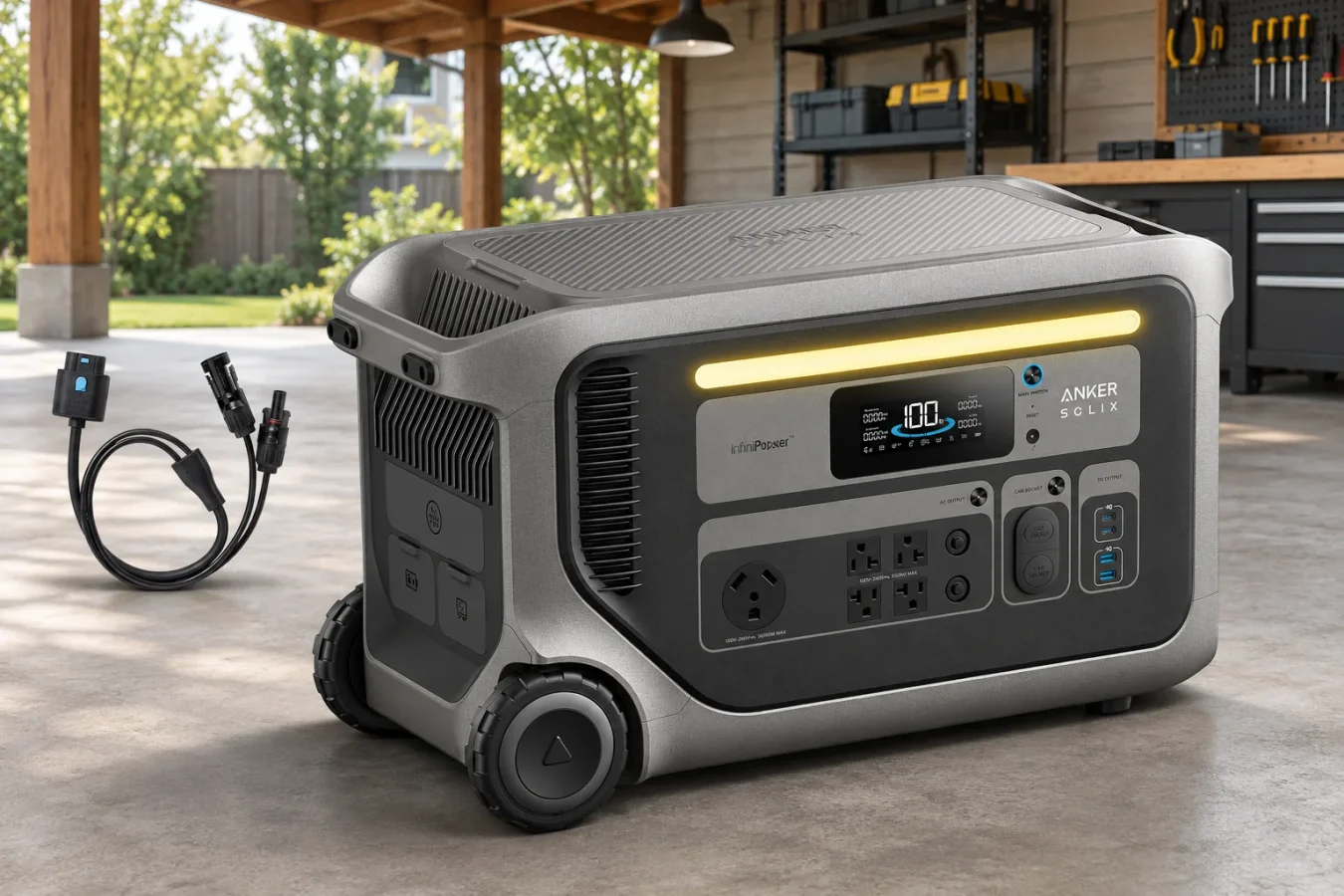
- Capacity
- 3,072 Wh
- Rated output
- 6,000 W
- Chemistry
- See listing
- Value for its size
- Premium price
- Amazon rating
- 4.4 / 5
- Buyer ratings
- 258
Specifications as stated in the Amazon listing. Check current details before buying.
How the score is calculated
This spec- and buyer-rating-based score is not a measure of independently measured performance. Value: Excellent 3, Good 2.2, Fair 1.4, Premium 0.6 points. Amazon rating: 4.0 earns 0, 5.0 earns 2.5, proportional in between. Rating volume: 1.5 × ln(1 + ratings) / ln(5,001), capped at 1.5. Output: 1.5 × rated W / Wh, capped at 1.5; unknown output earns 0.75. Stated LiFePO4: 1 point. Stated cycles, weight and solar input: 0.5/3 each, rounded together to three decimals. Missing value, rating, volume or listing details earn 0 for that criterion. The total is rounded to one decimal.
Read our full ranking methodologyThe short verdict
The Anker SOLIX F3000 is built for buyers who want far more than phone charging: its 3,072Wh capacity and 6,000W AC output can cover major household essentials and demanding equipment. It carries a Premium price for its size class, so check the current price on Amazon and compare the alternatives before committing.
Pros
- Large 3,072Wh capacity for extended outage coverage
- Rated 6,000W AC output for demanding appliances and equipment
- Up to 2,400W solar recharging through compatible solar inputs
- Supports 120/240V output when two units are paired
- 3,600W pass-through charging can keep appliances running while charging
Cons
- Premium price for its 3,072Wh size class
- A capacity this large is better suited to stationary backup or vehicle use than casual carry
- Amazon rating is 4.4 out of 5 from 258 ratings, not an overwhelmingly large review base
Best for
- Homeowners who need quiet backup for refrigerators, networking and essential appliances
- Campers and van users who want substantial capacity for multi-day trips
- Job-site users who need high AC output for demanding tools and equipment
Look elsewhere if
- Shoppers seeking the lightest, simplest power bank for occasional device charging
- Buyers who want the strongest capacity-per-dollar value in this size class
Full specifications
| Capacity | 3,072 Wh |
|---|---|
| Rated AC output | 6,000 W |
| LiFePO4 stated | See listing |
| Charge cycles | See listing |
| Weight | See listing |
| Solar input | 2400 W |
| Value for its size | Premium price |
Specifications as stated in the Amazon listing. Cycle-life conditions and solar compatibility vary; see the listing.
What can it power?
Choose your devices and daily run time. Battery capacity needed = watts × hours ÷ 0.85. Peak running watts assumes all selected devices run at once.
These are planning estimates, not measured runtimes. Appliance startup surges, fridge duty cycles, CPAP humidifiers and charging losses can change demand. Check your device label and the listing’s surge limit.
Runtime reference · 3,072 Wh at 85% usable energy
| Device | Running watts | Estimated hours |
|---|---|---|
| Phone | 15 W | 174.1 |
| Laptop | 60 W | 43.5 |
| Router | 40 W | 65.3 |
| CPAP | 45 W | 58.0 |
| Mini fridge | 50 W | 52.2 |
| Full fridge | 150 W | 17.4 |
| TV | 100 W | 26.1 |
| LED lights | 20 W | 130.6 |
| Coffee maker | 900 W | 2.9 |
| Microwave | 1000 W | 2.6 |
| Space heater | 750 W | 3.5 |
| E-bike charger | 500 W | 5.2 |
| Drill | 600 W | 4.4 |
Runtime estimates
Estimated usable energy is 85% of rated capacity. Actual runtime varies with load, temperature and battery age. See the device reference above for calculated estimates.
| Device | Estimated runtime |
|---|---|
| Phone charge (15 W) | 174 h |
| Laptop (60 W) | 44 h |
| LED lights + Wi-Fi router (40 W) | 65 h |
| CPAP, heated humidifier (45 W avg) | 58 h |
| Mini fridge/cooler (50 W avg) | 52 h |
| Full-size fridge (150 W avg) | 17 h |
| 55-inch TV (100 W) | 26 h |
| Drip coffee maker (900 W) | 2.9 h |
| Microwave (1,000 W) | 2.6 h |
| Space heater, low (750 W) | 3.5 h |
When the power fails during a storm, the priority is not just keeping a phone alive. You may need the refrigerator cold, the Wi-Fi router online, lights running and a CPAP machine operating overnight. The Anker SOLIX F3000 is aimed at that bigger job. Its 3,072 Wh battery and 6,000 W rated AC output put it firmly in the serious home-backup and high-demand equipment category.
This is also a solar generator, with up to 2,400 W of solar recharging listed by Anker. The unit supports 120V operation by itself and can reach 240V when two units are paired. It is not the obvious pick for a lightweight weekend power bank. It makes more sense for blackouts, extended camping, van setups and job sites where capacity and output matter more than compactness.
Who the Anker SOLIX F3000 Is Really For
The F3000 is for people planning around real power needs rather than occasional gadget charging. During a blackout, 3,072 Wh gives you a meaningful reserve for refrigeration, communications, lighting and medical equipment. The listed runtime estimate for a full-size refrigerator is 17 hours, while a mini fridge or cooler is estimated at 52 hours. That difference is a useful reminder to size the station around the actual load, not the appliance label alone.
It also suits a campsite or van where several devices run together: laptops, lights, a router, a cooler and cooking equipment can all draw from the same large battery. On a job site, the 6,000 W rating gives it a far wider operating envelope than small stations. Buyers should still think about portability. A 3,072 Wh station is a substantial piece of backup equipment by definition, so it is better for a home, vehicle or established base camp than casual day hiking.
Capacity, Output and What It Can Run
Capacity is the F3000’s headline strength. Using the standard 85% usable-efficiency estimate, the listed runtimes translate into a practical picture of its reserve:
| Load | Estimated runtime |
|---|---|
| LED lights plus Wi-Fi router | 65 hours |
| CPAP with heated humidifier | 58 hours |
| Full-size refrigerator | 17 hours |
| 55-inch TV | 26 hours |
| Microwave | 2.6 hours |
| Space heater, low | 3.5 hours |
Other listed estimates include 174 hours for phone charging, 44 hours for a laptop, 2.9 hours for a drip coffee maker and 52 hours for a mini fridge or cooler. The 6,000 W AC rating is the key distinction: it is intended for much larger loads than a basic power bank. Actual runtime varies with cycling, startup demand and conversion losses, so treat these figures as planning estimates rather than guarantees.
Features and Ports: What the Spec Sheet Tells Us
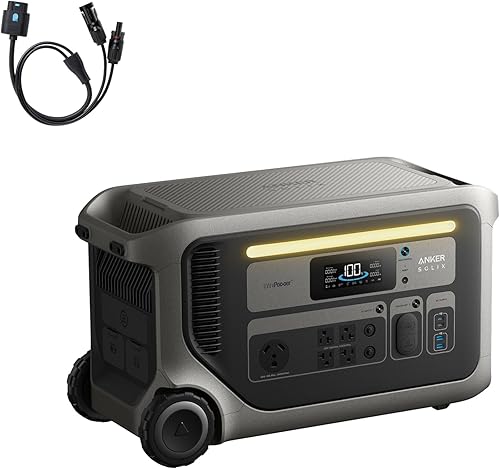
Anker lists 120V operation from one F3000 and 120/240V output when two units are paired. That gives the system a path toward appliances that require 240V, although the two-unit configuration naturally means buying and managing more equipment. The headline 6,000 W AC rating also makes this a plausible fit for demanding appliances and job-site equipment, subject to each device’s startup and continuous requirements.
The feature set is centered on power throughput. Anker lists 3,600 W pass-through charging, allowing the station to recharge from a 120V generator while running appliances at full power. That matters during a prolonged outage because the battery does not have to sit idle while another source replenishes it. The solar inputs are described as 165V and 60V ports, with compatibility for portable and rigid panels. The listing also describes grid integration using a Bi-Directional Inlet Box and Smart Meter. Verify the exact included accessories, installation requirements and US configuration on Amazon before planning a permanent setup.
Charging, Solar and Long-Term Ownership
Solar charging is a major part of the F3000’s appeal. Anker lists up to 2,400 W of solar recharging, which is substantial input for a 3,072 Wh battery. In ideal conditions, that input could replace a large share of the battery’s energy during daylight, but real charging depends on panel output, sun angle, weather, wiring and the station’s input limits. Panel compatibility matters too: the listing specifically references 165V and 60V ports, so confirm the panel arrangement and voltage requirements before purchasing hardware.
The station can also accept 3,600 W through pass-through charging from a 120V generator, and Anker describes up to 6,000 W of combined fuel-generator and solar input for faster emergency recharging. Those figures describe maximum input capability, not a promise that every source will deliver it continuously. For long outages, the useful advantage is flexibility: use solar when conditions cooperate, a generator when you need predictable replenishment, and the stored battery for quiet overnight power. For grid integration, verify the Bi-Directional Inlet Box and Smart Meter requirements with a qualified installer.
How It Stacks Up Against the Alternatives
The closest alternatives share the F3000’s 3,072 Wh capacity, so output and value become the meaningful separators. The Jackery HomePower 3000 also lists 3,072 Wh and carries a Good value label, while the EcoFlow DELTA 3 Ultra Plus is the same capacity with a Fair value label. The EcoFlow DELTA 3 Ultra also offers 3,072 Wh and is labeled Good value. These options deserve close comparison if maximum capacity per dollar matters.
The DABBSSON 3000L matches the 3,072 Wh capacity and is labeled Excellent value, making it the strongest value-oriented alternative in this group. For more stored energy, the Jackery HomePower 3600 Plus lists 3,584 Wh but carries a Premium price label. The F3000’s standout claim is its 6,000 W rated AC output and broad charging options. If that output ceiling is central to your plan, it earns its place; otherwise, compare current Amazon pricing carefully.
Frequently asked questions
How long can the Anker SOLIX F3000 run a refrigerator?
The listed estimate is 17 hours for a full-size refrigerator and 52 hours for a mini fridge or cooler. Actual runtime depends on cycling, temperature, door openings and the refrigerator’s startup demand. Use those figures as planning estimates, not guaranteed operating times.
Can the F3000 run 240V appliances?
Anker lists 120V/240V output when two F3000 units are paired. A single unit is described for 120V operation. Confirm the exact US wiring, pairing method and appliance compatibility on Amazon before planning to power a 240V load.
How much solar input does the F3000 support?
The listing specifies up to 2,400W of solar recharging and references 165V and 60V solar ports. Real-world input varies with sunlight, panel orientation, weather and the panel setup. Check the current Amazon listing for compatible panel arrangements and included hardware.
Can it charge while running appliances?
Yes. Anker lists 3,600W pass-through charging, including recharging with a 120V generator while running appliances at full power. This is useful during extended outages, although the generator, appliance and wiring must all support the required load safely.
Is the Anker SOLIX F3000 good for CPAP use?
It is well suited to CPAP planning on capacity alone. The listed estimate is 58 hours for a CPAP with heated humidifier. Actual nights depend on pressure settings, humidifier use and other connected loads, so allow a reserve rather than planning to drain the battery completely.