Buying guide
Best LiFePO4 Portable Power Stations
Longer-lived chemistry, quieter backup power and the right capacity for everything from CPAP nights to extended outages.
Quick picks


Best lightweight option
EcoFlow
EcoFlow River 2 Max 500
- 499 Wh
- Output: see listing
- LiFePO4
Excellent value


Best high-output 1,000Wh model
Jackery
Jackery Explorer 1000 v2
- 1,024 Wh
- Output: see listing
- LiFePO4
Premium price
Amazon prices change constantly: tap the button for today's price.
When the lights go out, a LiFePO4 power station gives you something a gas generator cannot: silent electricity without fumes, fuel storage or engine maintenance. The right model can keep a refrigerator cold, recharge phones during a storm, run a CPAP machine overnight or bring serious power to a campsite. The wrong one can be too small for the job, too heavy to move or expensive for the capacity it provides.
This guide ranks eight portable power stations whose listings specifically identify LiFePO4 or LFP batteries. You will find clear picks for home backup, camping, job-site power, RV use, small loads and long-duration outages, plus runtime estimates based on usable energy rather than optimistic capacity claims. Start with our broader best portable power stations ranking if chemistry is not your first concern.
We picked these models from manufacturer-listed specifications, their stated value for their size class and the volume and strength of Amazon buyer ratings. Runtime estimates use the standard calculation of watt-hours multiplied by 0.85, divided by the device’s watt draw. Always check the current price and the latest US specifications on Amazon before buying.
Why LiFePO4 is the battery chemistry to want
LiFePO4, also called LFP, is a lithium-ion battery chemistry built around lithium iron phosphate. Compared with the nickel-manganese-cobalt chemistry commonly called NMC, LFP generally prioritizes stability and longevity over maximum energy density. That matters in a power station, which may spend years sitting charged for hurricane season or cycling repeatedly in an RV.
Cycle life is the useful concept here. One cycle means using an amount of energy equal to the battery’s full capacity, even if that happens through several partial discharges. A higher cycle rating suggests the battery can go through more full-equivalent charge and discharge cycles before its available capacity falls substantially. It does not mean the station will suddenly stop working at that number, and it does not guarantee identical results in every climate or charging pattern.
LFP’s chemistry is also widely valued for thermal stability. That is a safety advantage, but it is not permission to cover vents, use damaged cables or store a station in extreme heat. Follow the manufacturer’s instructions. The tradeoff is weight: LFP cells can be heavier for the same energy than NMC cells. You see that compromise most clearly when comparing compact stations intended for backpack-style portability with larger outage batteries designed to sit near a refrigerator or transfer setup. For a deeper chemistry comparison, read LiFePO4 vs. NMC power stations.
1. BLUETTI AC180: best overall LiFePO4 power station
The BLUETTI AC180 is the easiest all-around recommendation because its numbers suit both emergency backup and serious recreation. It stores 1,152 Wh and provides 1,800 W of rated AC output, with a 2,700 W peak mode available through the BLUETTI app. That is enough headroom for many demanding household devices, while the capacity remains manageable for a portable station rather than a full home battery.
Its listing states that AC charging can reach full capacity in one hour at 1,440 W, and its built-in MPPT controller accepts up to 500 W of solar input. The listing also claims a 20 ms UPS response for home backup and identifies nine outlets. Those features make it particularly compelling for a home office, refrigerator support during an outage or a campsite where several people need power at once.
Runtime math gives roughly 979 Wh of practical output before conversion losses are considered beyond the standard estimate. That works out to about 49 hours for a 20 W router, 9.8 hours at 100 W or 4.9 hours at 200 W. The AC180 earns Excellent value for its size class and carries a 4.5 out of 5 Amazon rating from 1,900 ratings. It is our best overall pick and a strong starting point for the home-backup category.
2. EcoFlow DELTA 3 Max: best for extended outages
For a longer blackout, the EcoFlow DELTA 3 Max gives you 2,048 Wh of LFP storage and 2,400 W of rated output. That is the largest capacity-to-output combination in this roundup, making it the clearest choice for running several essentials without immediately reaching for an expansion battery. The listing also describes a 3,400 W continuous X-Boost mode for appliances that need extra help.
The station is aimed squarely at emergency use. EcoFlow lists 0–80% charging in 1.13 hours, a transfer time below 10 ms and ultra-quiet operation. A fast transfer time can help keep sensitive electronics powered during an interruption, but users should still confirm that the station’s UPS behavior suits their particular computer, medical device or networking equipment.
The standard runtime estimate is about 1,741 Wh of usable energy. A 60 W load could run for approximately 29 hours; a 100 W load for 17.4 hours; and a 500 W load for about 3.5 hours. Actual results vary with startup surges, temperature and the mix of AC and USB loads. Its value label is Good value, and its 4.7 out of 5 Amazon rating from 656 ratings is excellent. Choose it for outage resilience, a van build or a demanding worksite where capacity matters more than minimum carry weight.
3. DJI Power 2000 and DJI Power 1000 V2: strong capacity choices
The DJI Power 2000 is a straightforward high-capacity option: 2,048 Wh with an LFP battery. Its value label is Excellent value for its size class, and its Amazon rating is 4.4 out of 5 from 818 ratings. That combination makes it attractive when the priority is storing enough energy for a long night, a multi-day camping trip or repeated smaller loads during an outage. With the standard 0.85 factor, the nominal battery equates to about 1,741 Wh of practical energy. At 100 W, that is approximately 17.4 hours.
The DJI Power 1000 V2 cuts capacity in half to 1,024 Wh and is rated Good value. Its Amazon rating is 4.3 out of 5 from 1,200 ratings. It is a sensible middle ground for users who want a substantial battery without stepping up to a 2,000 Wh class station. Expect roughly 870 Wh using the same runtime estimate, or about 8.7 hours at 100 W.
Neither listing supplies a rated AC output number in the information available here, so do not assume either unit can run a particular heater, microwave or power tool. Check the current Amazon listing for US output ratings, port details, charging behavior and warranty information before buying. For a practical capacity match, compare these models with our watt-hour sizing guide.
4. Jackery Explorer 1000 v2: best polished 1,000Wh option
The Jackery Explorer 1000 v2 pairs a 1,024 Wh LFP battery with 1,500 W of pure-sine AC output and a 3,000 W surge peak. That is a useful specification for refrigerator startup, electric cooking devices and many job-site tools, though high-wattage heating appliances can consume its battery quickly. Jackery lists three AC ports, two USB-C ports, one USB-A port, one DC car port and LED lights.
The listing describes one-hour charging, with the emergency charging function activated in the Jackery app, plus a 1.7-hour fast-charging mode intended to optimize battery status. It also identifies a 30 dB silent mode for nighttime operation. Those details fit a bedroom blackout, CPAP setup or quiet campsite particularly well. The listing states a five-year warranty, but buyers should confirm the current US terms and exclusions.
At the standard estimate, its battery supplies about 870 Wh of practical energy. A 40 W CPAP setup would theoretically run for about 21.8 hours before accounting for any humidifier-specific demand, while a 100 W load would run about 8.7 hours. Its 4.7 out of 5 rating from 3,700 ratings is the strongest rating volume combination in the roundup. The tradeoff is its Premium price value label. Check the current price on Amazon if you want a refined, high-output station from Jackery.
5. EcoFlow River 2 Max 500 and compact LFP picks
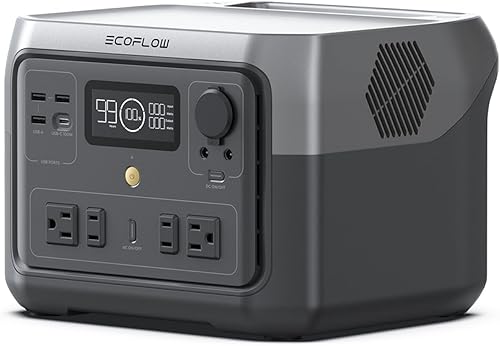
The EcoFlow River 2 Max 500 is the compact standout. Its 499 Wh LFP battery provides 300 W AC output, while the listing also describes up to 1,000 W output in a special mode. It weighs 6.0 kg, offers USB-C and other charging ports, and is designed for camping, RV trips and small home backup. EcoFlow says its LFP cells can provide over 10 years of use and lists battery-management protection for voltage, current and temperature.
Using the standard calculation, expect about 424 Wh of practical energy. That is approximately 8.5 hours at 50 W, 4.2 hours at 100 W or 1.7 hours at 250 W. It is a good fit for phones, laptops, lights, routers and modest medical-device loads. It is not the right tool for sustained electric heating or large kitchen appliances. Its 4.6 out of 5 Amazon rating from 1,400 ratings and Excellent value label strengthen the case.
For smaller loads, the Anker SOLIX 521 stores 256 Wh, supplies 300 W rated AC output with a 600 W peak and carries a 4.4 rating from 3,100 ratings. Anker explicitly rates its LFP battery for 3,000-plus charge cycles and lists a five-year full-device support period. The BLUETTI Elite 30 V2 offers 288 Wh, 600 W AC output and nine outlets in a 9.5-pound design. Both have a Premium price label, so compare current Amazon pricing carefully.
LiFePO4 power station comparison
| Model | Capacity | Rated AC output | Value label | Amazon rating |
|---|---|---|---|---|
| BLUETTI AC180 | 1,152 Wh | 1,800 W | Excellent value | 4.5 from 1,900 |
| EcoFlow DELTA 3 Max | 2,048 Wh | 2,400 W | Good value | 4.7 from 656 |
| DJI Power 2000 | 2,048 Wh | Check listing | Excellent value | 4.4 from 818 |
| DJI Power 1000 V2 | 1,024 Wh | Check listing | Good value | 4.3 from 1,200 |
| Jackery Explorer 1000 v2 | 1,024 Wh | 1,500 W | Premium price | 4.7 from 3,700 |
| EcoFlow River 2 Max 500 | 499 Wh | 300 W | Excellent value | 4.6 from 1,400 |
| BLUETTI Elite 30 V2 | 288 Wh | 600 W | Premium price | 4.5 from 1,200 |
| Anker SOLIX 521 | 256 Wh | 300 W | Premium price | 4.4 from 3,100 |
Capacity tells you how long a station can run a load; output tells you whether it can start and sustain that load. A refrigerator may need modest average energy but a higher startup surge. A CPAP machine may need little wattage but several hours of dependable overnight runtime. A hair dryer or space heater can drain a 1,000 Wh battery quickly. Use both figures, not capacity alone, when comparing models. For solar-compatible systems, see the best solar generators and verify the input specification on the exact Amazon listing.
How to choose the right LiFePO4 station
Begin with your largest essential load. Add the running wattage of devices you expect to use simultaneously, then leave room for startup surges from refrigerators, pumps and motors. A 300 W-class model suits phones, lights, laptops and small electronics. A 1,000 Wh-class station is more flexible for CPAP nights, routers, refrigeration support and cooking devices. A 2,000 Wh-class model is the better foundation for extended blackouts or a van build.
Next, calculate duration. Multiply capacity by 0.85 and divide by the load in watts. A 499 Wh station at a 100 W load yields about 4.2 hours. A 2,048 Wh station at the same load yields about 17.4 hours. USB and DC loads may differ from AC runtime because the inverter is not involved, so treat these figures as planning estimates rather than guarantees.
Then consider portability and charging. LFP’s durability comes with a weight tradeoff, especially in larger capacities. Fast AC charging is valuable before a storm; solar input matters when grid power stays down, but only models whose listings provide solar details should be compared on that basis. For use in a vehicle, check dimensions, ventilation and cable compatibility on Amazon. Our complete buying guide covers the rest, including ports, UPS behavior and recharge planning.
Common mistakes to avoid
The first mistake is buying by watt-hours alone. A large battery with insufficient inverter output may not run the appliance you care about. Check rated output and peak or surge behavior. The second is treating an advertised special output mode as the same thing as continuous rated output. Modes such as X-Boost can have limitations, so confirm appliance compatibility in the current listing.
Another error is assuming every power station is a complete home backup system. A portable station can support selected loads, but it should not be connected to household wiring unless the installation uses an appropriate transfer arrangement and qualified guidance. Never backfeed an outlet. Keep the station dry, uncovered and away from heat sources. Do not use damaged cables or attempt to open the battery enclosure.
Finally, do not confuse cycle life with runtime. Cycle life describes long-term battery aging; watt-hours describe how much energy is available on a particular charge. LFP usually offers a strong longevity and stability proposition, but capacity still declines over time. Store and recharge the unit according to the manufacturer’s instructions, and verify current warranty, temperature, port and US-voltage details on Amazon. For severe-weather preparation, use our hurricane and blackout checklist.
Final recommendation
The BLUETTI AC180 is the best choice for most buyers because it balances 1,152 Wh of storage, 1,800 W output, fast charging, UPS capability, solar input and Excellent value. It has enough authority for serious emergency loads without moving into the biggest and most cumbersome class.
Choose the EcoFlow DELTA 3 Max when the priority is extended outage coverage, high-demand appliances or a van and job-site setup. Its 2,048 Wh capacity and 2,400 W rated output give it the broadest practical range here. Choose the Jackery Explorer 1000 v2 for a polished 1,000 Wh-class station with strong buyer feedback, quiet mode and a 1,500 W inverter. The River 2 Max 500 is the best lightweight choice, while the Anker SOLIX 521 is the sensible small-device option if its compact capacity matches your needs.
Before ordering, check the current price on Amazon, confirm the US listing’s output and input specifications, and match the battery to your actual loads rather than an imagined worst-case appliance list. If your main scenario is camping, compare these picks with our camping guide. For a CPAP, router or medical device, prioritize overnight watt-hours, quiet operation and confirmed compatibility in our CPAP and medical-device guide.
Every model mentioned, at a glance
| Value for its size | Availability | |||||||||
|---|---|---|---|---|---|---|---|---|---|---|
| BLUETTI AC180 Best overall | 8.2 | 1,152 | 1,800 | Yes | See listing | 500 | See listing | 4.51,900 ratings | Excellent value | Check price on Amazon |
| EcoFlow DELTA 3 Max Best LiFePO4 | 7.6 | 2,048 | 2,400 | Yes | See listing | See listing | See listing | 4.7656 ratings | Good value | Check price on Amazon |
| EcoFlow River 2 Max 500 | 7.9 | 499 | See listing | Yes | See listing | 220 | 13.2 | 4.61,400 ratings | Excellent value | Check price on Amazon |
| Anker SOLIX 521 | 5.5 | 256 | 300 | Yes | See listing | See listing | See listing | 4.43,100 ratings | Premium price | Check price on Amazon |
| Jackery Explorer 1000 v2 | 5.9 | 1,024 | See listing | Yes | 4000 | See listing | 25 | 4.73,700 ratings | Premium price | Check price on Amazon |
| DJI Power 2000 | 6.9 | 2,048 | See listing | Yes | See listing | See listing | See listing | 4.4818 ratings | Excellent value | Check price on Amazon |
| DJI Power 1000 V2 | 5.9 | 1,024 | See listing | Yes | See listing | See listing | See listing | 4.31,200 ratings | Good value | Check price on Amazon |
| BLUETTI Elite 30 V2 Best budget | 5.8 | 288 | 600 | Yes | See listing | See listing | 9.5 | 4.51,200 ratings | Premium price | Check price on Amazon |
Specifications as stated in the Amazon listing. Missing details: see listing. Scores use specifications and buyer ratings. How we rank.
Frequently asked questions
Are LiFePO4 power stations safer than NMC models?
LiFePO4 chemistry is widely valued for strong thermal stability compared with NMC, which is one reason it is popular in portable power stations. Safety still depends on the complete product, battery-management system, charger, enclosure and user behavior. Keep the station ventilated, dry and undamaged, and follow the manufacturer’s storage and charging instructions.
How long does a LiFePO4 power station last?
Lifespan depends on temperature, charging habits, depth of discharge and construction. Cycle life describes full-equivalent charge and discharge cycles before capacity declines substantially; it is not a fixed expiration date. Some listings provide a specific cycle claim, such as Anker’s 3,000-plus-cycle statement for the SOLIX 521, while others emphasize years of intended use instead.
What size LiFePO4 power station do I need for a CPAP?
Start with the CPAP’s actual watt draw, then account for humidifier and heated-tube settings, which can raise consumption. Apply the estimate of watt-hours multiplied by 0.85, divided by watts. A 1,024Wh station provides roughly 870Wh by this method, but confirm your device’s requirements and expected runtime before relying on it overnight.
Can these power stations run a refrigerator?
Some can, but you must check both running wattage and startup surge. The Jackery Explorer 1000 v2 lists 1,500W AC output and a 3,000W surge peak, while the BLUETTI AC180 lists 1,800W output and a 2,700W peak. Battery duration depends on the refrigerator’s duty cycle, so capacity matters as much as inverter output.
Does a LiFePO4 station need solar panels?
No. Solar is optional unless you specifically need off-grid recharging. AC charging is usually the simplest preparation method before a storm or trip. If solar matters, verify that the exact model’s Amazon listing states solar compatibility, maximum input and controller details. Do not assume a solar-related title means every panel or cable will work.
Are LiFePO4 power stations heavier than NMC models?
Often, yes. LFP chemistry generally trades some energy density for durability and stability, so a station with the same nominal capacity may weigh more than an NMC alternative. That tradeoff matters for camping and frequent carrying. For compact portability, the EcoFlow River 2 Max 500 is listed at 6.0 kg, while larger-capacity models prioritize runtime and output.
Shop the models in this guide

- 2,048 Wh
- Output: see listing
- LiFePO4
Excellent value