EcoFlow · Spec-based review
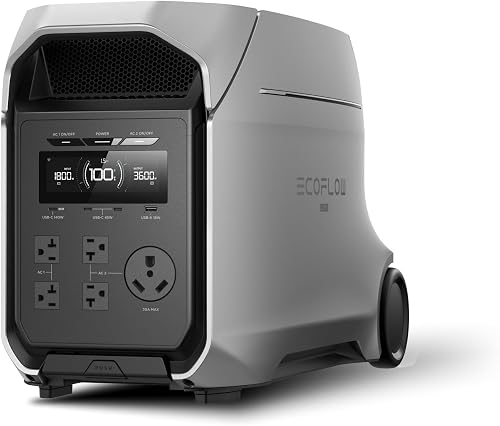
EcoFlow DELTA 3 Ultra Plus: Serious Whole-Home Backup
A 3,072Wh LiFePO4 power station built for long outages, demanding appliances, and expandable backup.
We may earn a commission from product links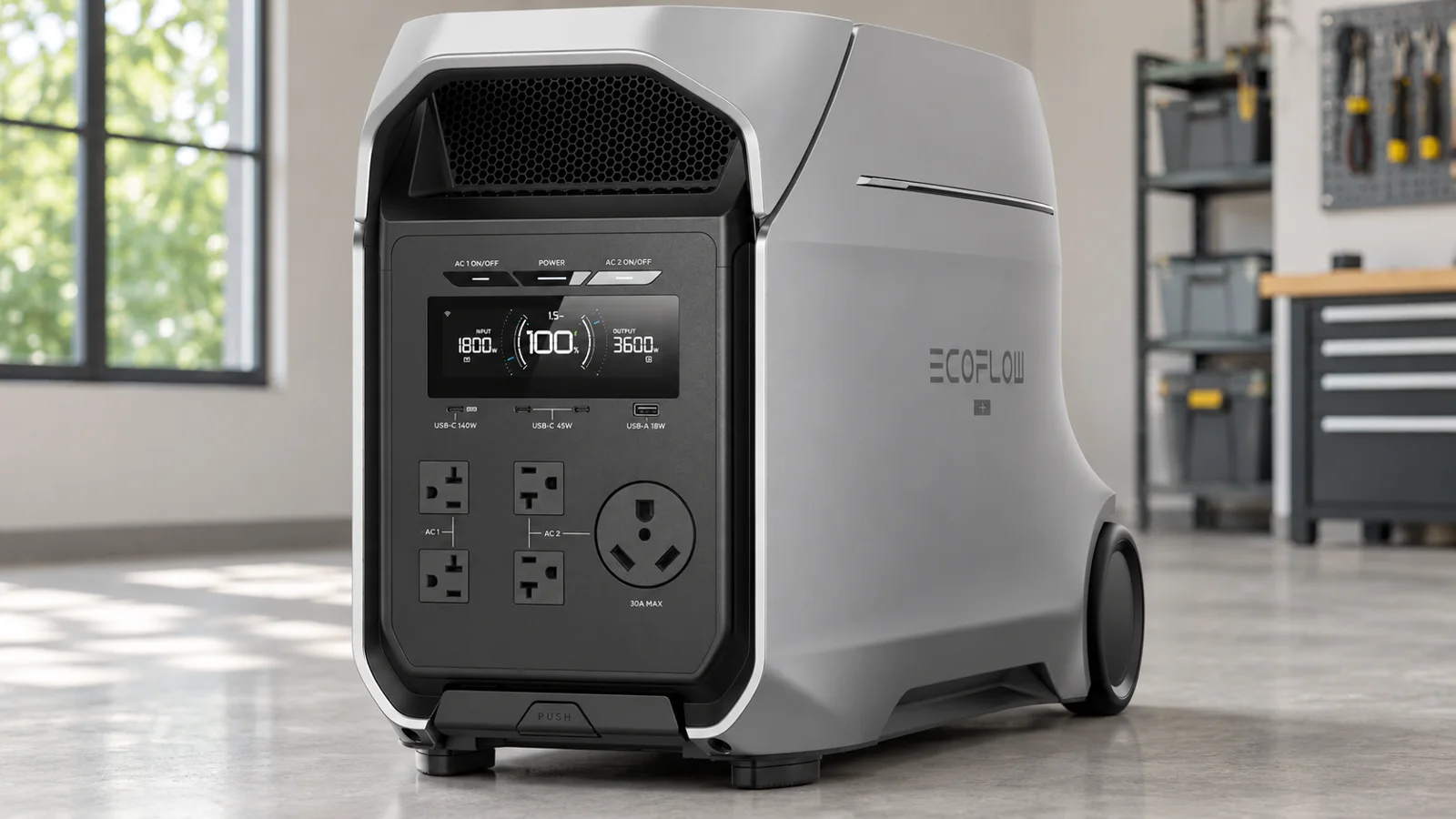
- Capacity
- 3,072 Wh
- Rated output
- 3,600 W
- Chemistry
- See listing
- Value for its size
- Fair value
- Amazon rating
- 4.4 / 5
- Buyer ratings
- 185
Specifications as stated in the Amazon listing. Check current details before buying.
How the score is calculated
This spec- and buyer-rating-based score is not a measure of independently measured performance. Value: Excellent 3, Good 2.2, Fair 1.4, Premium 0.6 points. Amazon rating: 4.0 earns 0, 5.0 earns 2.5, proportional in between. Rating volume: 1.5 × ln(1 + ratings) / ln(5,001), capped at 1.5. Output: 1.5 × rated W / Wh, capped at 1.5; unknown output earns 0.75. Stated LiFePO4: 1 point. Stated cycles, weight and solar input: 0.5/3 each, rounded together to three decimals. Missing value, rating, volume or listing details earn 0 for that criterion. The total is rounded to one decimal.
Read our full ranking methodologyThe short verdict
The EcoFlow DELTA 3 Ultra Plus is a substantial backup battery with enough capacity for refrigerators, networking gear, medical equipment, and selected heating or cooking loads. Its 3,600W output, under-10ms UPS, quiet 25dB operation, and expandable design make it especially compelling for home backup and RV use, although its Fair value rating means buyers should check the current price on Amazon carefully.
Pros
- Large 3,072Wh LiFePO4 battery for extended backup
- Strong 3,600W continuous output with 7,200W surge capability
- Under-10ms UPS switching for computers, routers, and medical equipment
- Quiet 25dB operation, even under load
- Expandable capacity from 3kWh to 11kWh
Cons
- Fair value for its size class rather than a standout bargain
- A 3,072Wh battery is substantial for casual camping and vehicle storage
- Runtime falls quickly with high-draw appliances such as heaters and microwaves
Best for
- Homeowners who need quiet backup for refrigerators, routers, medical equipment, and lights
- RV owners who want 3,072Wh of starting capacity with room to expand
- Campers and remote workers who need multi-day device and appliance power
Look elsewhere if
- Shoppers who only need a lightweight battery for phones and laptops
- Buyers seeking the strongest value in the 3,000Wh class
Full specifications
| Capacity | 3,072 Wh |
|---|---|
| Rated AC output | 3,600 W |
| LiFePO4 stated | See listing |
| Charge cycles | See listing |
| Weight | See listing |
| Solar input | See listing |
| Value for its size | Fair value |
Specifications as stated in the Amazon listing. Cycle-life conditions and solar compatibility vary; see the listing.
What can it power?
Choose your devices and daily run time. Battery capacity needed = watts × hours ÷ 0.85. Peak running watts assumes all selected devices run at once.
These are planning estimates, not measured runtimes. Appliance startup surges, fridge duty cycles, CPAP humidifiers and charging losses can change demand. Check your device label and the listing’s surge limit.
Runtime reference · 3,072 Wh at 85% usable energy
| Device | Running watts | Estimated hours |
|---|---|---|
| Phone | 15 W | 174.1 |
| Laptop | 60 W | 43.5 |
| Router | 40 W | 65.3 |
| CPAP | 45 W | 58.0 |
| Mini fridge | 50 W | 52.2 |
| Full fridge | 150 W | 17.4 |
| TV | 100 W | 26.1 |
| LED lights | 20 W | 130.6 |
| Coffee maker | 900 W | 2.9 |
| Microwave | 1000 W | 2.6 |
| Space heater | 750 W | 3.5 |
| E-bike charger | 500 W | 5.2 |
| Drill | 600 W | 4.4 |
Runtime estimates
Estimated usable energy is 85% of rated capacity. Actual runtime varies with load, temperature and battery age. See the device reference above for calculated estimates.
| Device | Estimated runtime |
|---|---|
| Phone charge (15 W) | 174 h |
| Laptop (60 W) | 44 h |
| LED lights + Wi-Fi router (40 W) | 65 h |
| CPAP, heated humidifier (45 W avg) | 58 h |
| Mini fridge/cooler (50 W avg) | 52 h |
| Full-size fridge (150 W avg) | 17 h |
| 55-inch TV (100 W) | 26 h |
| Drip coffee maker (900 W) | 2.9 h |
| Microwave (1,000 W) | 2.6 h |
| Space heater, low (750 W) | 3.5 h |
A blackout starts at the worst possible time: the refrigerator is full, the Wi-Fi router is blinking out, and the next storm is already on the forecast. The EcoFlow DELTA 3 Ultra Plus is built for that larger problem. Its 3,072 Wh battery can cover essential household devices for many hours, while its 3,600 W AC output reaches into power tools, RV appliances, coffee makers, and other demanding loads.
This is a serious LiFePO4 power station from EcoFlow, not a small emergency charger. It supports under-10ms UPS switching, operates at a claimed 25dB under load, and can expand from roughly 3kWh to 11kWh with extra batteries. The Amazon rating is 4.4 out of 5 from 185 ratings. Its overall value is Fair for the 3,000 Wh class, so the right buyer is someone who will use the capacity and output—not someone shopping for the smallest occasional backup.
Who the EcoFlow DELTA 3 Ultra Plus Is Really For
This model makes the most sense when an outage means more than charging a phone. A 3,072 Wh reserve can keep a full-size refrigerator, modem, lights, and laptops operating through a meaningful portion of a blackout. It also suits CPAP users, remote workers, and households that want quiet indoor backup without running a gas engine.
RV owners get a useful middle ground: enough energy for several nights of electronics and selected appliances, plus 3,600 W of continuous AC output for heavier equipment. Campers can use it for lights, coolers, laptops, and cooking appliances, but its capacity also makes it a substantial item to transport and store. The expandable design is the bigger attraction for long outages, van builds, or backup systems that may grow later.
It is less sensible for a day hike, a quick phone top-up, or anyone who rarely needs more than a few hundred watt-hours. Those buyers are paying for reserve capacity they may never use. For everyone else, the combination of capacity, output, quiet operation, and UPS behavior is unusually broad.
Capacity, Output, and What It Can Run
The 3,072 Wh battery gives the DELTA 3 Ultra Plus real endurance, while its 3,600 W rated AC output handles much more than basic electronics. It also has a listed 7,200 W surge capability, useful for appliances and tools with short startup demands. Actual runtime depends on the device, power setting, startup surge, and conversion losses; the estimates below use 85% usable efficiency.
| Device or load | Estimated runtime |
|---|---|
| Phone charging | 174 hours |
| Laptop | 44 hours |
| LED lights and Wi-Fi router | 65 hours |
| CPAP with heated humidifier | 58 hours |
| Mini fridge or cooler | 52 hours |
| Full-size refrigerator | 17 hours |
| 55-inch TV | 26 hours |
| Drip coffee maker | 2.9 hours |
| Microwave | 2.6 hours |
| Space heater on low | 3.5 hours |
Those figures are best read as planning estimates, not guarantees. A refrigerator cycles on and off, while a heater can draw continuously. High-wattage appliances consume the battery quickly even when the inverter has enough output headroom.
Features and Ports: What Matters in Practice
The most important feature here is the under-10ms UPS response. When utility power fails, the station automatically switches to battery power quickly enough to protect the continuity of computers, routers, and medical equipment. That makes it more useful beside a desk or home networking cabinet than a basic battery that requires manual intervention.
EcoFlow also lists X-Quiet 3.0 technology and 25dB operation under load. Quiet operation matters during overnight CPAP backup, in an RV, or in a bedroom during a storm. The unit is rated at 3,600 W continuously, with a 7,200 W surge rating, so it is positioned for heavy-duty household appliances, power tools, and RV essentials rather than only USB devices.
The LiFePO4 chemistry is a strong fit for a frequently used backup battery. The manufacturer describes EV-grade CTC construction and a 24/7 battery management system designed to protect against extreme heat, cold, and heavy loads. Capacity can expand from 3kWh to 11kWh. Confirm the port layout and connector mix on the Amazon page before ordering, especially if you already own specific cables or adapters.
Charging, Solar, and Long-Term Ownership
The DELTA 3 Ultra Plus offers six charging routes: a home outlet, solar panels, a car charger, an EV station, a generator, and the EcoFlow Smart Generator. That range gives it flexibility across a suburban blackout, an RV trip, and a remote campsite. EcoFlow also claims X-Stream fast charging to reach 80% in under an hour, which can be valuable when a storm warning leaves a short preparation window.
Solar charging is supported, but the practical result depends on panel wattage, sunlight, orientation, temperature, and the station’s charging limits. Without a solar input figure, size the panel system around the manufacturer’s current Amazon specifications rather than assuming a particular recharge time. The same principle applies to vehicle and EV charging: the source and available power determine how quickly the battery refills.
The listed LiFePO4 battery and EV-grade structure are intended for 10 years of daily use. Its smart battery management system is designed for continuous monitoring and protection. Expansion to 11kWh can turn a single power station into a longer-duration outage system, but added batteries increase the system’s footprint and total purchase commitment. Check the current price on Amazon before choosing the expansion path.
How It Stacks Up Against the Alternatives
The closest comparison is the EcoFlow DELTA 3 Ultra, which also has 3,072 Wh and is rated Good value. The Ultra Plus separates itself with a 3,600 W output, making it the more natural choice for heavier appliances if the current Amazon specifications match your needs.
The Anker SOLIX F3000 matches the 3,072 Wh capacity and carries a Premium price label, while the Jackery HomePower 3000 also matches 3,072 Wh and is rated Good value. The DABBSSON 3000L has the same capacity and an Excellent value label, so it deserves close attention from shoppers prioritizing cost efficiency over brand ecosystem or specific features.
For more capacity, the Jackery HomePower 3600 Plus reaches 3,584 Wh—512 Wh more than this EcoFlow—but carries a Premium price label. In other words, the DELTA 3 Ultra Plus is not the largest option in this group, nor the value leader. Its case is the balance: 3,072 Wh, 3,600 W output, UPS switching, quiet operation, six charging methods, and expansion to 11kWh. Compare the current price on Amazon and prioritize the features you will actually use.
Frequently asked questions
How long can the EcoFlow DELTA 3 Ultra Plus run a refrigerator?
The estimated runtime is 17 hours for a full-size refrigerator, using 85% usable battery efficiency. That is a planning estimate because refrigerators cycle rather than drawing a constant load. Door openings, room temperature, compressor behavior, and other devices connected at the same time can shorten the result.
Can it run a CPAP machine overnight?
Yes. The estimated runtime for a CPAP with a heated humidifier is 58 hours. That provides substantial multi-night potential, although actual results depend on pressure settings, humidity settings, mask leaks, and whether other devices share the battery. Confirm your CPAP’s power requirements and cable arrangement before ordering.
Is the DELTA 3 Ultra Plus suitable for home backup?
It is well suited to essential-load backup rather than powering an entire home indefinitely. The 3,600W continuous output can support many appliances, and the under-10ms UPS can help maintain power for computers, routers, and medical equipment. High-draw heaters and cooking appliances will consume the 3,072Wh reserve quickly.
Does it support solar charging?
Yes. Solar panels are one of the listed charging methods. Recharge speed depends on panel output, sunlight, orientation, temperature, and the station’s solar input limits. Check the current Amazon page for compatible panel specifications before building a solar setup, particularly if you plan to recharge during short winter days.
Can the battery capacity be expanded?
Yes. The system is described as expandable from 3kWh to 11kWh with extra batteries. That gives it a useful path from occasional backup to longer blackouts, RV living, or extended outdoor trips. Expansion adds capability but also increases the system’s overall size and commitment, so compare the current Amazon price before buying additional capacity.