AFERIY · Spec-based review
AFERIY 1024Wh 1800W: Big Backup, Compact Design
A 1,024Wh LiFePO4 power station with 1,800W output for outages, campsites and serious weekend power.
We may earn a commission from product links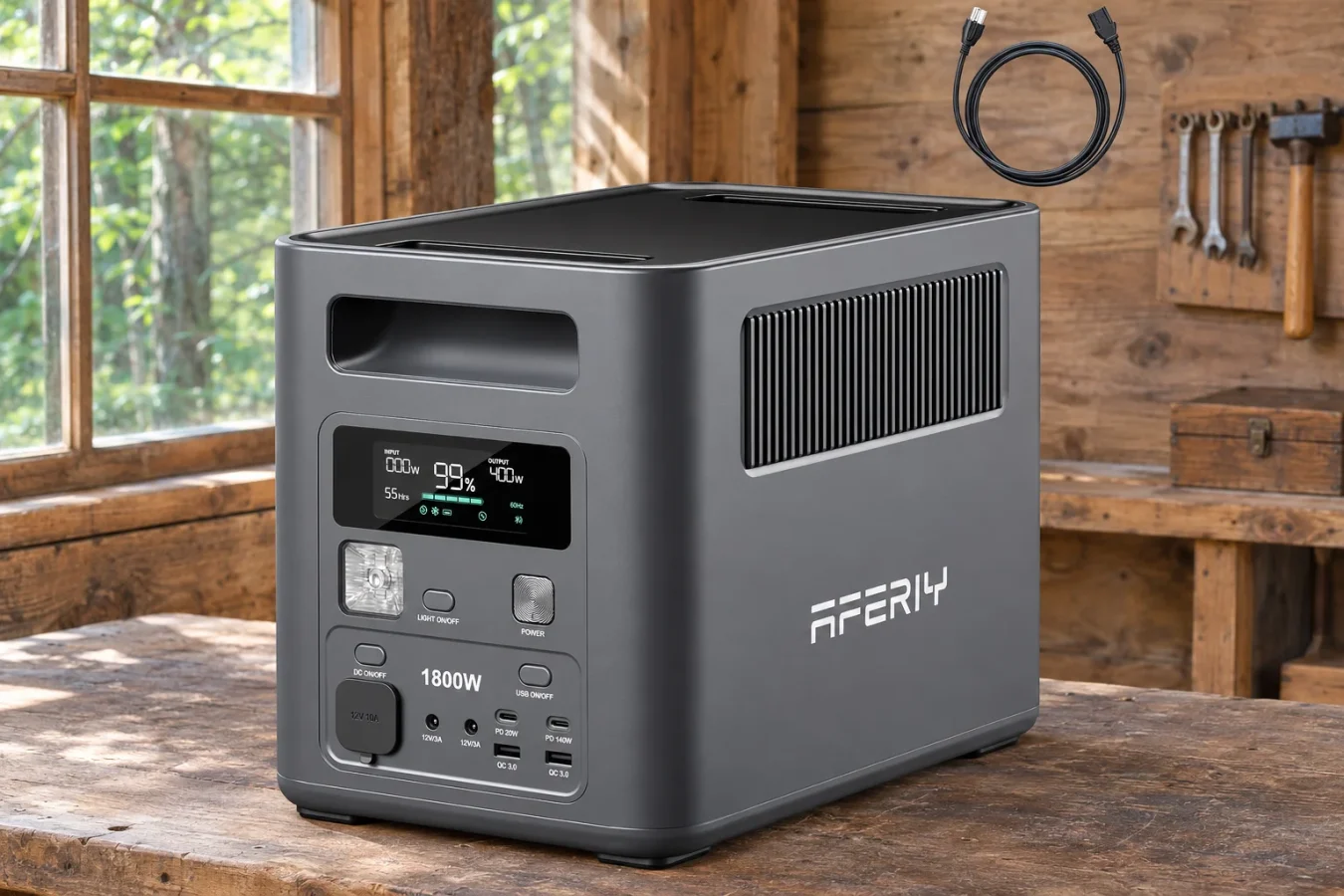

- Capacity
- 1,024 Wh
- Rated output
- 1,800 W
- Chemistry
- See listing
- Value for its size
- Fair value
- Amazon rating
- 4.6 / 5
- Buyer ratings
- 136
Specifications as stated in the Amazon listing. Check current details before buying.
How the score is calculated
This spec- and buyer-rating-based score is not a measure of independently measured performance. Value: Excellent 3, Good 2.2, Fair 1.4, Premium 0.6 points. Amazon rating: 4.0 earns 0, 5.0 earns 2.5, proportional in between. Rating volume: 1.5 × ln(1 + ratings) / ln(5,001), capped at 1.5. Output: 1.5 × rated W / Wh, capped at 1.5; unknown output earns 0.75. Stated LiFePO4: 1 point. Stated cycles, weight and solar input: 0.5/3 each, rounded together to three decimals. Missing value, rating, volume or listing details earn 0 for that criterion. The total is rounded to one decimal.
Read our full ranking methodologyThe short verdict
The AFERIY 1024Wh 1800W is a capable middle-class power station with enough output for many appliances, a LiFePO4 battery, fast charging and a useful UPS feature. Its Fair value rating and limited buyer-rating volume keep it from being an automatic class leader, but the specification is well suited to home backup, camping and CPAP nights.
Pros
- 1,024Wh capacity and 1,800W rated AC output cover a broad range of appliances
- LiFePO4 battery is listed for 4,000-plus cycles and a 10-year lifespan
- Fast AC charging reaches 80% in 55 minutes; AC plus solar reaches 80% in 35 minutes
- UPS transfer time is listed at under 10 milliseconds
- 13 ports, a 140W USB-C PD port, app control and three LED modes
Cons
- Fair value for its size class rather than a standout value
- A 25.57-pound chassis is portable, but still substantial for casual carry
- Only 136 Amazon ratings provide less buyer feedback than some established alternatives
Best for
- Weekend campers who need refrigerator, laptop and lighting power
- Homeowners who want quiet short-outage backup for essential devices
- CPAP users who need a large battery and multiple charging options
Look elsewhere if
- People who need to run high-wattage heaters or whole-home loads for long periods
- Buyers seeking the strongest value rating among 1,024Wh alternatives
Full specifications
| Capacity | 1,024 Wh |
|---|---|
| Rated AC output | 1,800 W |
| LiFePO4 stated | See listing |
| Charge cycles | 4000 |
| Weight | 25.6 lb |
| Solar input | See listing |
| Value for its size | Fair value |
Specifications as stated in the Amazon listing. Cycle-life conditions and solar compatibility vary; see the listing.
What can it power?
Choose your devices and daily run time. Battery capacity needed = watts × hours ÷ 0.85. Peak running watts assumes all selected devices run at once.
These are planning estimates, not measured runtimes. Appliance startup surges, fridge duty cycles, CPAP humidifiers and charging losses can change demand. Check your device label and the listing’s surge limit.
Runtime reference · 1,024 Wh at 85% usable energy
| Device | Running watts | Estimated hours |
|---|---|---|
| Phone | 15 W | 58.0 |
| Laptop | 60 W | 14.5 |
| Router | 40 W | 21.8 |
| CPAP | 45 W | 19.3 |
| Mini fridge | 50 W | 17.4 |
| Full fridge | 150 W | 5.8 |
| TV | 100 W | 8.7 |
| LED lights | 20 W | 43.5 |
| Coffee maker | 900 W | 1.0 |
| Microwave | 1000 W | 0.9 |
| Space heater | 750 W | 1.2 |
| E-bike charger | 500 W | 1.7 |
| Drill | 600 W | 1.5 |
Runtime estimates
Estimated usable energy is 85% of rated capacity. Actual runtime varies with load, temperature and battery age. See the device reference above for calculated estimates.
| Device | Estimated runtime |
|---|---|
| Phone charge (15 W) | 58 h |
| Laptop (60 W) | 15 h |
| LED lights + Wi-Fi router (40 W) | 22 h |
| CPAP, heated humidifier (45 W avg) | 19 h |
| Mini fridge/cooler (50 W avg) | 17 h |
| Full-size fridge (150 W avg) | 5.8 h |
| 55-inch TV (100 W) | 8.7 h |
| Drip coffee maker (900 W) | 58 min |
| Microwave (1,000 W) | 52 min |
| Space heater, low (750 W) | 1.2 h |
A storm rolls through, the lights blink out, and the practical questions arrive fast: Will the refrigerator stay cold? Can the Wi-Fi router, phones and CPAP keep running? The AFERIY 1024 Wh 1800 W is built for that middle ground between a small camping battery and a much larger home-backup system. It has enough stored energy for overnight essentials, plus enough AC output for many kitchen appliances and tools.
This model combines a 1,024 Wh LiFePO4 battery with 1,800 W of rated AC output. AFERIY lists fast AC charging, solar and car charging, a sub-10ms UPS, app control, 13 ports and three LED modes. It is listed at 25.57 pounds and measures 13.77 by 8.66 by 10.35 inches. On Amazon, it holds a 4.6-out-of-5 rating from 136 ratings. Its size-class value is Fair, so the appeal is the balanced feature set rather than the lowest cost.
Who the AFERIY 1024Wh 1800W Is Really For
This AFERIY makes the most sense for someone who wants one power station to cover several realistic jobs. At a campsite, 1,024 Wh can support lights, phones, a laptop, a cooler and occasional cooking loads without immediately forcing a recharge. During a short blackout, it can keep communications and selected appliances going quietly indoors. For hurricane preparation, the built-in UPS and multiple charging paths add useful resilience when grid power is unreliable.
It is also a credible CPAP companion. The listed runtime for a CPAP with heated humidifier is 19 hours, enough for a night with some margin, though actual results vary with pressure, humidifier settings and other loads. Van builders and job-site users get a useful blend of capacity and output, while the 25.57-pound weight remains carryable even if it is not featherlight.
Skip it if your priority is sustained space-heater use, whole-home backup or the smallest possible battery. This is a one-station essentials platform, not a substitute for a permanently installed system or gas generator.
Capacity, Output and What It Can Run
The central specification is straightforward: 1,024 Wh of battery capacity and 1,800 W of rated AC output. That output level covers many refrigerators, coffee makers, microwaves, laptops and power tools, provided their startup and running demands stay within the station’s limits. Four 1,800 W pure sine wave AC outlets are listed, which is useful when several ordinary household devices need power at once.
Estimated runtimes below use 85% usable efficiency and are best treated as planning figures. Heating appliances consume stored energy quickly; communication and low-power devices stretch it much farther.
| Load | Estimated runtime |
|---|---|
| Phone charge | 58 hours |
| Laptop | 15 hours |
| LED lights plus Wi-Fi router | 22 hours |
| CPAP with heated humidifier | 19 hours |
| Mini fridge or cooler | 17 hours |
| Full-size refrigerator | 5.8 hours |
| 55-inch TV | 8.7 hours |
| Drip coffee maker | 58 minutes |
| Microwave | 52 minutes |
| Space heater, low | 1.2 hours |
Features and Ports That Matter
AFERIY lists 13 multi-purpose ports, including four 1,800 W pure sine wave AC outlets and a 140 W USB-C PD port. That USB-C output is a particularly useful detail for modern laptops, including high-performance models such as a MacBook Pro. Pure sine wave AC is also the appropriate format for sensitive electronics and ordinary household equipment.
The built-in UPS is specified to activate in under 10 milliseconds. For a desktop computer, router or other critical electronics, that fast transition is more reassuring than a basic manual changeover. It is still sensible to confirm that your specific equipment accepts the UPS behavior before relying on it as a medical or work-critical system.
The station also includes companion-app control for monitoring battery status, scheduling charging and switching outputs remotely. A built-in LED offers steady, SOS and other listed lighting modes. The manufacturer describes operation as ultra-quiet below 30dB in most daily-use scenarios. Its LiFePO4 chemistry and listed 4,000-plus cycles make it better suited to frequent charging than a comparable conventional lithium-ion design.
Charging, Solar and Long-Term Ownership
Charging flexibility is one of this model’s strongest practical advantages. AFERIY lists AC charging from zero to 80% in 55 minutes, solar charging for off-grid use, car charging for road trips and combined AC-plus-solar charging from zero to 80% in 35 minutes. The combined figure is especially useful when a storm is approaching or a campsite window is short, although solar charge time will depend on panel output, sunlight and positioning.
The solar-generator label does not mean panels are included; verify the current Amazon listing for the exact package contents and solar-input specifications before ordering. The same check is worthwhile for plug and voltage details, especially for buyers outside the United States.
Long-term ownership looks promising on paper. The LiFePO4 battery is listed for more than 4,000 cycles and a 10-year lifespan, while AFERIY also lists UL certification and seven-year support. Battery capacity is not the same as usable AC energy, so our runtime estimates apply an 85% efficiency assumption. Keep high-draw appliances selective, and use solar or AC charging to restore the station before the next outage.
How It Stacks Up Against the Alternatives
The closest comparisons all sit at 1,024 Wh, making output and value the key separators. The Jackery Explorer 1000 v2 matches the capacity but carries a Premium price label. The BLUETTI Elite 100 V2 is also 1,024 Wh and is labeled Good value. The OUPES Mega 1 matches the capacity and shares AFERIY’s Fair value label.
The EcoFlow Delta 3 Classic has 1,024 Wh and an Excellent value label, making it the strongest value-focused rival in this group. The EcoFlow Delta 3 also lists 1,024 Wh but carries a Premium price label. AFERIY’s differentiator is its listed 1,800 W AC output, plus the 140 W USB-C port, under-10ms UPS and 35-minute AC-plus-solar 80% charge claim. Check the current price on Amazon, then compare the exact port layout and charging specifications before choosing.
Frequently asked questions
Can the AFERIY 1024Wh 1800W run a refrigerator?
Yes, its 1,800W rated AC output is suitable for many refrigerators, assuming startup demand stays within the station's limits. The estimated runtime for a full-size refrigerator is 5.8 hours. Actual duration depends on compressor cycling, ambient temperature, door openings and any other devices connected at the same time.
How long can it run a CPAP machine?
The estimated runtime for a CPAP with heated humidifier is 19 hours. That should cover a typical night in many setups, but humidifier temperature, pressure, mask leaks and the machine's power draw can change the result. Disable unnecessary outputs and confirm your CPAP's power requirements before an outage.
Does this power station include solar panels?
Solar charging is listed as a charging method, but the provided product information does not confirm that panels are included. Check the current Amazon listing for the package contents, solar-input details and compatible panel requirements. Charging speed will also depend on sunlight, panel output and the charging setup.
Is it suitable for a space heater?
It can run a low space-heater setting for an estimated 1.2 hours, assuming the heater's demand is within the 1,800W AC rating. That is a short reserve because heating is an exceptionally heavy load. It is better suited to refrigerators, networking equipment, lights, laptops and brief appliance use.
What does the UPS feature do?
The UPS is designed to transfer connected equipment to battery power when grid electricity fails. AFERIY lists a transfer time of under 10 milliseconds. That can help keep computers and networking equipment online, but compatibility varies. Verify your equipment's requirements and use the station's UPS mode as directed.


