Jackery · Spec-based review
Jackery Explorer 1000 v2: Serious Backup in a Compact Class
A LiFePO4 1,024Wh power station with 1,500W output for outages, camping and everyday backup.
We may earn a commission from product links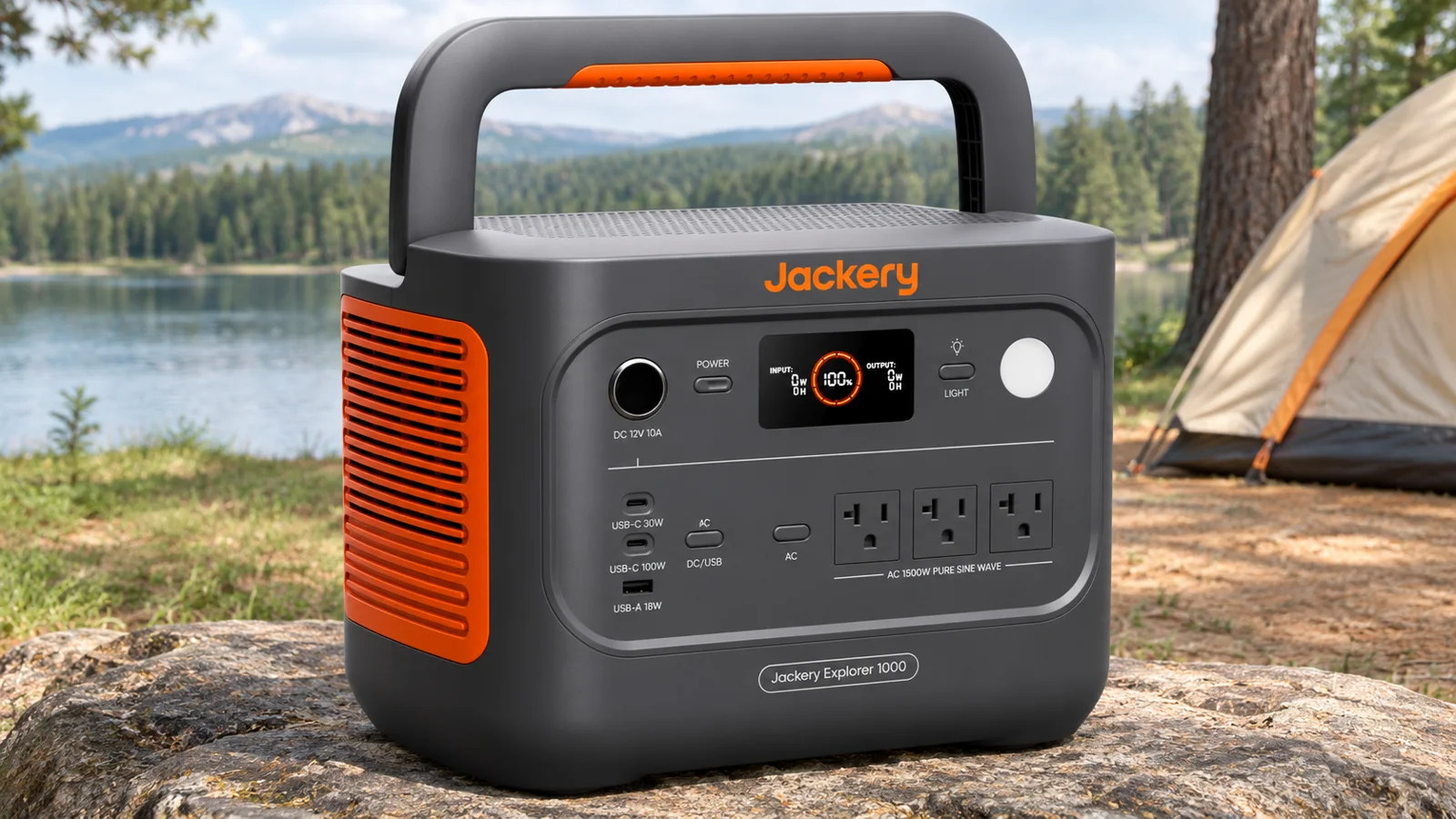

- Capacity
- 1,024 Wh
- Rated output
- See listing
- Chemistry
- LiFePO4
- Value for its size
- Premium price
- Amazon rating
- 4.7 / 5
- Buyer ratings
- 3,700
Specifications as stated in the Amazon listing. Check current details before buying.
How the score is calculated
This spec- and buyer-rating-based score is not a measure of independently measured performance. Value: Excellent 3, Good 2.2, Fair 1.4, Premium 0.6 points. Amazon rating: 4.0 earns 0, 5.0 earns 2.5, proportional in between. Rating volume: 1.5 × ln(1 + ratings) / ln(5,001), capped at 1.5. Output: 1.5 × rated W / Wh, capped at 1.5; unknown output earns 0.75. Stated LiFePO4: 1 point. Stated cycles, weight and solar input: 0.5/3 each, rounded together to three decimals. Missing value, rating, volume or listing details earn 0 for that criterion. The total is rounded to one decimal.
Read our full ranking methodologyThe short verdict
The Jackery Explorer 1000 v2 is a capable mid-size power station with enough energy for overnight essentials and enough AC output for demanding appliances. Its 1,024Wh LiFePO4 battery, 1,500W pure sine wave output, fast charging and strong 4.7-star Amazon rating make it a persuasive all-rounder, though its Premium price for this size class puts extra pressure on the feature set.
Pros
- 1,024Wh LiFePO4 battery suits overnight and emergency use
- 1,500W pure sine wave AC output with 3,000W surge peak
- One-hour charging option through the Jackery app
- Useful mix of AC, USB-C, USB-A and DC outputs
- Strong 4.7 out of 5 Amazon rating from 3,700 ratings
Cons
- Premium price for its 1,024Wh size class
- A space heater drains the battery quickly even on low
- The 1,500W output cannot replace a larger home-backup system
Best for
- Weekend campers who need fridge, lights and device power
- Homeowners who want quiet backup for Wi-Fi, phones and a CPAP
- Van travelers and job-site users who need 1,500W AC output
Look elsewhere if
- Shoppers seeking the lowest-cost 1,000Wh option
- Households needing multi-day whole-home backup or high-wattage heating
Full specifications
| Capacity | 1,024 Wh |
|---|---|
| Rated AC output | See listing |
| LiFePO4 stated | Yes |
| Charge cycles | 4000 |
| Weight | 25 lb |
| Solar input | See listing |
| Value for its size | Premium price |
Specifications as stated in the Amazon listing. Cycle-life conditions and solar compatibility vary; see the listing.
What can it power?
Choose your devices and daily run time. Battery capacity needed = watts × hours ÷ 0.85. Peak running watts assumes all selected devices run at once.
These are planning estimates, not measured runtimes. Appliance startup surges, fridge duty cycles, CPAP humidifiers and charging losses can change demand. Check your device label and the listing’s surge limit.
Runtime reference · 1,024 Wh at 85% usable energy
| Device | Running watts | Estimated hours |
|---|---|---|
| Phone | 15 W | 58.0 |
| Laptop | 60 W | 14.5 |
| Router | 40 W | 21.8 |
| CPAP | 45 W | 19.3 |
| Mini fridge | 50 W | 17.4 |
| Full fridge | 150 W | 5.8 |
| TV | 100 W | 8.7 |
| LED lights | 20 W | 43.5 |
| Coffee maker | 900 W | 1.0 |
| Microwave | 1000 W | 0.9 |
| Space heater | 750 W | 1.2 |
| E-bike charger | 500 W | 1.7 |
| Drill | 600 W | 1.5 |
Runtime estimates
Estimated usable energy is 85% of rated capacity. Actual runtime varies with load, temperature and battery age. See the device reference above for calculated estimates.
| Device | Estimated runtime |
|---|---|
| Phone charge (15 W) | 58 h |
| Laptop (60 W) | 15 h |
| LED lights + Wi-Fi router (40 W) | 22 h |
| CPAP, heated humidifier (45 W avg) | 19 h |
| Mini fridge/cooler (50 W avg) | 17 h |
| Full-size fridge (150 W avg) | 5.8 h |
| 55-inch TV (100 W) | 8.7 h |
| Drip coffee maker (900 W) | 58 min |
| Microwave (1,000 W) | 52 min |
| Space heater, low (750 W) | 1.2 h |
A blackout hits after dinner. The refrigerator needs to stay cold, the router needs to stay online, and someone still needs to charge a phone. The Jackery Explorer 1000 v2 is built for that middle ground: considerably more capable than a small personal power bank, but easier to deploy than a large home-backup battery.
This model combines a 1,024 Wh LiFePO4 battery with 1,500 W of pure sine wave AC output and a 3,000 W surge peak. It also brings fast charging, app control, USB-C output and LED lighting. For campers, van travelers, CPAP users and blackout preparation, it is a flexible 1,000 Wh-class option. Its Premium price for the size class means buyers should compare carefully, especially against newer rivals.
Who the Jackery Explorer 1000 v2 is really for
This is a strong fit for people who want one portable battery to cover several realistic scenarios. At a campsite, it can run lights, phones, laptops and a cooler without the noise or fuel handling of a gas generator. During an outage, it can keep a router, refrigerator and small medical setup operating for useful stretches. In a van, the 1,500 W AC inverter opens the door to more than simple USB charging.
CPAP owners should look closely at the calculated runtime: about 19 hours for a CPAP with heated humidifier. That points to roughly one night, with limited margin for losses beyond the stated calculation. It is also suitable for job sites where quiet power for chargers, lights or smaller tools matters. The 4.7 out of 5 Amazon rating from 3,700 ratings is a reassuring ownership signal, although ratings cannot replace matching the output and runtime to your own equipment.
It is less convincing as a whole-home solution. High-draw heating appliances consume stored energy quickly, and 1,024 Wh remains a finite reserve during a long outage.
Capacity, output and what it can run
The 1,024 Wh battery gives the Explorer 1000 v2 meaningful endurance, while the 1,500 W pure sine wave AC inverter handles many common household appliances. Its 3,000 W surge peak helps with brief startup demands from compatible equipment. Runtime depends on the device, conversion losses and operating pattern, so the figures below are practical estimates based on 85% usable efficiency rather than promises for every setup.
| Device | Calculated runtime |
|---|---|
| Phone charge | 58 hours |
| Laptop | 15 hours |
| LED lights + Wi-Fi router | 22 hours |
| CPAP with heated humidifier | 19 hours |
| Mini fridge/cooler | 17 hours |
| Full-size refrigerator | 5.8 hours |
| 55-inch TV | 8.7 hours |
| Space heater, low | 1.2 hours |
Short bursts are possible for a drip coffee maker, at about 58 minutes, or a microwave, at about 52 minutes. Those figures illustrate the difference between appliance wattage and battery capacity: a high-power appliance can empty a 1,024 Wh station surprisingly fast.
Features and ports: practical flexibility in a 1,000Wh class
The Explorer 1000 v2 uses LiFePO4 battery chemistry, also called LFP. In practical terms, that chemistry is a sensible match for a portable station intended for repeated camping trips, emergency preparation and regular backup duty. The capacity is large enough to support overnight essentials without moving into the bulkier, higher-capacity class.
For connectivity, the station includes three pure sine wave AC ports, two USB-C ports, one USB-A port and a DC car port. One USB-C port supports 100 W fast charging, with USB-C input and output capability described for the unit. LED lights add useful campsite or outage illumination, while the Jackery app provides control over charging modes and silent operation.
The 30dB silent mode is particularly relevant at night, beside a bed or in a tent where fan noise becomes more noticeable. App-based control also makes it easier to manage the one-hour super-charge function. Confirm the port layout on the Amazon page before ordering, especially if several people will charge devices simultaneously.
Charging, solar and long-term ownership
Jackery lists a one-hour charge from 0% to 100% when the emergency charging function is activated in the app before charging. A separate 1.7-hour fast-charging mode is designed to optimize battery status and performance. That gives buyers a useful choice: maximum speed when a storm is approaching, or a gentler fast-charge mode for routine preparation.
The app is central to the charging experience, so it is worth setting up before an emergency rather than waiting until the power is out. The stated 30dB silent mode is another practical ownership feature for overnight charging or use near sleeping areas. LiFePO4 chemistry is well suited to repeated cycling, although actual service life also depends on temperature, load and charging habits.
Solar charging can be part of a portable-power setup, but panel compatibility and solar input specifications should be confirmed on the Amazon page before ordering. The key electrical reality remains simple: a 1,024 Wh battery stores a finite amount of energy. Charging from any source restores that reserve; it does not increase the output the inverter can deliver.
The package includes the Explorer 1000 v2, a user manual and an AC charging cable, with a stated five-year warranty.
How it stacks up against the alternatives
Most of the closest alternatives share the same 1,024 Wh capacity, so the decision comes down to output, value and feature priorities. The BLUETTI Elite 100 V2 is also rated at 1,024 Wh and carries a Good value label. The OUPES Mega 1 matches the capacity with Fair value, while the EcoFlow Delta 3 Classic matches it with Excellent value. Those options deserve attention if value within the size class is your main filter.
The EcoFlow Delta 3 also has 1,024 Wh but carries a Premium price label, making it a closer value comparison. The DJI Power 1000 V2 matches the capacity and is labeled Good value. Against all of them, the Jackery’s headline strengths are its 1,500 W AC output, 3,000 W surge peak, app-controlled fast charging and 100 W USB-C capability.
For a broader shortlist, see best portable power stations under $1,000. Check the current price on Amazon before deciding, because value can shift with promotions.
Frequently asked questions
How long can the Jackery Explorer 1000 v2 run a refrigerator?
The calculated runtime is about 5.8 hours for a full-size refrigerator and about 17 hours for a mini fridge or cooler. Actual results vary with compressor cycling, room temperature and how often the door opens. Treat the figures as planning estimates, not guaranteed runtime.
Can the Explorer 1000 v2 run a CPAP overnight?
Yes, the calculated runtime is about 19 hours for a CPAP with heated humidifier. That covers a typical night with meaningful margin, but the exact result depends on pressure settings, humidifier use and other devices connected at the same time.
What is the Explorer 1000 v2 AC output?
It provides 1,500W of pure sine wave AC output and a 3,000W surge peak. That is enough for many refrigerators, electric pots and smaller appliances, but a high-draw space heater will use the battery quickly even on low.
How quickly does the Jackery Explorer 1000 v2 charge?
Jackery lists a 0% to 100% charge time of as little as one hour when emergency charging is activated in the app. Its 1.7-hour fast-charging mode is intended to optimize battery status and performance for routine charging.
Is the Jackery Explorer 1000 v2 a good blackout power station?
It is well suited to essential backup such as Wi-Fi, phones, lights, a CPAP, a TV or refrigerator. Its 1,024Wh capacity is not designed for multi-day whole-home power, and heating appliances can drain it rapidly. Match each appliance’s wattage to the 1,500W output limit.


