EcoFlow · Spec-based review
EcoFlow Delta 3: Serious Backup Power in a 1,024Wh Class
Fast charging, LiFePO4 longevity and enough output for real emergency loads.
We may earn a commission from product links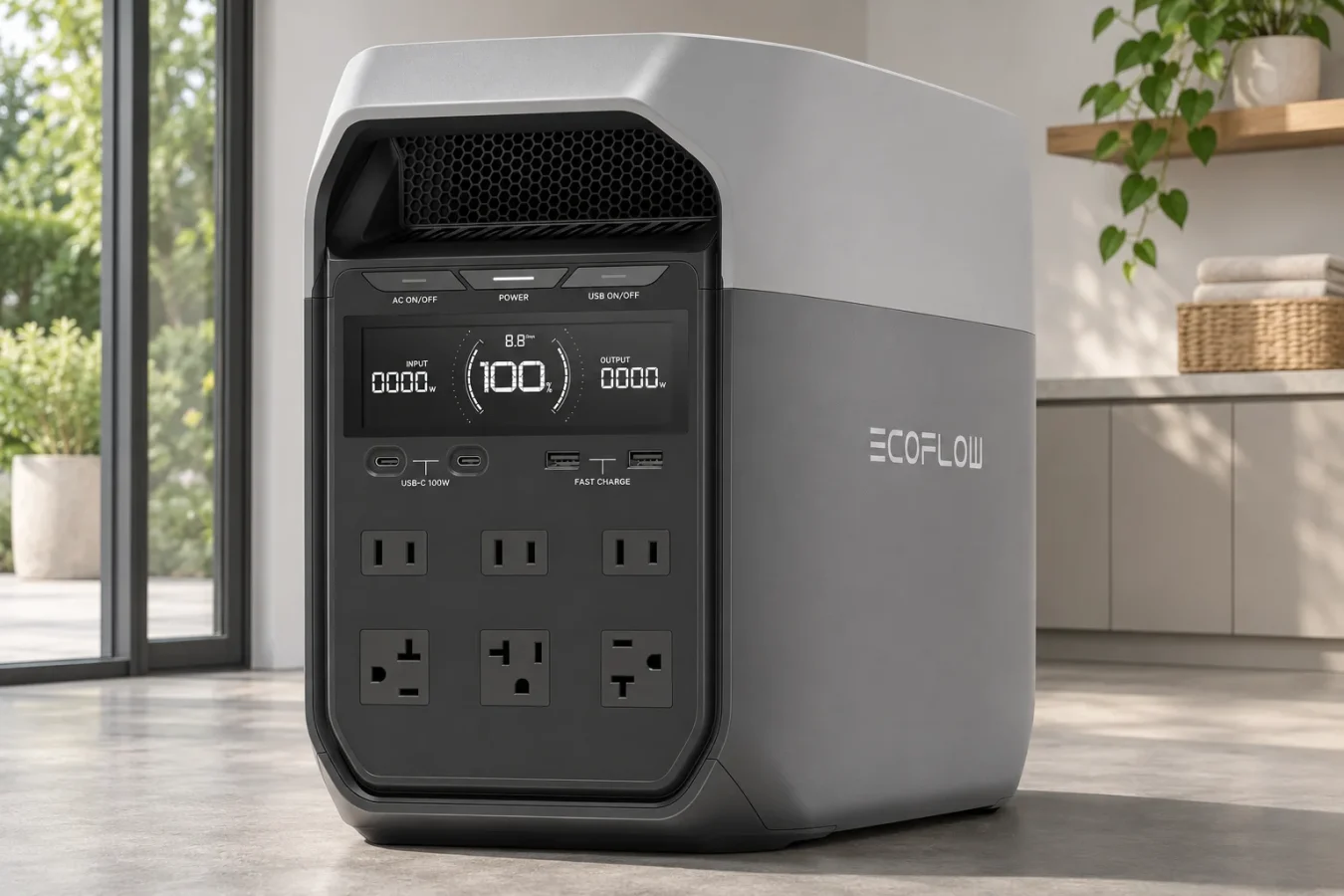

- Capacity
- 1,024 Wh
- Rated output
- 1,800 W
- Chemistry
- See listing
- Value for its size
- Premium price
- Amazon rating
- 4.7 / 5
- Buyer ratings
- 1,300
Specifications as stated in the Amazon listing. Check current details before buying.
How the score is calculated
This spec- and buyer-rating-based score is not a measure of independently measured performance. Value: Excellent 3, Good 2.2, Fair 1.4, Premium 0.6 points. Amazon rating: 4.0 earns 0, 5.0 earns 2.5, proportional in between. Rating volume: 1.5 × ln(1 + ratings) / ln(5,001), capped at 1.5. Output: 1.5 × rated W / Wh, capped at 1.5; unknown output earns 0.75. Stated LiFePO4: 1 point. Stated cycles, weight and solar input: 0.5/3 each, rounded together to three decimals. Missing value, rating, volume or listing details earn 0 for that criterion. The total is rounded to one decimal.
Read our full ranking methodologyThe short verdict
The EcoFlow Delta 3 is a strong all-around power station for outages, camping, CPAP use and demanding household electronics. Its 1,024Wh capacity and 1,800W AC output are genuinely useful, while the fast charging and LiFePO4 battery add long-term appeal. The trade-off is value: it carries a Premium price for its size class, so check the current price on Amazon before ordering.
Pros
- 1,024Wh capacity with 1,800W rated AC output
- Fast full charging in 56 minutes and 80% charging in 30 minutes
- LiFePO4 cells rated for 4,000 cycles at 80%
- Can power 13 household appliances simultaneously
- 5 kWh expansion through compatible EcoFlow batteries
Cons
- Premium price for its size class
- A 1,024Wh battery is not enough for long whole-home backup
- High-draw heating appliances drain the battery quickly
Best for
- Homeowners who need refrigerator and communications backup during outages
- Campers and van users who want fast recharging and broad appliance support
- CPAP users who want a high-capacity LiFePO4 power station
Look elsewhere if
- Shoppers seeking the most capacity per dollar in the 1,000Wh class
- Users who mainly need a tiny, lightweight power bank for phones and laptops
Full specifications
| Capacity | 1,024 Wh |
|---|---|
| Rated AC output | 1,800 W |
| LiFePO4 stated | See listing |
| Charge cycles | 4000 |
| Weight | See listing |
| Solar input | 500 W |
| Value for its size | Premium price |
Specifications as stated in the Amazon listing. Cycle-life conditions and solar compatibility vary; see the listing.
What can it power?
Choose your devices and daily run time. Battery capacity needed = watts × hours ÷ 0.85. Peak running watts assumes all selected devices run at once.
These are planning estimates, not measured runtimes. Appliance startup surges, fridge duty cycles, CPAP humidifiers and charging losses can change demand. Check your device label and the listing’s surge limit.
Runtime reference · 1,024 Wh at 85% usable energy
| Device | Running watts | Estimated hours |
|---|---|---|
| Phone | 15 W | 58.0 |
| Laptop | 60 W | 14.5 |
| Router | 40 W | 21.8 |
| CPAP | 45 W | 19.3 |
| Mini fridge | 50 W | 17.4 |
| Full fridge | 150 W | 5.8 |
| TV | 100 W | 8.7 |
| LED lights | 20 W | 43.5 |
| Coffee maker | 900 W | 1.0 |
| Microwave | 1000 W | 0.9 |
| Space heater | 750 W | 1.2 |
| E-bike charger | 500 W | 1.7 |
| Drill | 600 W | 1.5 |
Runtime estimates
Estimated usable energy is 85% of rated capacity. Actual runtime varies with load, temperature and battery age. See the device reference above for calculated estimates.
| Device | Estimated runtime |
|---|---|
| Phone charge (15 W) | 58 h |
| Laptop (60 W) | 15 h |
| LED lights + Wi-Fi router (40 W) | 22 h |
| CPAP, heated humidifier (45 W avg) | 19 h |
| Mini fridge/cooler (50 W avg) | 17 h |
| Full-size fridge (150 W avg) | 5.8 h |
| 55-inch TV (100 W) | 8.7 h |
| Drip coffee maker (900 W) | 58 min |
| Microwave (1,000 W) | 52 min |
| Space heater, low (750 W) | 1.2 h |
A blackout arrives just as the refrigerator is running, the Wi-Fi router is keeping everyone informed and someone needs a CPAP machine overnight. This is where a 1,000 Wh-class power station earns its space. The EcoFlow Delta 3 has enough stored energy for several smaller devices or selected essential appliances, plus the output to handle many demanding household loads.
This model combines a 1,024 Wh battery with 1,800 W of rated AC output. It uses LiFePO4 chemistry, supports expansion within the EcoFlow ecosystem and is rated highly by Amazon buyers at 4.7 out of 5 from 1,300 ratings. It qualifies for the under-$1,000 tier, but its value label is Premium price for this size class. Check the current price on Amazon.
Who the EcoFlow Delta 3 Is Really For
The Delta 3 is aimed at people who need more than phone charging but do not want a giant home battery. It makes sense for weekend campers running lights, a router, a laptop and a cooler. It also suits van users who need a compact electrical hub for everyday devices, provided the 1,024 Wh capacity matches their load plan.
For home backup, think essentials rather than whole-house operation. A refrigerator, modem, lights and medical equipment are realistic priorities. The 1,800 W AC rating also gives it enough headroom for many kitchen and workshop devices, although runtime becomes the limiting factor with high-wattage appliances.
Its strongest audience may be buyers who value fast turnaround. A full charge in 56 minutes means less waiting after an outage or campsite arrival. LiFePO4 chemistry and the claimed 4,000 cycles at 80% also make it a logical choice for frequent use rather than occasional emergency storage alone.
Capacity, Output and What It Can Run
The 1,024 Wh battery is substantial for portable use, while the 1,800 W rated AC output covers many household appliances. EcoFlow also says its X-Boost mode supports resistive devices requiring more than 2,600 W continuously. That does not create extra battery energy, so high-power loads still empty the station rapidly.
| Load | Estimated runtime |
|---|---|
| CPAP with heated humidifier | 19 hours |
| LED lights and Wi-Fi router | 22 hours |
| Mini fridge or cooler | 17 hours |
| Full-size refrigerator | 5.8 hours |
| 55-inch TV | 8.7 hours |
| Space heater, low | 1.2 hours |
Other estimates include 58 hours of phone charging, 15 hours for a laptop, 58 minutes for a drip coffee maker and 52 minutes for a microwave. Actual results vary with cycling and device draw. These figures use 85% usable efficiency.
Features, Interfaces and Battery Chemistry
EcoFlow says the Delta 3 can power 13 household appliances simultaneously. That is useful during an outage when the refrigerator, communications gear, lights and personal electronics all compete for power. The key practical question is how those loads fit within the 1,800 W AC rating and the battery’s 1,024 Wh energy reserve.
The Delta 3 uses LiFePO4 cells and is rated for 4,000 cycles at 80%, with a claimed 10-year lifespan for daily use. In plain terms, that chemistry is well suited to repeated charging and discharging. It is a better fit for regular camping, van use or scheduled backup than a station intended to sit untouched for years.
Expansion is another meaningful feature. The Delta 3 series can connect with compatible Delta 3, Delta Pro 3 and Delta 2 Max batteries, reaching up to 5 kWh of total capacity. That changes the product from a portable 1,024 Wh unit into a more serious backup system. Confirm the port layout on the Amazon page before ordering.
Charging, Solar Compatibility and Long-Term Ownership
Charging speed is one of the Delta 3’s clearest advantages. EcoFlow states that it reaches 80% in 30 minutes and a full charge in 56 minutes using its maximum AC charging setup. That matters after a short utility restoration, before leaving for a campsite or between work shifts. A fast recharge also reduces the temptation to leave essential equipment disconnected while waiting.
Solar charging is part of the Delta 3’s broader charging ecosystem, giving off-grid users another way to replenish the battery when grid power is unavailable. Solar output depends on panel conditions, sunlight, orientation and the connected equipment, so real charging time will be slower or faster depending on the setup. Confirm the compatible solar accessories and port arrangement on the Amazon page before ordering.
The LiFePO4 battery, 4,000-cycle rating at 80% and claimed 10-year daily-use lifespan support frequent ownership. Its IP65 battery protection is described as splash-proof, dust-proof and oil-resistant. Keep the basic physics in mind: charging speed helps availability, but it does not increase the 1,024 Wh energy reserve.
How the Delta 3 Stacks Up Against Alternatives
Most of the closest alternatives share the same 1,024 Wh capacity, so the meaningful differences are output, value positioning and ecosystem fit. The Jackery Explorer 1000 v2 is also rated at 1,024 Wh and carries a Premium price label. The BLUETTI Elite 100 V2 matches the capacity with a Good value label, while the OUPES Mega 1 is marked Fair value.
The EcoFlow Delta 3 Classic also provides 1,024 Wh and is labeled Excellent value, making it the first comparison to investigate if price efficiency matters more than the Delta 3’s specific feature mix. The DJI Power 1000 V2 has the same 1,024 Wh capacity and a Good value label.
The Delta 3’s 1,800 W rated output, 13-appliance claim, fast charging and expansion support make it a well-rounded premium choice. If your priority is maximum value, compare alternatives carefully. If you want a fast-charging EcoFlow platform with long-life chemistry, the Delta 3 has a persuasive case.
Frequently asked questions
How long will the EcoFlow Delta 3 run a CPAP machine?
The estimated runtime is 19 hours for a CPAP with a heated humidifier. That covers one typical night with useful margin, although actual time depends on pressure settings, humidifier use and the machine's power draw. Turning off the humidifier can extend runtime substantially.
Can the Delta 3 run a refrigerator during a blackout?
Yes, its 1,800W rated AC output is suitable for many refrigerator loads, and the estimated runtime for a full-size refrigerator is 5.8 hours. Refrigerators cycle rather than drawing continuously, so results depend on the appliance, room temperature and how often the compressor starts.
How quickly does the EcoFlow Delta 3 charge?
EcoFlow states that the Delta 3 reaches 80% charge in 30 minutes and a full charge in 56 minutes using its maximum AC charging setup. Charging from solar follows changing conditions, including sunlight, panel placement and the connected equipment.
Is the EcoFlow Delta 3 expandable?
Yes. The Delta 3 series supports expansion with compatible Delta 3, Delta Pro 3 and Delta 2 Max batteries. EcoFlow describes expansion up to 5 kWh. Extra batteries add stored capacity, but they do not change the basic power demand of connected appliances.
Is the Delta 3 suitable for a space heater?
It can run a space heater on low, but the estimated runtime is only 1.2 hours. Heating appliances consume energy quickly, so this is best treated as short-term emergency warmth rather than an overnight heating solution. The 1,800W output rating is not the same as long runtime.


