EcoFlow · Spec-based review
EcoFlow Delta 3 Classic: Serious Backup in a Compact Class
A 1,024Wh power station with enough output for blackout essentials and campsite comforts.
We may earn a commission from product links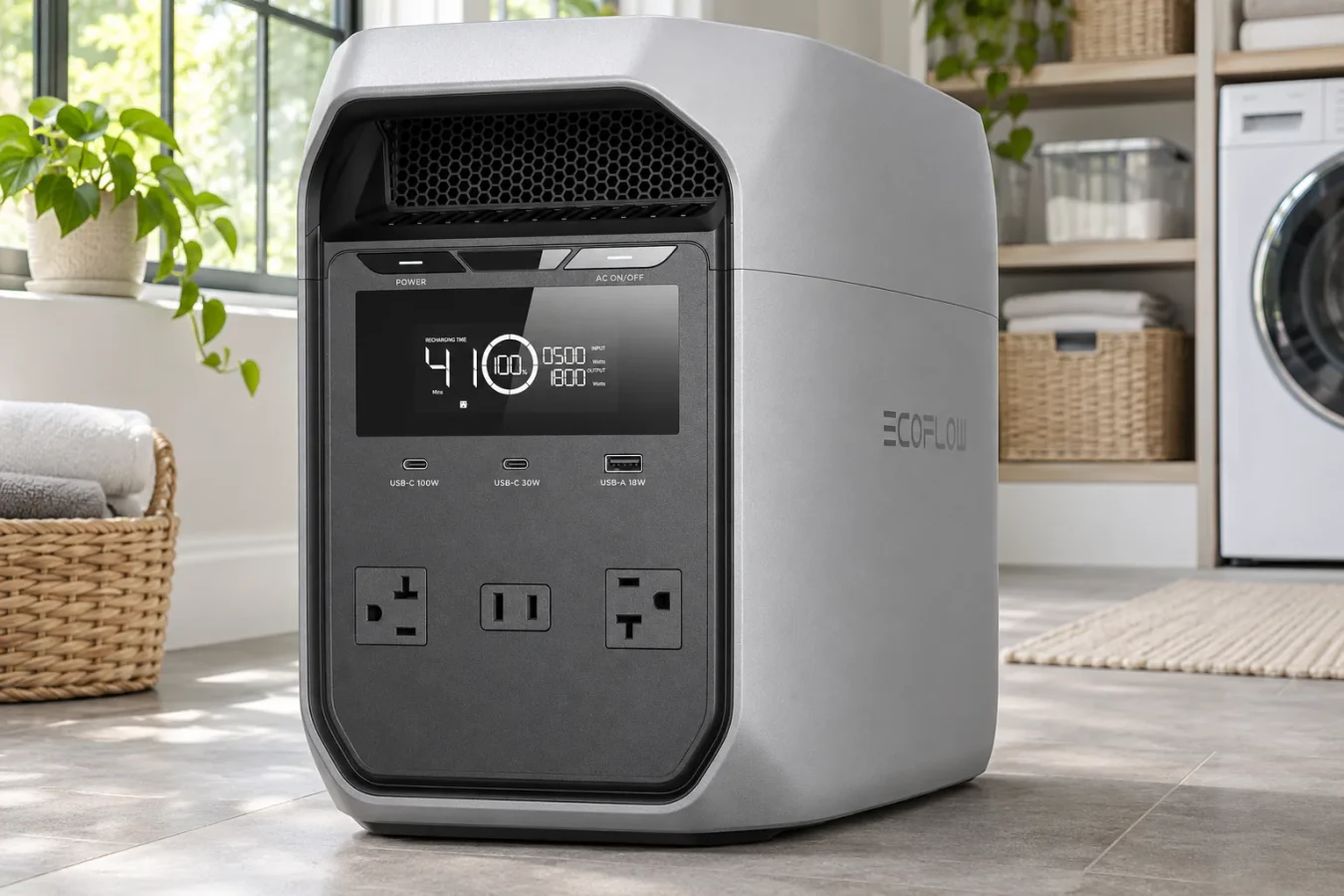

- Capacity
- 1,024 Wh
- Rated output
- 1,800 W
- Chemistry
- See listing
- Value for its size
- Excellent value
- Amazon rating
- 4.7 / 5
- Buyer ratings
- 1,300
Specifications as stated in the Amazon listing. Check current details before buying.
How the score is calculated
This spec- and buyer-rating-based score is not a measure of independently measured performance. Value: Excellent 3, Good 2.2, Fair 1.4, Premium 0.6 points. Amazon rating: 4.0 earns 0, 5.0 earns 2.5, proportional in between. Rating volume: 1.5 × ln(1 + ratings) / ln(5,001), capped at 1.5. Output: 1.5 × rated W / Wh, capped at 1.5; unknown output earns 0.75. Stated LiFePO4: 1 point. Stated cycles, weight and solar input: 0.5/3 each, rounded together to three decimals. Missing value, rating, volume or listing details earn 0 for that criterion. The total is rounded to one decimal.
Read our full ranking methodologyThe short verdict
The EcoFlow Delta 3 Classic is a strong middle-class power station for buyers who want meaningful home-backup capacity without moving into much larger systems. Its 1,024Wh battery and 1,800W AC output cover refrigerators, networking gear, CPAP equipment, kitchen appliances and many job-site tools, while its excellent value rating makes it especially compelling in the under-$1,000 tier. Check the current price on Amazon.
Pros
- 1,024Wh capacity supports long overnight and outage scenarios
- 1,800W rated AC output handles many household appliances
- Excellent value for its size class
- Useful computed runtimes for refrigerators, CPAP equipment and electronics
- Strong 4.7-out-of-5 Amazon rating from 1,300 ratings
Cons
- A 1,024Wh battery is not enough for extended whole-home backup
- High-draw appliances drain the battery quickly
- Its capacity class is more substantial than a grab-and-go phone charger
Best for
- Homeowners who need several hours of essential backup during outages
- Campers and van travelers who want to run appliances, lights and electronics
- CPAP users who need overnight power with room for other devices
Look elsewhere if
- Buyers who need multi-day whole-home backup or high-wattage heating
- Shoppers seeking the smallest possible power station for phone charging
Full specifications
| Capacity | 1,024 Wh |
|---|---|
| Rated AC output | 1,800 W |
| LiFePO4 stated | See listing |
| Charge cycles | See listing |
| Weight | See listing |
| Solar input | See listing |
| Value for its size | Excellent value |
Specifications as stated in the Amazon listing. Cycle-life conditions and solar compatibility vary; see the listing.
What can it power?
Choose your devices and daily run time. Battery capacity needed = watts × hours ÷ 0.85. Peak running watts assumes all selected devices run at once.
These are planning estimates, not measured runtimes. Appliance startup surges, fridge duty cycles, CPAP humidifiers and charging losses can change demand. Check your device label and the listing’s surge limit.
Runtime reference · 1,024 Wh at 85% usable energy
| Device | Running watts | Estimated hours |
|---|---|---|
| Phone | 15 W | 58.0 |
| Laptop | 60 W | 14.5 |
| Router | 40 W | 21.8 |
| CPAP | 45 W | 19.3 |
| Mini fridge | 50 W | 17.4 |
| Full fridge | 150 W | 5.8 |
| TV | 100 W | 8.7 |
| LED lights | 20 W | 43.5 |
| Coffee maker | 900 W | 1.0 |
| Microwave | 1000 W | 0.9 |
| Space heater | 750 W | 1.2 |
| E-bike charger | 500 W | 1.7 |
| Drill | 600 W | 1.5 |
Runtime estimates
Estimated usable energy is 85% of rated capacity. Actual runtime varies with load, temperature and battery age. See the device reference above for calculated estimates.
| Device | Estimated runtime |
|---|---|
| Phone charge (15 W) | 58 h |
| Laptop (60 W) | 15 h |
| LED lights + Wi-Fi router (40 W) | 22 h |
| CPAP, heated humidifier (45 W avg) | 19 h |
| Mini fridge/cooler (50 W avg) | 17 h |
| Full-size fridge (150 W avg) | 5.8 h |
| 55-inch TV (100 W) | 8.7 h |
| Drip coffee maker (900 W) | 58 min |
| Microwave (1,000 W) | 52 min |
| Space heater, low (750 W) | 1.2 h |
A storm knocks out the neighborhood, the refrigerator is quiet, and your Wi-Fi router is already running on borrowed time. The EcoFlow Delta 3 Classic is built for this middle ground: large enough to keep essential devices going, but not so oversized that it belongs only in a permanent backup installation. It can also make a campsite more comfortable by powering lights, a coffee maker, a cooler or entertainment gear.
This EcoFlow power station combines a 1,024 Wh capacity with 1,800 W of rated AC output. That is a useful pairing. The battery offers practical endurance, while the output rating supports many everyday appliances. With an Amazon rating of 4.7 out of 5 from 1,300 ratings and an Excellent value label for its size class, the Delta 3 Classic deserves a close look from outage planners, campers and van travelers.
Who the EcoFlow Delta 3 Classic Is Really For
The Delta 3 Classic is aimed at people who want more than emergency phone charging but do not need a giant battery system. It is a sensible fit for a refrigerator during a short blackout, a CPAP night, a home office during an outage or a campsite where ordinary wall power is unavailable. The 1,800 W AC rating also gives it useful headroom for kitchen appliances and selected power tools.
For hurricane season, the capacity offers a practical reserve for communications, food storage and lighting. A router, LED lights and other modest loads can run for many hours, making this more useful than a tiny travel battery when an outage stretches through the evening. Campers get similar flexibility: charge phones, run a laptop, power lights and still have energy left for a cooler or coffee maker.
It is less suitable as a whole-home replacement. Space heaters, microwaves and other high-draw appliances consume stored energy rapidly. Buyers who need several days of refrigeration, electric heating or multiple large appliances should consider a larger class of station. For most short outages and weekend trips, though, this is a well-balanced capacity tier.
Capacity, Output and What It Can Run
The Delta 3 Classic stores 1,024 Wh and delivers 1,800 W of rated AC output. In practical terms, the battery has enough reserve for low-power essentials over a long night, while the inverter rating supports demanding devices whose running wattage stays within that limit. Runtime varies with the device, startup surges and conversion losses, so the figures below use the stated 85% usable-efficiency calculation.
| Device or load | Computed runtime |
|---|---|
| Phone charge | 58 hours |
| Laptop | 15 hours |
| LED lights plus Wi-Fi router | 22 hours |
| CPAP with heated humidifier | 19 hours |
| Mini fridge or cooler | 17 hours |
| Full-size refrigerator | 5.8 hours |
| 55-inch TV | 8.7 hours |
| Drip coffee maker | 58 minutes |
| Microwave | 52 minutes |
| Space heater, low | 1.2 hours |
These numbers show the trade-off clearly: small electronics last a long time, while heat-producing appliances use the battery quickly. A refrigerator’s compressor also cycles, so real operation depends on the appliance and conditions.
Features and Ports: What the Capacity Means in Practice
The most important practical feature here is the combination of 1,024 Wh storage and 1,800 W AC output. That pairing gives the Delta 3 Classic enough energy for overnight essentials and enough output for common household appliances that smaller power stations cannot support. It is the difference between merely topping up devices and managing a real temporary power plan.
The capacity also makes load planning straightforward. A phone and laptop are minor demands compared with a refrigerator, microwave or space heater. You can prioritize critical equipment first, then add comfort loads when the remaining battery allows. During a blackout, that might mean keeping the router and refrigerator operating before switching on the TV or coffee maker.
Portable power stations are also best treated as shared energy reserves rather than unlimited outlets. Running several devices at once combines their wattage, and the total must remain appropriate for the 1,800 W AC rating. Confirm the port layout on the Amazon page before ordering, especially if you have a specific mix of AC, USB or other connections in mind. The published information makes the capacity and output the clearest buying signals for this model.
Charging, Solar and Long-Term Ownership
The Delta 3 Classic’s 1,024 Wh battery is large enough that charging strategy matters. A full recharge after a deep discharge requires substantially more energy than topping up a phone or laptop, so it makes sense to keep the station charged before storm season, camping trips or planned job-site use. For long-term ownership, store it in a suitable location and follow EcoFlow’s current care guidance.
Solar compatibility can be an important advantage for extended outages and off-grid travel, but the available information here does not establish a solar-input wattage or charging time. Check the current Amazon page and EcoFlow documentation for the exact solar-input specification, connector details and supported charging methods before building a solar setup. Do not assume a panel’s rated output will equal the energy reaching the battery; sun angle, temperature, wiring and conversion losses all matter.
Runtime follows a simple rule: usable watt-hours divided by device watts. The 85% efficiency basis used for the figures in this review reflects the energy lost during conversion. High-wattage loads therefore shorten runtime dramatically, while networking gear, lights and small electronics make the stored energy last much longer.
How It Stacks Up Against Similar 1,024Wh Power Stations
The Delta 3 Classic sits in a crowded but useful class. The Jackery Explorer 1000 v2, BLUETTI Elite 100 V2, OUPES Mega 1, EcoFlow Delta 3 and DJI Power 1000 V2 all use the same 1,024 Wh capacity point, so the central comparison is output, feature set, ownership preferences and value.
Against the Jackery Explorer 1000 v2 and EcoFlow Delta 3, both labeled Premium price for this size class, the Delta 3 Classic’s Excellent value label gives it a sharper value position. The BLUETTI Elite 100 V2 and DJI Power 1000 V2 carry Good value labels, while the OUPES Mega 1 is labeled Fair value. Those labels are useful starting points, but port arrangements and charging specifications can matter more if you already have a particular setup.
Capacity alone will not determine the winner: every model here stores 1,024 Wh, while output figures and detailed features may differ. The Delta 3 Classic’s confirmed 1,800 W rating makes it a versatile choice for common appliances. Compare current specifications and check the current price on Amazon before choosing between these similarly sized options.
Frequently asked questions
How long can the EcoFlow Delta 3 Classic run a refrigerator?
The computed runtime is 5.8 hours for a full-size refrigerator and 17 hours for a mini fridge or cooler. Actual results vary because refrigerators cycle rather than drawing their maximum power continuously. Door openings, room temperature and compressor behavior can all change the energy used.
Can the Delta 3 Classic run a microwave?
Yes, its 1,800W rated AC output is intended for substantial appliance loads, and the computed microwave runtime is 52 minutes. Confirm that the microwave's operating and startup requirements fit within the station's output capability. Runtime will be much shorter if other appliances run simultaneously.
Is this power station suitable for CPAP use?
Yes. The computed runtime for a CPAP with a heated humidifier is 19 hours, which covers a typical overnight scenario with reserve. Actual duration depends on the CPAP's settings and power draw. Humidifier use generally consumes more energy than CPAP operation alone.
Can it power a space heater?
It can support a space heater on low when the heater's demand stays within the 1,800W AC rating, but the computed runtime is only 1.2 hours. Electric heating is one of the fastest ways to drain a portable battery. It is better suited to brief supplemental use than sustained heating.
Does the EcoFlow Delta 3 Classic support solar charging?
Solar charging details should be confirmed on the current Amazon page and EcoFlow documentation before purchase. The available specifications establish the 1,024Wh capacity and 1,800W AC output, but not a solar-input wattage, connector arrangement or solar recharge time.


