DJI · Spec-based review
DJI Power 1000 V2: A Strong 1,024Wh Backup Core
A LiFePO4 power station sized for blackout essentials, CPAP nights, and serious weekend camping.
We may earn a commission from product links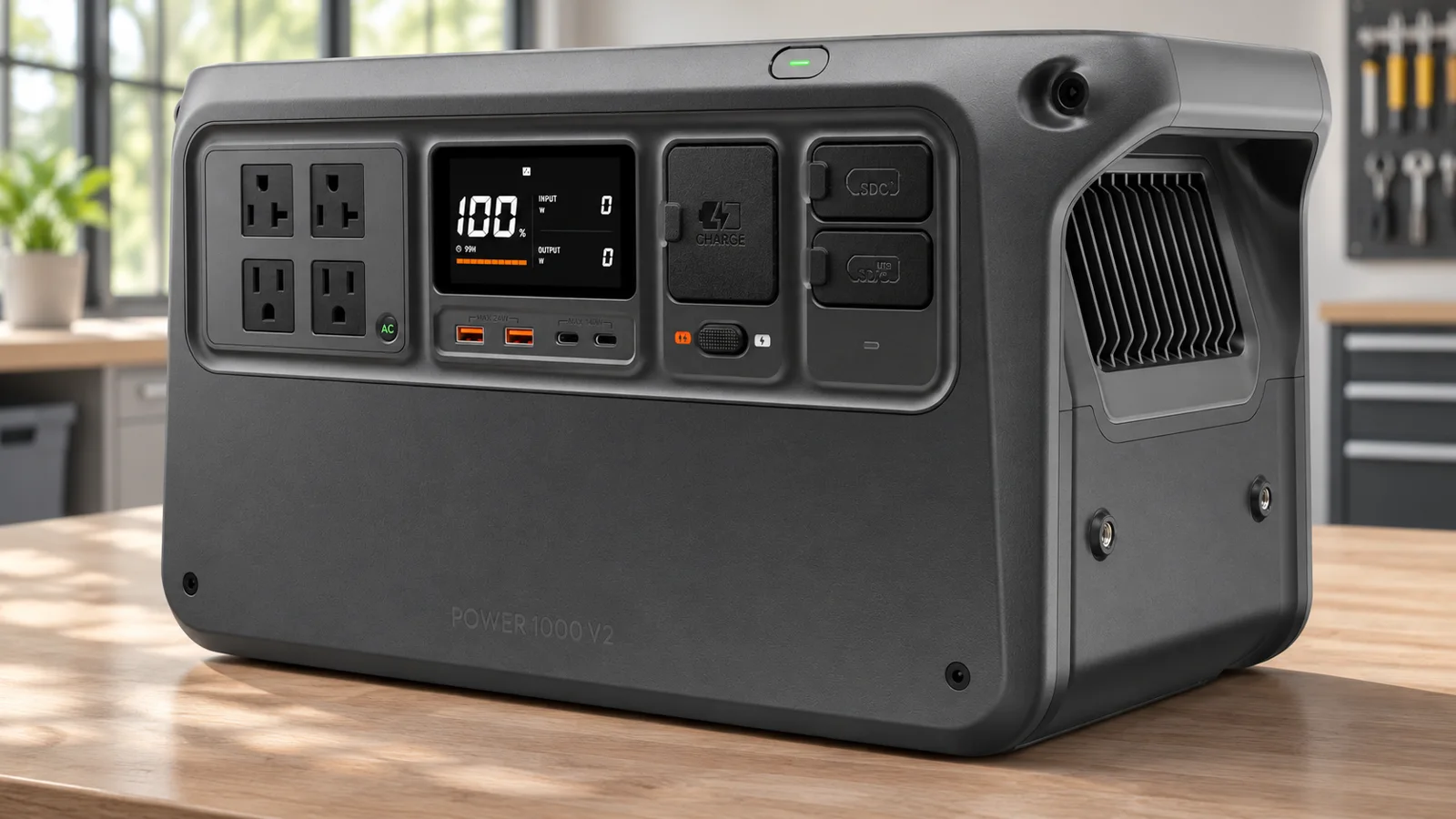

- Capacity
- 1,024 Wh
- Rated output
- See listing
- Chemistry
- LiFePO4
- Value for its size
- Good value
- Amazon rating
- 4.3 / 5
- Buyer ratings
- 1,200
Specifications as stated in the Amazon listing. Check current details before buying.
How the score is calculated
This spec- and buyer-rating-based score is not a measure of independently measured performance. Value: Excellent 3, Good 2.2, Fair 1.4, Premium 0.6 points. Amazon rating: 4.0 earns 0, 5.0 earns 2.5, proportional in between. Rating volume: 1.5 × ln(1 + ratings) / ln(5,001), capped at 1.5. Output: 1.5 × rated W / Wh, capped at 1.5; unknown output earns 0.75. Stated LiFePO4: 1 point. Stated cycles, weight and solar input: 0.5/3 each, rounded together to three decimals. Missing value, rating, volume or listing details earn 0 for that criterion. The total is rounded to one decimal.
Read our full ranking methodologyThe short verdict
The DJI Power 1000 V2 combines a useful 1,024Wh capacity with LiFePO4 chemistry and Good value for its size class. It is a strong fit for essential home backup, CPAP use, camping, and portable electronics, but heavy appliances will drain it quickly.
Pros
- Useful 1,024Wh capacity for blackout essentials and camping
- LiFePO4 chemistry supports a practical long-term ownership profile
- Good value for its size class
- Estimated 19 hours for a CPAP with heated humidifier
- 4.3 out of 5 Amazon rating from 1,200 ratings
Cons
- High-draw appliances consume the battery quickly
- A 1,024Wh unit is a substantial size class for casual carry
- The product page should be checked carefully for the exact port layout before ordering
Best for
- Weekend campers who need multi-day power for electronics and lighting
- Homeowners who want quiet backup for refrigeration, Wi-Fi, and medical equipment
- Travelers who value LiFePO4 chemistry and a full 1,024Wh capacity
Look elsewhere if
- Whole-home backup requiring long runtimes for heating or cooking
- Buyers seeking a compact power bank for occasional phone charging
Full specifications
| Capacity | 1,024 Wh |
|---|---|
| Rated AC output | See listing |
| LiFePO4 stated | Yes |
| Charge cycles | See listing |
| Weight | See listing |
| Solar input | See listing |
| Value for its size | Good value |
Specifications as stated in the Amazon listing. Cycle-life conditions and solar compatibility vary; see the listing.
What can it power?
Choose your devices and daily run time. Battery capacity needed = watts × hours ÷ 0.85. Peak running watts assumes all selected devices run at once.
These are planning estimates, not measured runtimes. Appliance startup surges, fridge duty cycles, CPAP humidifiers and charging losses can change demand. Check your device label and the listing’s surge limit.
Runtime reference · 1,024 Wh at 85% usable energy
| Device | Running watts | Estimated hours |
|---|---|---|
| Phone | 15 W | 58.0 |
| Laptop | 60 W | 14.5 |
| Router | 40 W | 21.8 |
| CPAP | 45 W | 19.3 |
| Mini fridge | 50 W | 17.4 |
| Full fridge | 150 W | 5.8 |
| TV | 100 W | 8.7 |
| LED lights | 20 W | 43.5 |
| Coffee maker | 900 W | 1.0 |
| Microwave | 1000 W | 0.9 |
| Space heater | 750 W | 1.2 |
| E-bike charger | 500 W | 1.7 |
| Drill | 600 W | 1.5 |
Runtime estimates
Estimated usable energy is 85% of rated capacity. Actual runtime varies with load, temperature and battery age. See the device reference above for calculated estimates.
| Device | Estimated runtime |
|---|---|
| Phone charge (15 W) | 58 h |
| Laptop (60 W) | 15 h |
| LED lights + Wi-Fi router (40 W) | 22 h |
| CPAP, heated humidifier (45 W avg) | 19 h |
| Mini fridge/cooler (50 W avg) | 17 h |
| Full-size fridge (150 W avg) | 5.8 h |
| 55-inch TV (100 W) | 8.7 h |
| Drip coffee maker (900 W) | 58 min |
| Microwave (1,000 W) | 52 min |
| Space heater, low (750 W) | 1.2 h |
A blackout does not need to become a crisis to be disruptive. Keep a refrigerator cold, preserve Wi-Fi, run a CPAP overnight, and you have covered the essentials that matter most. At a campsite, the same reserve can handle phones, laptops, lights, and entertainment without immediately reaching empty.
The DJI Power 1000 V2 is a 1,024 Wh portable power station built around a LiFePO4 battery. That places it in the useful middle ground between small emergency power banks and much larger home-backup systems. Its Amazon rating is 4.3 out of 5 from 1,200 ratings, while its size-class value is rated Good.
Who the DJI Power 1000 V2 is really for
This model makes the most sense for people who want one substantial battery reserve rather than several small chargers. A 1,024 Wh capacity is enough to support a blackout plan centered on essentials: a refrigerator for part of the day, a router and LED lights through the evening, or a CPAP through the night. It also suits weekend camping, where phones, laptops, lights, and a small cooler all compete for the same stored energy.
It is especially appealing for CPAP users. The estimated runtime for a CPAP with heated humidifier is 19 hours, giving a useful overnight margin before accounting for unusual settings or additional devices. Van travelers and remote workers can also treat it as a central energy reserve for communication and computing.
Its limits are equally clear. A space heater on low is estimated at 1.2 hours, while a full-size refrigerator is estimated at 5.8 hours. That is emergency support, not whole-home independence. For broader outage coverage, see our home-backup guide.
Capacity, output and what it can run
The 1,024 Wh battery gives the DJI Power 1000 V2 meaningful reserve for low- and medium-draw devices. Runtime estimates below use 85% usable efficiency, so they represent practical energy available to connected devices rather than the full nameplate capacity.
| Device | Estimated runtime |
|---|---|
| Phone charge | 58 hours |
| Laptop | 15 hours |
| LED lights and Wi-Fi router | 22 hours |
| CPAP with heated humidifier | 19 hours |
| Mini fridge or cooler | 17 hours |
| Full-size refrigerator | 5.8 hours |
| 55-inch TV | 8.7 hours |
| Drip coffee maker | 58 minutes |
| Microwave | 52 minutes |
| Space heater on low | 1.2 hours |
These figures show the right strategy: reserve the battery for essentials and use high-draw appliances briefly. A coffee maker or microwave can be practical in short bursts, but resistance heating steadily consumes stored energy.
Features, battery chemistry and everyday practicality
The headline feature is the battery itself: 1,024 Wh of LiFePO4, also called LFP, chemistry. For buyers keeping a power station for recurring outages, camping seasons, or vehicle travel, that chemistry is a sensible foundation. It is widely chosen for its durability profile and stable operation compared with older lithium battery formats.
In practical terms, the capacity gives you flexibility. You do not have to choose between keeping a phone alive and running the router for a few hours. You can maintain several low-draw loads at once, then preserve the remaining reserve for a refrigerator cycle or medical device. That matters during storms, when communications and refrigeration are more valuable than entertainment.
The unit belongs to the 1,000 Wh class, so portability comes with a trade-off: it is more substantial than a small personal power bank. It is best positioned where you can keep it ready near emergency supplies, in a vehicle, at a campsite, or in a van rather than carry it casually all day. Confirm the port layout on the Amazon page before ordering, especially if you need a particular charging or output connection.
Charging, solar and long-term ownership
Solar charging is not part of the product title information used for this review, so the safest buying decision is to confirm solar compatibility, input limits, and cable requirements on the Amazon page before ordering. Those details determine whether the station can be replenished during a multi-day outage or camping trip.
The central ownership advantage is the LFP battery. A 1,024 Wh reserve is large enough to become part of a regular emergency routine: keep it charged before hurricane season, use it for occasional camping, and top it back up after an outage. Avoid spending the stored energy on appliances that can be postponed when a refrigerator, router, or CPAP has priority.
Runtime always depends on the connected load. The estimates here use the standard relationship of battery watt-hours multiplied by 0.85, divided by device watts. Real devices cycle rather than draw constantly, especially refrigerators, so their actual operating pattern can vary. Treat the figures as planning estimates, not guarantees, and leave extra reserve for startup behavior and changing conditions.
How it stacks up against close alternatives
The closest alternatives all sit at 1,024 Wh, making this a comparison of chemistry, brand preference, and value positioning rather than raw storage. The Jackery Explorer 1000 v2 matches the capacity but carries a Premium price label. The BLUETTI Elite 100 V2 also has 1,024 Wh and is rated Good value, putting it closest to the DJI on both size and value.
The OUPES Mega 1 matches the 1,024 Wh capacity with Fair value. If maximizing value is the priority, the EcoFlow Delta 3 Classic is rated Excellent value at the same capacity. The EcoFlow Delta 3 also matches the capacity but carries a Premium price label.
That makes the DJI Power 1000 V2 a balanced choice rather than an outlier. It offers the same storage class as all five alternatives, LiFePO4 chemistry, and Good value. For a broader ranking, compare it with other models in the best power stations under $1,000, then check the current price on Amazon.
Frequently asked questions
How long will the DJI Power 1000 V2 run a CPAP?
The estimated runtime is 19 hours for a CPAP with heated humidifier, using 85% usable efficiency. That covers a typical overnight period with some margin, although actual runtime varies with pressure settings, humidifier use, and other connected devices.
Can it run a refrigerator during a power outage?
Yes, the estimated runtime is 5.8 hours for a full-size refrigerator. A mini fridge or cooler is estimated at 17 hours. Refrigerators cycle on and off, so actual duration depends on the appliance, room temperature, door openings, and startup behavior.
Is the DJI Power 1000 V2 good for camping?
Yes. Its 1,024Wh capacity can support phones, laptops, LED lights, a Wi-Fi router, and a mini cooler across a weekend-style trip. It is better suited to a base camp, vehicle, or van than casual all-day carrying.
How long can it run a microwave?
The estimated runtime for a microwave is 52 minutes. That is a total energy estimate rather than one continuous cooking session. Short heating cycles are a sensible use; repeated high-power cooking will reduce the remaining reserve quickly.
Is the DJI Power 1000 V2 a good value?
It is rated Good value for its 1,024Wh size class. The LiFePO4 battery and useful runtimes strengthen its appeal for backup, camping, and CPAP use. Check the current price on Amazon because purchase value can change over time.


