Jackery · Spec-based review
Jackery Explorer 300: Compact Backup for Essentials
A 292Wh grab-and-go power station for phones, laptops, lights, and short emergency sessions.
We may earn a commission from product links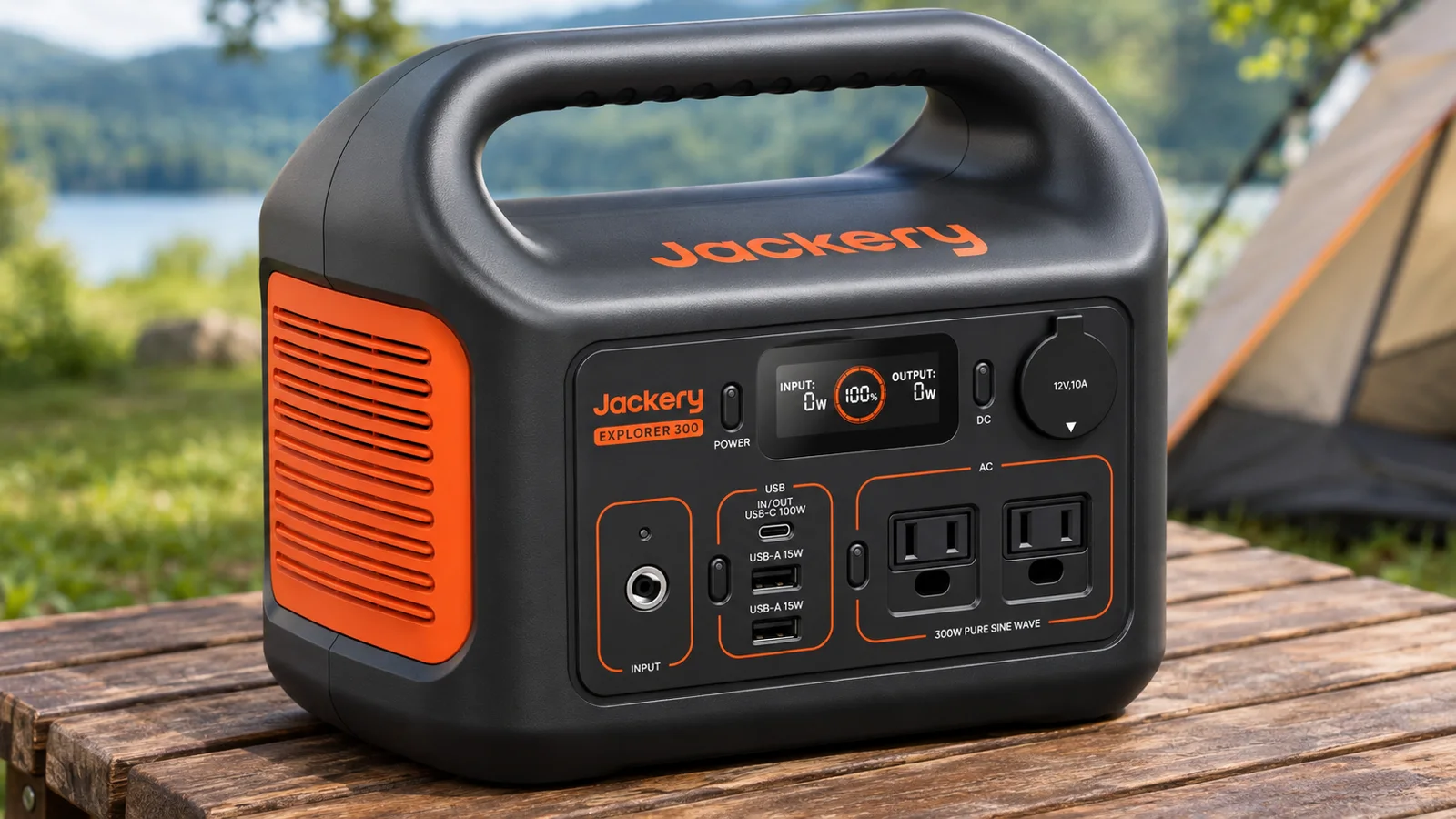

- Capacity
- 292 Wh
- Rated output
- See listing
- Chemistry
- See listing
- Value for its size
- Fair value
- Amazon rating
- 4.6 / 5
- Buyer ratings
- 11,300
Specifications as stated in the Amazon listing. Check current details before buying.
How the score is calculated
This spec- and buyer-rating-based score is not a measure of independently measured performance. Value: Excellent 3, Good 2.2, Fair 1.4, Premium 0.6 points. Amazon rating: 4.0 earns 0, 5.0 earns 2.5, proportional in between. Rating volume: 1.5 × ln(1 + ratings) / ln(5,001), capped at 1.5. Output: 1.5 × rated W / Wh, capped at 1.5; unknown output earns 0.75. Stated LiFePO4: 1 point. Stated cycles, weight and solar input: 0.5/3 each, rounded together to three decimals. Missing value, rating, volume or listing details earn 0 for that criterion. The total is rounded to one decimal.
Read our full ranking methodologyThe short verdict
The Jackery Explorer 300 is a sensible small power station for weekend camping, communications gear, and short backup windows. Its 292Wh capacity covers everyday essentials well, but its Fair value makes the closest alternatives worth comparing before you order.
Pros
- 292Wh capacity fits the compact power-station class
- Useful runtime for phones, laptops, lights, and Wi-Fi
- Can support a CPAP with heated humidifier for about 5.5 hours
- Strong 4.6 out of 5 Amazon rating from 11,300 ratings
- Qualifies for the under-$300 category
Cons
- Fair value compared with several similarly sized alternatives
- Full-size refrigerator runtime is only about 1.7 hours
- High-draw appliances drain the battery in minutes
Best for
- Weekend campers who need phone, laptop, and lighting power
- Apartment dwellers who want short backup for Wi-Fi and small electronics
- CPAP users who need a compact overnight power reserve
Look elsewhere if
- Whole-home backup or long refrigerator outages
- Anyone powering heaters, microwaves, or coffee makers for extended periods
Full specifications
| Capacity | 292 Wh |
|---|---|
| Rated AC output | See listing |
| LiFePO4 stated | See listing |
| Charge cycles | See listing |
| Weight | See listing |
| Solar input | See listing |
| Value for its size | Fair value |
Specifications as stated in the Amazon listing. Cycle-life conditions and solar compatibility vary; see the listing.
What can it power?
Choose your devices and daily run time. Battery capacity needed = watts × hours ÷ 0.85. Peak running watts assumes all selected devices run at once.
These are planning estimates, not measured runtimes. Appliance startup surges, fridge duty cycles, CPAP humidifiers and charging losses can change demand. Check your device label and the listing’s surge limit.
Runtime reference · 292 Wh at 85% usable energy
| Device | Running watts | Estimated hours |
|---|---|---|
| Phone | 15 W | 16.5 |
| Laptop | 60 W | 4.1 |
| Router | 40 W | 6.2 |
| CPAP | 45 W | 5.5 |
| Mini fridge | 50 W | 5.0 |
| Full fridge | 150 W | 1.7 |
| TV | 100 W | 2.5 |
| LED lights | 20 W | 12.4 |
| Coffee maker | 900 W | 0.3 |
| Microwave | 1000 W | 0.2 |
| Space heater | 750 W | 0.3 |
| E-bike charger | 500 W | 0.5 |
| Drill | 600 W | 0.4 |
Runtime estimates
Estimated usable energy is 85% of rated capacity. Actual runtime varies with load, temperature and battery age. See the device reference above for calculated estimates.
| Device | Estimated runtime |
|---|---|
| Phone charge (15 W) | 17 h |
| Laptop (60 W) | 4.1 h |
| LED lights + Wi-Fi router (40 W) | 6.2 h |
| CPAP, heated humidifier (45 W avg) | 5.5 h |
| Mini fridge/cooler (50 W avg) | 5.0 h |
| Full-size fridge (150 W avg) | 1.7 h |
| 55-inch TV (100 W) | 2.5 h |
| Drip coffee maker (900 W) | 17 min |
| Microwave (1,000 W) | 15 min |
| Space heater, low (750 W) | 20 min |
A short blackout does not need to become a full-house power project. A charged Jackery Explorer 300 can keep a phone available, a laptop running, and a Wi-Fi router plus LED lights operating while you wait for the utility to restore service. At a campsite, it is better suited to personal electronics and small essentials than to cooking or heating.
This is a compact portable power station with 292 Wh of capacity. That puts it in the useful middle ground between tiny phone-focused battery packs and much larger emergency-backup units. The Amazon rating is 4.6 out of 5 from 11,300 ratings, while its value for this size class is Fair. Check the current price on Amazon before ordering.
Who the Jackery Explorer 300 Is Really For
The Explorer 300 makes the most sense when portability and simple backup matter more than long runtimes. Weekend campers can use it for phones, a laptop, lights, or a small cooler without moving up to a much larger station. It also suits apartment residents who want a quiet reserve for communications during a short outage. There is no fuel, exhaust, or engine noise to manage while you charge a phone or keep a router running.
It is a particularly practical size for a CPAP user facing an overnight trip or an outage, although the 5.5-hour estimate with a heated humidifier is shorter than a full night. Turning off the humidifier can change the power requirement substantially, but actual runtime depends on the machine and settings. For hurricane preparation, use it as an essentials-first station: communications, lighting, and medical equipment before entertainment or appliances.
It is not the right scale for whole-home backup. A full-size refrigerator gets about 1.7 hours in the stated calculation, and a space heater on low lasts about 20 minutes. Those numbers make the role clear: preserve critical small loads, not normal household electricity.
Capacity, Output and What It Can Run
The 292 Wh battery offers a useful reserve, but watt-hours are a fuel tank, not a promise that every appliance will run for a long time. Runtime estimates below use 85% usable efficiency and assume a continuous load from full charge to empty. Real devices cycle, vary their draw, or start with a brief surge, so treat these as planning figures.
| Device or load | Estimated runtime |
|---|---|
| Phone charge | 17 hours |
| Laptop | 4.1 hours |
| LED lights plus Wi-Fi router | 6.2 hours |
| CPAP with heated humidifier | 5.5 hours |
| Mini fridge or cooler | 5.0 hours |
| 55-inch TV | 2.5 hours |
| Full-size refrigerator | 1.7 hours |
High-draw appliances consume that reserve quickly: a drip coffee maker gets about 17 minutes, a microwave about 15 minutes, and a low space heater about 20 minutes. Those are useful for a brief task, not sustained operation. Keep startup demands and the appliance’s actual wattage in mind before connecting it.
Features and Ports: What Matters in Daily Use
The most important feature here is the 292 Wh capacity in a compact class. That is enough energy to keep several low-draw essentials going through a meaningful part of a short outage, while remaining more approachable for car camping and occasional emergency storage than a full-size backup battery.
Its strongest practical use is combining modest loads. LED lights and a Wi-Fi router together are estimated at 6.2 hours, which can preserve both visibility and internet access during an evening interruption. A laptop receives about 4.1 hours, while phones stretch much farther because their battery demands are comparatively small. A 55-inch TV can run for approximately 2.5 hours, making it possible to follow weather alerts or local news without treating entertainment as the main priority.
Port layout and connector details affect whether it fits your particular kit, so confirm the port arrangement on the Amazon page before ordering. Also check the power requirements printed on your devices. The Explorer 300 is best viewed as a small electronics and essentials station, not as a substitute for a high-capacity home backup system.
Charging, Solar and Long-Term Ownership
The available capacity gives you a straightforward ownership rule: recharge after a major outing or outage, then store it ready for the next one. A 292 Wh battery can cover many low-power sessions, but repeated high-draw use will empty it rapidly. A microwave, coffee maker, or heater may be useful for a short burst, yet those loads leave little reserve for communications afterward.
Solar charging deserves careful attention when building an emergency kit. Solar input details are not included here, so confirm the compatible charging method and solar specifications on the Amazon page if panel charging is important to you. Do not assume that a portable panel will provide a particular recharge time. Sun intensity, panel angle, shade, temperature, and charging limits all affect the result.
For long-term readiness, keep the station accessible rather than buried in a closet, and periodically confirm that it still has charge. Store and operate it according to Jackery’s guidance. The practical advantage of this size is flexibility: it can cover communications and lighting without committing you to the footprint or larger energy budget of a 1,000 Wh-plus system.
How It Stacks Up Against Similar Power Stations
The Explorer 300 sits among several closely matched options. The Anker SOLIX C300 has 288 Wh and carries a Premium price label, while the Anker SOLIX C300 DC also has 288 Wh and is labeled Good value. Both are close enough in capacity that the choice should come down to current pricing, port needs, and charging details.
The MARBERO 296 Wh 350 W offers 296 Wh, slightly more than the Jackery, and is labeled Excellent value. That makes it an important comparison for shoppers focused on capacity per dollar. The BLUETTI Elite 30 V2 has 288 Wh and a Premium price label, so it targets buyers willing to pay more within the same broad capacity class.
The Anker SOLIX 521 drops to 256 Wh and carries a Premium price label. It may still appeal if its feature set matches your gear, but the Jackery offers more stored energy on paper. Overall, the Explorer 300’s 4.6 rating from 11,300 ratings is reassuring, yet its Fair value means a quick comparison is worthwhile. For more options, see the best portable power stations under $300.
Frequently asked questions
How long can the Jackery Explorer 300 run a CPAP?
With a heated humidifier included, the estimated runtime is about 5.5 hours from full charge to empty. Actual results depend on the CPAP model, pressure settings, humidifier use, and other connected loads. If overnight medical backup is essential, compare the station's runtime with your complete sleep schedule before relying on it.
Can the Explorer 300 power a refrigerator?
It can provide an estimated 1.7 hours for a full-size refrigerator under the stated runtime calculation. Refrigerators cycle rather than drawing a constant load, and startup demand can matter, so the actual result may vary. A mini fridge or cooler has a longer estimated runtime of about 5.0 hours.
Can it run a microwave or coffee maker?
Yes, but only briefly according to the calculated runtimes. A drip coffee maker is estimated at about 17 minutes, while a microwave is estimated at about 15 minutes. These appliances draw heavily compared with phones, lights, or routers, so using one can leave much less reserve for other emergency equipment.
Is the Jackery Explorer 300 good for camping?
Yes, especially for weekend trips centered on phones, laptops, lights, and small cooling equipment. Estimated runtimes include 17 hours for phone charging, 4.1 hours for a laptop, and 5.0 hours for a mini fridge or cooler. It is less suitable for electric cooking, heating, or long appliance-heavy stays.
Is the Explorer 300 a good blackout power station?
It is a useful short-outage station for essential electronics, not a whole-home backup battery. LED lights plus a Wi-Fi router are estimated at 6.2 hours, and a 55-inch TV at about 2.5 hours. A full-size refrigerator gets about 1.7 hours, so prioritize communications, lighting, and medical equipment.


