Buying guide
Best Portable Power Stations Under $300
Small-capacity stations can keep phones, laptops and campsite essentials running—but they’re not whole-home backup.
Quick picks


Amazon prices change constantly: tap the button for today's price.
A short blackout can turn a dead phone into a real problem. At a campsite, it can mean choosing between a charged camera and a working laptop. Portable power stations under $300 are built for those smaller jobs: compact energy for electronics, lights and select low-wattage devices—not an electric range, space heater or full home backup system.
This guide compares seven options, from a 150 Wh MARBERO to 296 Wh models, plus compact units with rated AC output as high as 600 W. You’ll find the best fit for campsite charging, USB-C gear, occasional AC use and a small emergency reserve. The key distinction is simple: watt-hours estimate how long a station can run a load; watts determine whether it can start or sustain that load in the first place.
Our ranking uses manufacturer-listed capacity and output, each model’s value-for-its-size-class label, and the volume and level of Amazon buyer ratings. It is a specification-based comparison, not a report of physical product testing. For sizing help before you buy, see how many watt-hours you need and our portable power station buying guide.
The picks at a glance
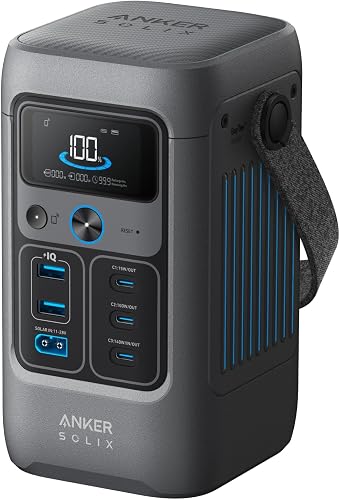
For the broadest AC capability in this roundup, start with the BLUETTI Elite 30 V2: it lists 288 Wh, a 600 W AC inverter and an LFP battery. If your kit is mostly USB-C laptops and phones, the Anker SOLIX C300 DC stands out for its two 140 W two-way USB-C ports and 288 Wh capacity. Need capacity and an AC outlet while keeping value front and center? MARBERO’s 296 Wh 350 W model is the Excellent-value pick.
The Jackery Explorer 300 is a familiar middle-ground choice with 292 Wh and a strong 4.6-out-of-5 Amazon rating across 11,300 ratings. The Anker SOLIX 521 has less capacity at 256 Wh, but lists 300 W AC output, LFP chemistry and two AC outlets. The smaller Anker C200 DC and MARBERO 150 Wh make more sense when your priorities are portable electronics and a lighter-duty power plan.
| Model | Capacity | Rated AC output | Value for size |
|---|---|---|---|
| BLUETTI Elite 30 V2 | 288 Wh | 600 W | Premium price |
| Anker SOLIX C300 DC | 288 Wh | 300 W | Good value |
| MARBERO 296 Wh 350 W | 296 Wh | 350 W | Excellent value |
| Jackery Explorer 300 | 292 Wh | — | Fair value |
| Anker SOLIX 521 | 256 Wh | 300 W | Premium price |
| Anker SOLIX C200 DC | 192 Wh | 200 W | Fair value |
| MARBERO 150 Wh | 150 Wh | 150 W | Good value |
For the whole field, see our portable power station rankings.
Best overall: BLUETTI Elite 30 V2
The BLUETTI Elite 30 V2 leads on a number that matters when you want to plug in an AC device: its manufacturer-listed inverter output is 600 W. That is more than any other model here, while the station still offers 288 Wh of stored energy. It also lists an LFP battery and nine outlets, giving it a useful mix of output capability and connection options in a small-capacity class. Its Amazon rating is 4.5 out of 5 from 1,200 ratings.
That 600 W figure is a ceiling for power draw, not a promise of long runtime. A load that draws 600 W would use the stored energy quickly. Using the standard estimate of watt-hours × 0.85 ÷ watts, 288 Wh works out to about 0.4 hours at 600 W. At a 100 W load, the same calculation gives about 2.4 hours. Actual runtime varies with the device and operating conditions, so treat estimates as planning guidance.
The value label is Premium price, so this is the capability-first choice rather than the value-per-capacity winner. It suits buyers who need more AC headroom for compatible small devices, campsite gear or select emergency loads. Check the current price on Amazon and confirm the outlet layout for your devices before ordering. For more LFP options, compare the best LiFePO4 power stations.
Best for USB-C gear: Anker SOLIX C300 DC
The Anker SOLIX C300 DC is the clearest match for a modern electronics kit. It has 288 Wh of capacity, 300 W rated output and two 140 W two-way USB-C ports, plus a 100 W USB-C port, a 15 W USB-C port, two USB-A ports and a 120 W car socket. That seven-port lineup makes it particularly compelling for charging several phones, tablets or USB-C laptops without building your setup around AC adapters. Its Amazon rating is 4.5 out of 5 from 1,700 ratings, and its value label is Good value.
The model uses LiFePO4 chemistry and includes smart temperature control and an impact-resistant design among its listed features. Anker says it can recharge to 80% in an hour using the dual PD 3.1 USB-C port. It can also recharge by car or solar, though the solar panel is separate. For a 100 W device, a simple energy estimate is 288 Wh × 0.85 ÷ 100 W, or about 2.4 hours. That is a planning estimate, not a guaranteed laptop runtime.
One important distinction: the C300 DC’s appeal is its DC port selection, not an AC outlet for household plugs. It is a strong fit for a USB-C-centered campsite, travel kit or laptop bag companion. Confirm the port layout and charging method you need on Amazon before ordering. Compare it with the smaller Anker SOLIX C200 DC if you want a more compact-capacity option.
Best value and compact AC picks: MARBERO 296Wh and 150Wh
MARBERO’s 296 Wh 350 W model is the value standout: its size-class label is Excellent value, and its listed capacity is the largest in this roundup. Rated AC output is 350 W, giving it a useful middle ground for compatible electronics and small appliances whose draw stays within that limit. It has a 4.3-out-of-5 Amazon rating from 1,400 ratings. Solar is referenced in the product title, but verify the compatible panel and charging details on Amazon before planning a solar setup.
For a lower-capacity, more modest-power option, the MARBERO 150 Wh lists 150 W AC output and earns a Good value label. The Amazon rating is 4.3 out of 5 from 1,400 ratings. Its listed connections include three standard USB ports, one QC3.0 USB port, four DC ports and one AC outlet. The product information also describes built-in LED flashlights and recharging by wall outlet, car adapter or a compatible solar panel. This is the pick for phone charging, small electronics and short trips where 150 Wh is enough—not a long CPAP night or a high-draw appliance.
Use the runtime formula to set expectations: 150 Wh × 0.85 ÷ 30 W gives about 4.25 hours at a steady 30 W load. A larger device can cut that sharply. These MARBERO stations suit different jobs, so choose by load and required runtime, not by the lower capacity’s portability alone. See camping power station picks for more trip-focused options.
Familiar mid-size options: Jackery Explorer 300 and Anker SOLIX 521
The Jackery Explorer 300 offers 292 Wh of capacity and a 4.6-out-of-5 Amazon rating from 11,300 ratings—the largest rating count among these seven candidates. Its value label is Fair value. It’s a sensible choice for shoppers who prioritize broad buyer feedback and a near-300 Wh capacity for phones, cameras, lights and other modest loads. The provided figures do not establish its rated AC output, so check the Amazon page for the exact output and port arrangement before choosing it for an AC appliance.
The Anker SOLIX 521 trades some capacity for a more fully specified AC-and-USB-C setup: 256 Wh, 300 W rated AC output, two AC outlets and a 60 W USB-C PD output. It uses LFP chemistry and has a 4.4-out-of-5 rating from 3,100 Amazon ratings. Anker lists 3,000+ charge cycles for its LFP battery and five-year full-device support. Its size-class value label is Premium price, making it a feature-and-support pick rather than a capacity-per-dollar leader.
For a phone, router or laptop, either could be part of a small outage kit, but the details that matter differ: Jackery brings more capacity and more rating volume, while Anker lists its AC output and USB-C PD wattage. Neither belongs in a plan for heating appliances. For a broader outage setup, explore power stations for home backup and our blackout checklist.
Smaller DC choice: Anker SOLIX C200 DC
The Anker SOLIX C200 DC is a useful step down from the C300 DC when 192 Wh is enough and your devices charge through USB. Its listed output is 200 W. Connections include one 140 W two-way USB-C port, one 100 W USB-C port, one 15 W USB-C port and two 12 W USB-A ports. It has an LFP battery, smart temperature control and an impact-resistant design, with a 3,000-cycle battery rating and three-year protection listed by Anker. Amazon buyers rate it 4.4 out of 5 from 1,000 ratings; its value label is Fair value.
Anker says the C200 DC can recharge to 80% in 1.3 hours through its PD 3.1 USB-C port. It can also be charged with solar, but verify panel compatibility before buying one: the product information identifies several incompatible panels. That check matters more than a vague assumption that any USB-C solar panel will work.
At a 40 W load, a rough runtime estimate is 192 Wh × 0.85 ÷ 40 W, or about 4.1 hours. That makes it plausible for a few low-power electronics needs, with runtime depending on the actual device draw. It is a DC-focused station, so don’t choose it for household AC plugs. For a larger Anker option, compare the C300 DC; for an overview of solar recharging, see how to charge a power station with solar panels.
How to choose a power station under $300
Start with the devices, not the station. Write down what you want to power, how many watts each device draws and how many hours it needs to run. Estimate energy with watt-hours × 0.85 ÷ watts. For example, a 288 Wh station powering a 40 W device pencils out to about 6.1 hours. This is an estimate; actual results can differ. For AC loads, also check rated output: a station’s watt-hours tell you about stored energy, while its watts tell you whether it can support the load at all.
Next, match the ports to your gear. USB-C-heavy users may prefer the C300 DC’s pair of 140 W two-way ports. Someone who needs AC outlets may look at the Anker 521 or MARBERO options, while the Elite 30 V2 offers the highest listed AC output here at 600 W. Keep the use case modest. A 150–296 Wh unit is a portable electronics reserve, not a replacement for a fuel generator or a large home-backup battery.
Then consider battery chemistry, charging and value. LFP models in this group include the Anker 521, Anker C200 DC, Anker C300 DC and BLUETTI Elite 30 V2. Compare the value-for-size label alongside rating level and rating count, not in isolation. Ratings are a useful signal of buyer feedback volume, but they don’t establish whether a particular model fits your setup. For more sizing advice, read our watt-hour sizing guide and our LFP versus lithium-ion comparison.
Mistakes to avoid with a budget power station
The biggest mistake is treating capacity and output as interchangeable. A 296 Wh station can store more energy than a 150 Wh model, but that does not automatically mean it can run every appliance. Check the device’s running draw against the station’s rated output, and be cautious with anything that heats, cools or uses a motor. Those loads can be demanding, and a small station may not be suitable.
Another trap is planning around ideal runtime. Use the 0.85 efficiency factor in the estimate, then leave some margin. If your CPAP, laptop or router must run overnight, calculate from its actual wattage and planned hours before buying. For CPAP use, confirm the machine’s power needs and whether it requires a heated humidifier or other accessories; don’t assume a station’s capacity guarantees a full night. Our CPAP and medical-device guide focuses on that planning.
Also avoid buying on a solar mention alone. Check the station’s compatible input method and panel requirements on Amazon, especially for DC-focused models. Finally, don’t assume a model can replace a home generator just because it has an AC outlet. These compact stations work best for selected devices and short-duration needs. If you need to run several household essentials through a long outage, move up in capacity and compare portable stations with gas generators.
Final recommendation
For most shoppers who want the strongest listed AC capability in this roundup, choose the BLUETTI Elite 30 V2: 288 Wh, 600 W rated AC output, LFP chemistry and nine outlets. Its Premium price label is the tradeoff. If your setup centers on USB-C devices, the Anker SOLIX C300 DC is a more targeted fit, with 288 Wh, Good value and a particularly capable port selection. For maximum capacity per the stated value category, the MARBERO 296 Wh 350 W is the clear value pick.
Choose the Jackery Explorer 300 if its 292 Wh capacity and substantial Amazon rating volume appeal to you. Choose the Anker SOLIX 521 when its two AC outlets, 300 W output, 60 W USB-C PD and listed long-term support matter more than value for size. For a smaller electronics backup, weigh the Anker C200 DC’s USB-C features against the MARBERO 150 Wh’s Good value rating and lower capacity.
These are budget-class stations for keeping essential electronics and select small loads going—not for powering an entire home. Check the current price on Amazon, confirm the ports and charging method you need, then size the unit around your real load and runtime. If your needs are larger, browse our picks under $1,000 or the complete under-$300 guide.
Every model mentioned, at a glance
| Value for its size | Availability | |||||||||
|---|---|---|---|---|---|---|---|---|---|---|
| BLUETTI Elite 30 V2 Best budget | 5.8 | 288 | 600 | Yes | See listing | See listing | 9.5 | 4.51,200 ratings | Premium price | Check price on Amazon |
| Anker SOLIX C300 DC | 6.4 | 288 | 300 | Not stated | See listing | 100 | See listing | 4.51,700 ratings | Good value | Check price on Amazon |
| MARBERO 296Wh 350W | 6.5 | 296 | 350 | Not stated | See listing | See listing | See listing | 4.31,400 ratings | Excellent value | Check price on Amazon |
| MARBERO 150Wh | 5.7 | 150 | 150 | Not stated | See listing | See listing | See listing | 4.31,400 ratings | Good value | Check price on Amazon |
| Anker SOLIX C200 DC | 5.3 | 192 | 200 | Not stated | See listing | 100 | See listing | 4.41,000 ratings | Fair value | Check price on Amazon |
Specifications as stated in the Amazon listing. Missing details: see listing. Scores use specifications and buyer ratings. How we rank.
Frequently asked questions
What can a portable power station under $300 run?
These compact stations are best suited to phones, tablets, laptops, lights, cameras, routers and other modest electronics. Some models also offer AC outlets for compatible small devices, but check the device’s wattage against the station’s rated output. They are not a practical substitute for whole-home backup or high-draw appliances such as space heaters.
How long will a 288Wh power station last?
A useful estimate is watt-hours × 0.85 ÷ device watts. At a steady 40W load, 288Wh works out to about 6.1 hours; at 100W, it is about 2.4 hours. These are planning estimates, not guaranteed runtimes. Your device’s actual draw and operating conditions affect the result.
Is the BLUETTI Elite 30 V2 the best station under $300?
It is the strongest pick here for listed AC output, with 600W, 288Wh and an LFP battery. That does not make it best for every buyer: it carries a Premium price value label, and USB-C-focused users may prefer the Anker SOLIX C300 DC. Match the station to your devices, ports and runtime needs.
Can a small power station run a CPAP machine overnight?
Possibly, but don’t assume that capacity alone guarantees a full night. Check your CPAP’s wattage and planned hours, including the effect of a heated humidifier or other accessories. Estimate runtime with watt-hours × 0.85 ÷ watts and leave a margin. The MARBERO 150Wh is especially limited for extended medical-device use.
Are LiFePO4 power stations worth choosing in this budget tier?
Several picks here use LFP chemistry, including the Anker SOLIX 521, Anker SOLIX C200 DC, Anker SOLIX C300 DC and BLUETTI Elite 30 V2. Compare their stated features and value labels with the capacity and output you need. LFP chemistry is one consideration, not a reason to overlook port compatibility or runtime.
Can I recharge these power stations with solar panels?
Solar capability and compatibility differ by model, so verify the supported charging method and panel requirements on the Amazon page before buying a panel. Some models mention solar, but that alone does not confirm that a panel you already own will work. For a setup guide, see our article on charging a power station with solar panels.