Jackery · Spec-based review
Jackery Explorer 5000 Plus: Serious Whole-Home Backup
A 5,040Wh reserve with 7,200W output for long outages and demanding appliances.
We may earn a commission from product links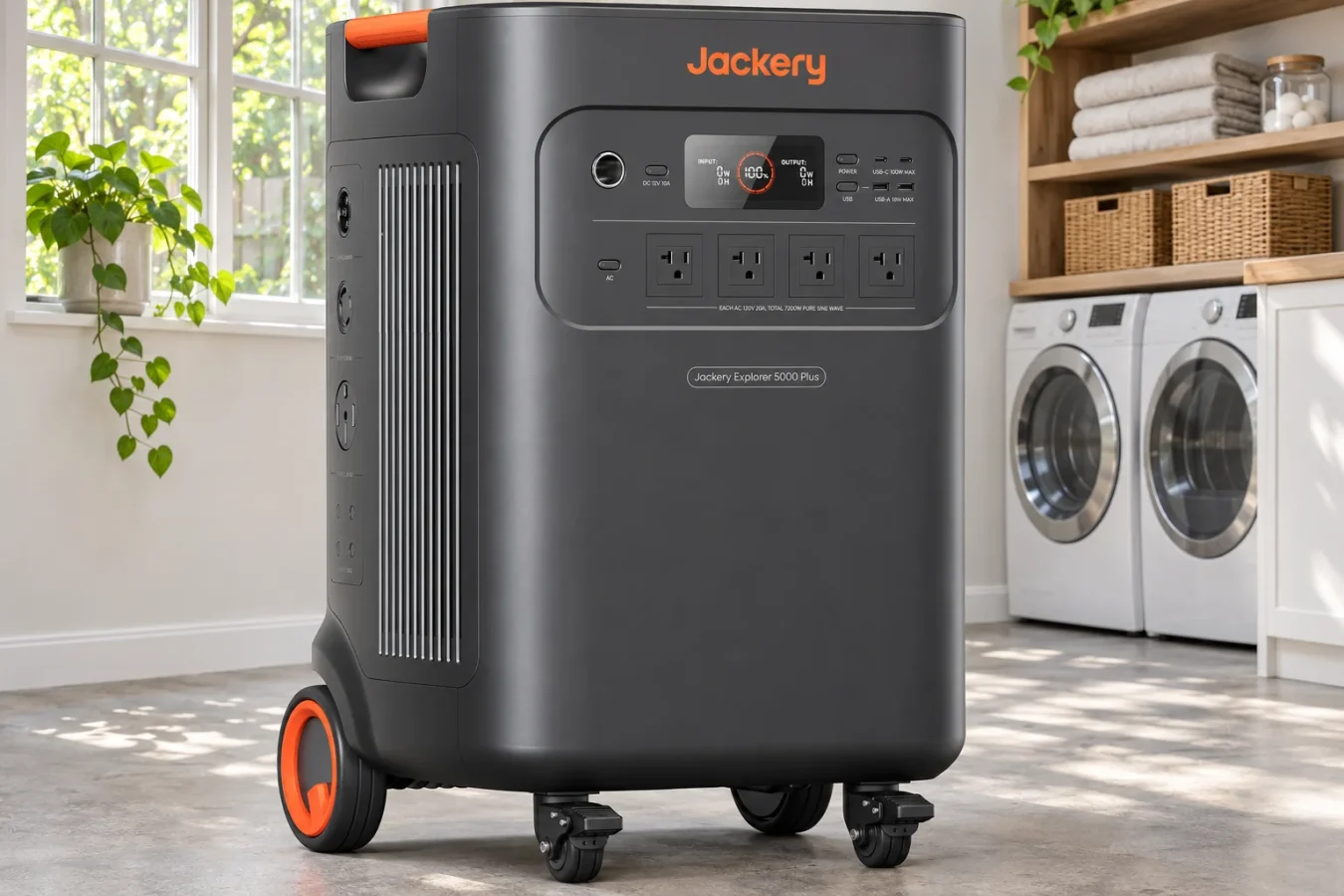

- Capacity
- 5,040 Wh
- Rated output
- 7,200 W
- Chemistry
- See listing
- Value for its size
- Premium price
- Amazon rating
- 4.3 / 5
- Buyer ratings
- 64
Specifications as stated in the Amazon listing. Check current details before buying.
How the score is calculated
This spec- and buyer-rating-based score is not a measure of independently measured performance. Value: Excellent 3, Good 2.2, Fair 1.4, Premium 0.6 points. Amazon rating: 4.0 earns 0, 5.0 earns 2.5, proportional in between. Rating volume: 1.5 × ln(1 + ratings) / ln(5,001), capped at 1.5. Output: 1.5 × rated W / Wh, capped at 1.5; unknown output earns 0.75. Stated LiFePO4: 1 point. Stated cycles, weight and solar input: 0.5/3 each, rounded together to three decimals. Missing value, rating, volume or listing details earn 0 for that criterion. The total is rounded to one decimal.
Read our full ranking methodologyThe short verdict
The Jackery Explorer 5000 Plus is built for serious backup rather than casual camping. Its 5,040Wh capacity, 7,200W AC output, dual-voltage capability, UPS mode and quiet operation make it a strong fit for outage preparation, but its Premium price for this size class demands a clear need for high output and long runtimes.
Pros
- Large 5,040Wh capacity supports substantial overnight and multi-day loads
- 7,200W rated AC output suits demanding appliances and equipment
- 120V/240V dual-voltage output expands its usefulness around the home
- 0ms Online UPS response is designed to keep critical electronics powered through outages
- Quiet operation under 30dB is practical for bedrooms, offices and living spaces
Cons
- Premium price for its size class
- A battery this large is more home-backup equipment than grab-and-go camping gear
- Amazon rating of 4.3 out of 5 comes from 64 ratings, a useful but limited sample
Best for
- Homeowners who need quiet backup for refrigerators, networking and essential appliances
- RV owners and van builders who need a large, high-output battery reserve
- Families preparing for extended outages, hurricane season or severe weather
Look elsewhere if
- Campers who want a compact power station for occasional weekend trips
- Shoppers focused on the strongest value per watt-hour
Full specifications
| Capacity | 5,040 Wh |
|---|---|
| Rated AC output | 7,200 W |
| LiFePO4 stated | See listing |
| Charge cycles | See listing |
| Weight | See listing |
| Solar input | See listing |
| Value for its size | Premium price |
Specifications as stated in the Amazon listing. Cycle-life conditions and solar compatibility vary; see the listing.
What can it power?
Choose your devices and daily run time. Battery capacity needed = watts × hours ÷ 0.85. Peak running watts assumes all selected devices run at once.
These are planning estimates, not measured runtimes. Appliance startup surges, fridge duty cycles, CPAP humidifiers and charging losses can change demand. Check your device label and the listing’s surge limit.
Runtime reference · 5,040 Wh at 85% usable energy
| Device | Running watts | Estimated hours |
|---|---|---|
| Phone | 15 W | 285.6 |
| Laptop | 60 W | 71.4 |
| Router | 40 W | 107.1 |
| CPAP | 45 W | 95.2 |
| Mini fridge | 50 W | 85.7 |
| Full fridge | 150 W | 28.6 |
| TV | 100 W | 42.8 |
| LED lights | 20 W | 214.2 |
| Coffee maker | 900 W | 4.8 |
| Microwave | 1000 W | 4.3 |
| Space heater | 750 W | 5.7 |
| E-bike charger | 500 W | 8.6 |
| Drill | 600 W | 7.1 |
Runtime estimates
Estimated usable energy is 85% of rated capacity. Actual runtime varies with load, temperature and battery age. See the device reference above for calculated estimates.
| Device | Estimated runtime |
|---|---|
| Phone charge (15 W) | 286 h |
| Laptop (60 W) | 71 h |
| LED lights + Wi-Fi router (40 W) | 107 h |
| CPAP, heated humidifier (45 W avg) | 95 h |
| Mini fridge/cooler (50 W avg) | 86 h |
| Full-size fridge (150 W avg) | 29 h |
| 55-inch TV (100 W) | 43 h |
| Drip coffee maker (900 W) | 4.8 h |
| Microwave (1,000 W) | 4.3 h |
| Space heater, low (750 W) | 5.7 h |
When the power fails at 2 a.m., the priority is rarely one phone charge. It is the refrigerator, Wi-Fi, lights, medical equipment and the ability to make coffee or heat food without starting a noisy fuel generator. The Jackery Explorer 5000 Plus is aimed at that bigger problem. Its 5,040 Wh battery reserve and 7,200 W rated AC output put it in a different class from compact camping power stations.
This is a large-format backup system for homeowners, RV users and anyone planning around long outages. It supports 120V/240V dual-voltage output, Online UPS operation with a stated 0ms response, app monitoring through Wi-Fi or Bluetooth, and quiet operation under 30dB. The trade-off is straightforward: this is a premium purchase, so the capacity and output need to match your real electrical needs.
Who the Jackery Explorer 5000 Plus is really for
The Explorer 5000 Plus makes sense when an outage plan involves more than a few small electronics. A 5,040 Wh reserve can cover a refrigerator, router, lights and communications equipment for a meaningful stretch, while 7,200 W of rated AC output gives it the headroom to handle demanding appliances and job-site equipment. That combination is the main reason to consider it.
It is especially well suited to houses in blackout-prone areas, hurricane-season preparation and backup for a home office or critical network setup. The 120V/240V output also broadens its role around a home, RV or van build. Jackery positions it for equipment such as dryers, water pumps and ovens, as well as RV recharging.
For a weekend campsite, it is likely more reserve than necessary. The same is true if your normal emergency plan is limited to phones, lamps and a small cooler. Those buyers should compare smaller options in our small power station guide. This model earns its place when long runtime and high-output capability matter more than easy portability.
Capacity, output and what it can run
The headline figures are substantial: 5,040 Wh of capacity and 7,200 W of rated AC output. In practical terms, that is enough battery reserve for repeated appliance use, not merely emergency phone charging. Actual runtime depends on the device, conversion losses and cycling behavior, so the figures below use a consistent 85% usable-efficiency estimate.
| Load | Estimated runtime |
|---|---|
| Phone charging | 286 hours |
| Laptop | 71 hours |
| LED lights and Wi-Fi router | 107 hours |
| CPAP with heated humidifier | 95 hours |
| Full-size refrigerator | 29 hours |
| 55-inch TV | 43 hours |
| Space heater, low setting | 5.7 hours |
High-wattage appliances drain the battery quickly: a drip coffee maker works out to about 4.8 hours, a microwave about 4.3 hours and a low-setting space heater about 5.7 hours. Refrigerators cycle rather than draw their maximum continuously, so real-world results vary. Use the output rating and the appliance’s running and startup requirements together.
Features and ports that matter in an outage
The most important connection feature is 120V/240V dual-voltage output. That gives the Explorer 5000 Plus a broader role than a standard single-voltage power station, particularly for home equipment and certain RV or workshop needs. The rated 7,200 W AC output also supports heavier electrical loads than compact units.
Its Online UPS mode is designed around a stated 0ms response time. That matters for equipment that should remain powered during a blackout, including a refrigerator, Wi-Fi system, aquarium, computer or data center. For a home office, the goal is continuity rather than waiting for someone to notice the outage and switch cables manually.
The Jackery App adds Wi-Fi and Bluetooth monitoring, with real-time charge and discharge information and adjustable settings. Automatic off-peak charging and peak shaving are also included with a smart transfer switch. These controls are most useful when the station is part of a fixed home-backup setup rather than stored in a closet for occasional emergencies.
Operation is rated at under 30dB, which suits bedrooms, offices and living areas better than a conventional fuel generator. Confirm the port layout and transfer-switch configuration on the Amazon page before ordering.
Charging, solar and long-term ownership
The Explorer 5000 Plus is best viewed as a large energy reservoir that can be managed intelligently. Its 5,040 Wh capacity gives you flexibility during a prolonged outage, but every watt-hour used has to be replaced before the next long event. That makes charging strategy important, especially for households relying on it through repeated outages.
The app’s automatic off-peak charging and peak-shaving functions can help coordinate when the station charges and discharges in a home setup. Bluetooth and Wi-Fi monitoring also make it easier to keep an eye on the remaining reserve without repeatedly checking the unit itself. Those features are valuable when the power station is serving as part of an outage plan rather than a one-off camping accessory.
The available information does not establish a solar-input figure, so solar charging performance cannot be responsibly estimated here. If solar replenishment is central to your plan, confirm compatible solar hardware, input limits and charging times on the Amazon page before ordering. For any charging method, the basic physics remains the same: a 5,040 Wh battery takes substantial energy and time to refill, while high-power appliances can consume that reserve rapidly.
Quiet operation under 30dB is a long-term ownership advantage. The unit can sit near living areas without the constant mechanical noise associated with fuel-powered backup.
How it stacks up against the alternatives
The closest capacity match is the EcoFlow DELTA Pro Ultra, with 6,144 Wh and a Premium price classification. It offers more stored energy, while the Jackery remains a substantial 5,040 Wh option with 7,200 W rated AC output. If you want a similarly serious home-backup category with more capacity, the EcoFlow deserves a direct comparison.
The AFERIY P310 3840 Wh has 3,840 Wh and an Excellent value classification. It gives up 1,200 Wh compared with the Jackery, but may appeal to buyers who prioritize capacity value over the Jackery’s higher output figure. The EcoFlow DELTA Pro and Growatt Helios 3600 both sit around 3,600 Wh; their value classifications are Fair and Good, respectively.
Jackery’s own Jackery HomePower 3600 Plus offers 3,584 Wh and carries a Premium price classification. That makes the Explorer 5000 Plus the larger-capacity choice, but not automatically the better buy for every household. Check the current price on Amazon, then compare the output you need, the runtime you expect and whether dual voltage or UPS operation justifies the premium.
Frequently asked questions
How long can the Jackery Explorer 5000 Plus run a refrigerator?
The estimated runtime for a full-size refrigerator is about 29 hours using 5,040Wh of capacity and an 85% usable-efficiency assumption. Refrigerators cycle on and off, so actual time depends on the appliance, room temperature, door openings and other loads sharing the battery.
Can it power a 240V appliance?
The Explorer 5000 Plus is described with 120V/240V dual-voltage output. That makes it suitable for a wider range of home equipment, but confirm the specific outlet arrangement, transfer-switch requirements and appliance compatibility on the Amazon page before connecting a 240V load.
Is it suitable for CPAP backup?
Yes, its large battery reserve is well suited to CPAP use. The estimated runtime for a CPAP with a heated humidifier is about 95 hours. Actual runtime changes with pressure settings, humidifier temperature and whether other devices are powered at the same time.
Does it work as an uninterruptible power supply?
Its Online UPS mode is specified with a 0ms response time, allowing supported critical equipment to switch to stored power during an outage. It is intended for devices such as refrigerators, Wi-Fi equipment, computers, aquariums and data-center equipment.
Is the Explorer 5000 Plus quiet enough indoors?
The unit is specified to operate at under 30dB, which is appropriate for bedrooms, offices and living spaces. That quiet profile is useful during overnight outages, when a fuel generator's engine noise would be disruptive.


