BLUETTI · Spec-based review
BLUETTI AC180: Big Backup Power Without the Bulk
A fast-charging LiFePO4 power station built for outages, campsites and demanding appliances.
We may earn a commission from product links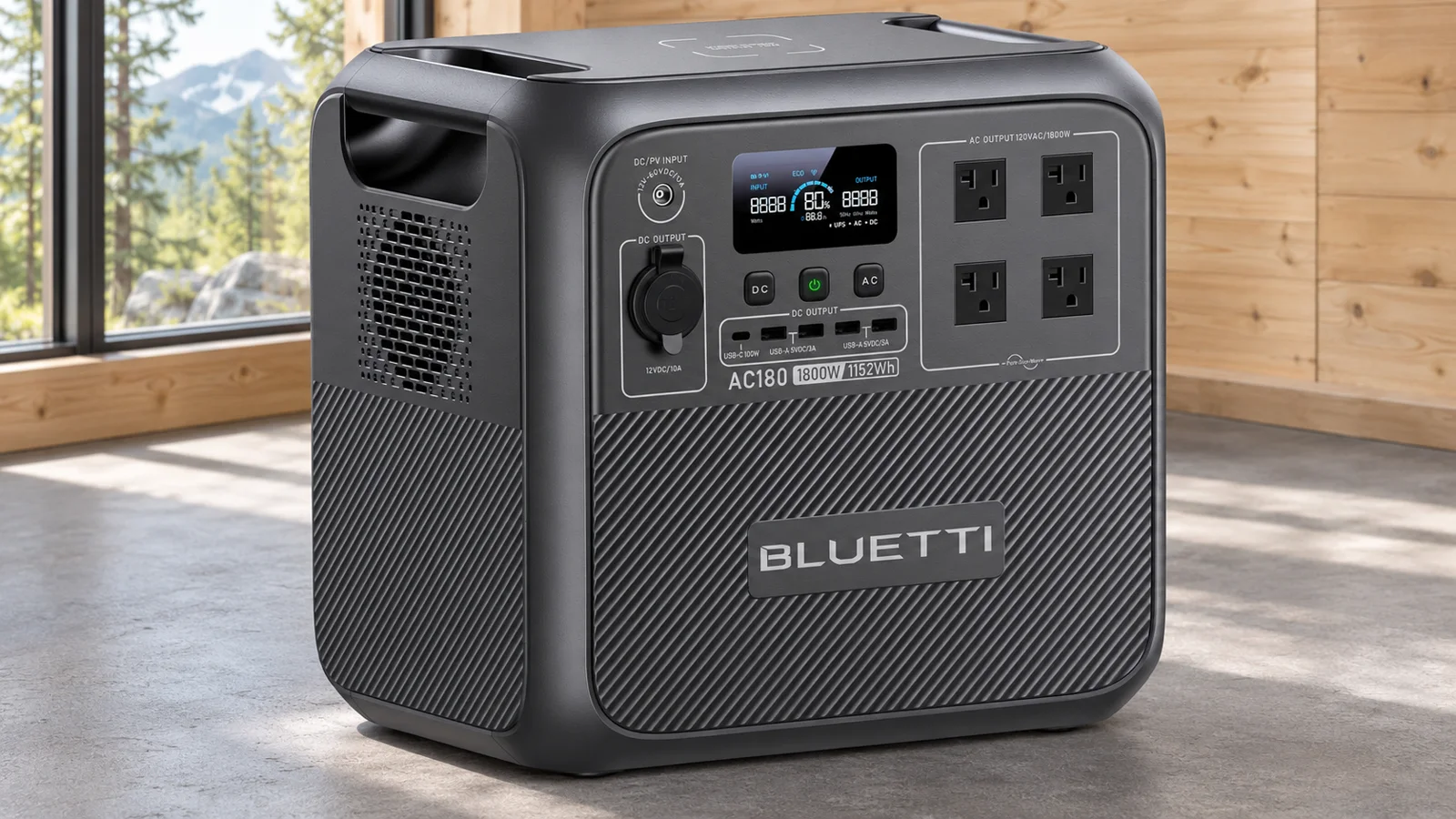

- Capacity
- 1,152 Wh
- Rated output
- 1,800 W
- Chemistry
- LiFePO4
- Value for its size
- Excellent value
- Amazon rating
- 4.5 / 5
- Buyer ratings
- 1,900
Specifications as stated in the Amazon listing. Check current details before buying.
How the score is calculated
This spec- and buyer-rating-based score is not a measure of independently measured performance. Value: Excellent 3, Good 2.2, Fair 1.4, Premium 0.6 points. Amazon rating: 4.0 earns 0, 5.0 earns 2.5, proportional in between. Rating volume: 1.5 × ln(1 + ratings) / ln(5,001), capped at 1.5. Output: 1.5 × rated W / Wh, capped at 1.5; unknown output earns 0.75. Stated LiFePO4: 1 point. Stated cycles, weight and solar input: 0.5/3 each, rounded together to three decimals. Missing value, rating, volume or listing details earn 0 for that criterion. The total is rounded to one decimal.
Read our full ranking methodologyThe short verdict
The BLUETTI AC180 is a strong all-around choice for anyone who needs more than a small camping battery but does not need a 2,000Wh-class system. Its 1,152Wh LFP battery, 1,800W AC output, fast charging and 500W solar input make it especially compelling for home backup, weekend camping and CPAP use.
Pros
- 1,152Wh LiFePO4 battery gives useful overnight and outage capacity
- 1,800W rated AC output handles many full-size appliances
- Fast AC charging and up to 500W solar input
- 20 ms UPS response is suited to essential electronics
- Excellent value for its size class and strong 4.5/5 buyer rating
Cons
- A 1,152Wh battery still needs careful load management during long outages
- High-wattage heating appliances drain the battery quickly
- Its capacity class is less convenient than compact units for lightweight travel
Best for
- Weekend campers who need refrigerator and appliance power
- Homeowners who want fast emergency backup for essentials
- CPAP users who need overnight capacity and solar flexibility
Look elsewhere if
- Buyers who need multi-day whole-home backup
- Travelers seeking the smallest, lightest power station
Full specifications
| Capacity | 1,152 Wh |
|---|---|
| Rated AC output | 1,800 W |
| LiFePO4 stated | Yes |
| Charge cycles | See listing |
| Weight | See listing |
| Solar input | 500 W |
| Value for its size | Excellent value |
Specifications as stated in the Amazon listing. Cycle-life conditions and solar compatibility vary; see the listing.
What can it power?
Choose your devices and daily run time. Battery capacity needed = watts × hours ÷ 0.85. Peak running watts assumes all selected devices run at once.
These are planning estimates, not measured runtimes. Appliance startup surges, fridge duty cycles, CPAP humidifiers and charging losses can change demand. Check your device label and the listing’s surge limit.
Runtime reference · 1,152 Wh at 85% usable energy
| Device | Running watts | Estimated hours |
|---|---|---|
| Phone | 15 W | 65.3 |
| Laptop | 60 W | 16.3 |
| Router | 40 W | 24.5 |
| CPAP | 45 W | 21.8 |
| Mini fridge | 50 W | 19.6 |
| Full fridge | 150 W | 6.5 |
| TV | 100 W | 9.8 |
| LED lights | 20 W | 49.0 |
| Coffee maker | 900 W | 1.1 |
| Microwave | 1000 W | 1.0 |
| Space heater | 750 W | 1.3 |
| E-bike charger | 500 W | 2.0 |
| Drill | 600 W | 1.6 |
Runtime estimates
Estimated usable energy is 85% of rated capacity. Actual runtime varies with load, temperature and battery age. See the device reference above for calculated estimates.
| Device | Estimated runtime |
|---|---|
| Phone charge (15 W) | 65 h |
| Laptop (60 W) | 16 h |
| LED lights + Wi-Fi router (40 W) | 24 h |
| CPAP, heated humidifier (45 W avg) | 22 h |
| Mini fridge/cooler (50 W avg) | 20 h |
| Full-size fridge (150 W avg) | 6.5 h |
| 55-inch TV (100 W) | 9.8 h |
| Drip coffee maker (900 W) | 1.1 h |
| Microwave (1,000 W) | 59 min |
| Space heater, low (750 W) | 1.3 h |
A storm knocks out the power just as the refrigerator starts warming up. You need a station that can keep food cold, run a router and charge phones—not merely top off a few gadgets. The BLUETTI AC180 is built for that middle ground: substantially more capable than a small personal battery, but less extreme than a multi-kilowatt-hour home system.
It combines a 1,152 Wh LiFePO4 battery with 1,800 W of rated AC output, a 2,700 W peak mode, rapid AC charging and up to 500 W of solar input. The listing also reports a 4.5 out of 5 Amazon rating from 1,900 ratings. For readers shopping in the under-$1,000 tier, it offers excellent value for its size class; check the current price on Amazon.
Who the BLUETTI AC180 Is Really For
The AC180 makes sense for people who want one power station to cover several roles. At a campsite, it can support lights, phones, laptops, a cooler and selected kitchen appliances. During a blackout, its 1,152 Wh reserve is enough to prioritize a refrigerator, communications equipment, lighting and medical equipment rather than trying to power an entire home.
It is also a sensible CPAP choice. The computed runtime for a CPAP with a heated humidifier is 22 hours, giving a full night with some margin for settings and conversion losses. The 20 ms UPS claim adds another useful angle for a home office or network setup, where a brief interruption can be inconvenient. Buyers should still confirm that their specific equipment is compatible.
This is not the right tool for running electric heat, central air conditioning or a full household load for days. Those jobs call for a much larger system or a fuel-powered generator. The AC180 is best understood as a versatile essentials-and-appliances station.
Capacity, Output and What It Can Run
The 1,152 Wh battery gives the AC180 useful endurance, while the 1,800 W rated AC output covers many demanding household and campsite loads. The listing identifies two 1,800 W AC outlets and a 2,700 W peak capability through the app. Runtime depends heavily on the appliance; these estimates use the stated 85% usable-efficiency calculation.
| Load | Estimated runtime |
|---|---|
| Phone charge | 65 hours |
| Laptop | 16 hours |
| LED lights and Wi-Fi router | 24 hours |
| CPAP with heated humidifier | 22 hours |
| Mini fridge/cooler | 20 hours |
| Full-size refrigerator | 6.5 hours |
| 55-inch TV | 9.8 hours |
| Drip coffee maker | 1.1 hours |
| Microwave | 59 minutes |
| Low space heater | 1.3 hours |
These figures are planning estimates, not guarantees. Refrigerators cycle on and off, while heaters and microwaves consume power rapidly. Avoid treating the peak figure as continuous output.
Features and Ports: Practical Power for Real Loads
The core specification is refreshingly straightforward: LFP chemistry, 1,152 Wh of capacity, 1,800 W AC output and a listing claim of nine outlets. That combination matters in an outage because several modest loads can share the station without immediately approaching its limit. The two AC outlets are the key option for household and job-site equipment.
LiFePO4 chemistry is a meaningful advantage for a station intended for repeated backup duty. In practical terms, it pairs a robust battery type with enough capacity for overnight essentials and enough output for many kitchen or workshop appliances. It does not change the basic math: a high-wattage load still empties a 1,152 Wh battery quickly.
The AC180 also supports app-controlled output boosting to 2,700 W, according to the listing. That feature is aimed at higher-demand devices, but buyers should check the appliance’s starting and running requirements before relying on it. The package includes AC, car and solar charging cables, plus a user manual. The listed warranty is five years.
Charging, Solar and Long-Term Ownership
Fast charging is one of the AC180’s clearest strengths. The listing says its 1,440 W AC input can fully charge the 1,152 Wh battery in one hour, while the product title claims a 0-to-80% charge in 45 minutes. That short turnaround is valuable during an unfolding outage: use the station, restore it quickly, then put it back on standby.
Solar charging is supported through a built-in MPPT charge controller with up to 500 W of solar input. BLUETTI lists a full solar charge time of 2.8 to 3.3 hours under its stated conditions. Actual results depend on sunlight, panel positioning and available panel output, so solar is best viewed as a replenishment strategy rather than an always-on guarantee.
For ownership, the LFP battery and five-year warranty are reassuring on paper. Keep expectations grounded: capacity is finite, and heating appliances can consume it in roughly an hour. For hurricane preparation, charge it ahead of time, prioritize refrigeration and communications, and keep the included charging options together.
How It Stacks Up Against the Alternatives
The AC180 sits slightly above the 1,000 Wh cluster, with 1,152 Wh and 1,800 W of rated AC output. That makes it a particularly interesting alternative to the Anker SOLIX C1000, which lists 1,056 Wh and Good value. The Jackery Explorer 1000 v2, BLUETTI Elite 100 V2 and OUPES Mega 1 each list 1,024 Wh, while the EcoFlow Delta 3 Classic also lists 1,024 Wh.
Those comparisons are not only about watt-hours. The AC180’s 1,800 W rating gives it a clear appliance-friendly position, and its 500 W solar input supports faster replenishment when conditions cooperate. Value labels vary: the Anker and BLUETTI Elite are Good value, the Jackery carries a Premium price label, the OUPES is Fair value, and the EcoFlow is Excellent value. The AC180 is labeled Excellent value for its size class.
Choose the AC180 when its extra capacity, LFP chemistry and strong AC output match your priorities. For a broader shortlist, see portable power stations under $1,000.
Frequently asked questions
How long can the BLUETTI AC180 run a CPAP?
The computed estimate is 22 hours for a CPAP with a heated humidifier. Actual runtime varies with pressure, humidifier temperature, tubing settings and the device's power draw. Treat the figure as a planning estimate and confirm your CPAP's requirements before relying on it for an outage.
Can the AC180 run a refrigerator during a blackout?
Yes, the stated estimate is about 6.5 hours for a full-size refrigerator. Refrigerators cycle, so real duration can differ substantially with room temperature, door openings and compressor behavior. A mini fridge or cooler has a longer computed estimate of 20 hours.
How quickly does the BLUETTI AC180 charge?
The listing says a full AC charge takes one hour using 1,440W input, while the product title claims 0-to-80% in 45 minutes. Solar charging is listed at 2.8 to 3.3 hours with up to 500W input under the stated conditions.
Can it power a space heater or microwave?
The 1,800W rated AC output is in the range required by many such appliances, but check each device's running and startup demands. The computed runtime is about 1.3 hours for a low space heater and 59 minutes for a microwave, so these loads drain the battery quickly.
Is the BLUETTI AC180 good for home backup?
It is well suited to prioritized backup: refrigeration, Wi-Fi, lighting, phones, a TV or CPAP. The listing also claims UPS response in 20 ms. It is not a whole-home, multi-day solution, so choose essential circuits and manage high-wattage appliances carefully.


