EcoFlow · Spec-based review
EcoFlow DELTA 3 Max: Serious Backup in a Portable Size
A 2,048Wh LFP power station built for blackouts, demanding appliances, and long nights away from the grid.
We may earn a commission from product links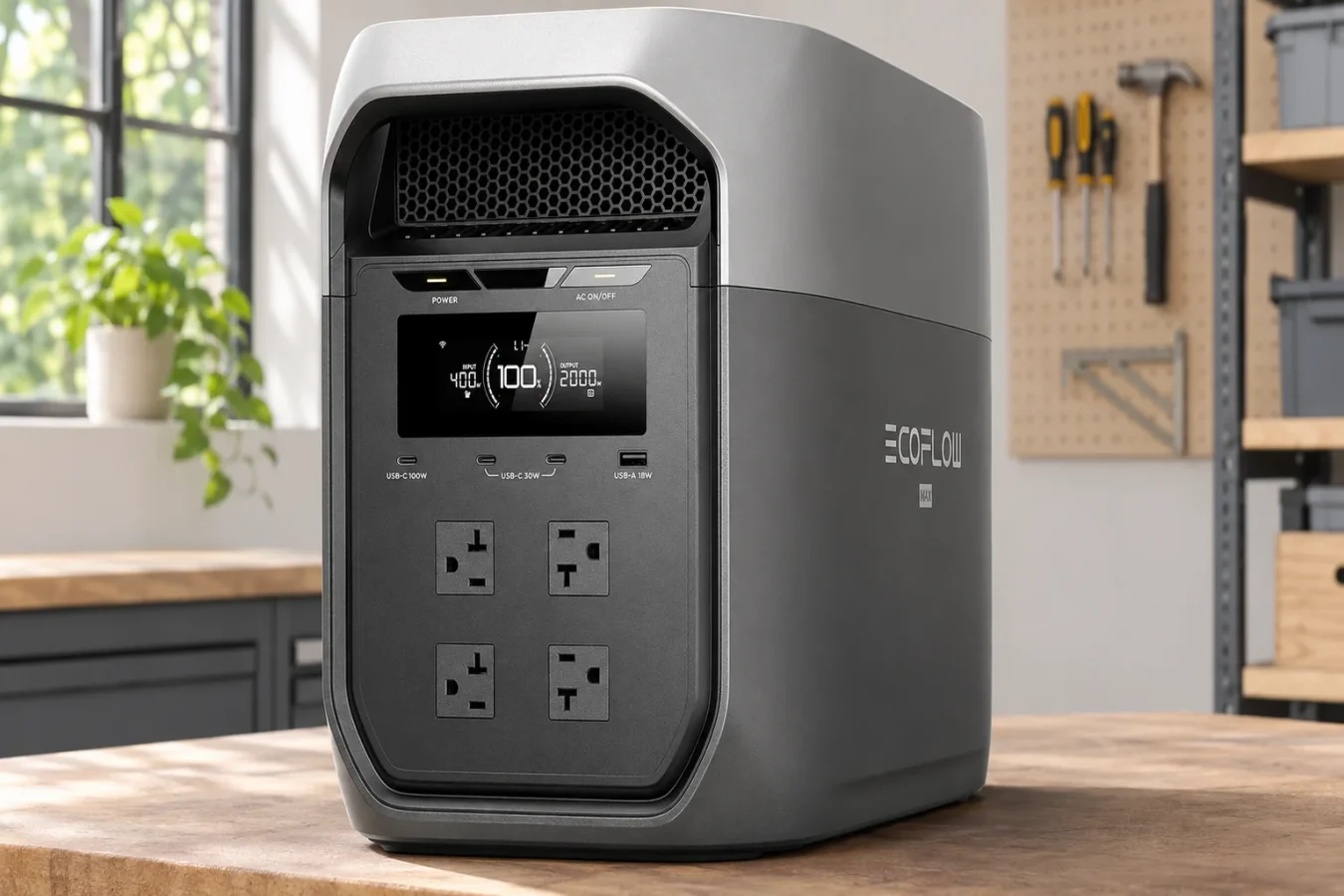

- Capacity
- 2,048 Wh
- Rated output
- 2,400 W
- Chemistry
- LiFePO4
- Value for its size
- Good value
- Amazon rating
- 4.7 / 5
- Buyer ratings
- 656
Specifications as stated in the Amazon listing. Check current details before buying.
How the score is calculated
This spec- and buyer-rating-based score is not a measure of independently measured performance. Value: Excellent 3, Good 2.2, Fair 1.4, Premium 0.6 points. Amazon rating: 4.0 earns 0, 5.0 earns 2.5, proportional in between. Rating volume: 1.5 × ln(1 + ratings) / ln(5,001), capped at 1.5. Output: 1.5 × rated W / Wh, capped at 1.5; unknown output earns 0.75. Stated LiFePO4: 1 point. Stated cycles, weight and solar input: 0.5/3 each, rounded together to three decimals. Missing value, rating, volume or listing details earn 0 for that criterion. The total is rounded to one decimal.
Read our full ranking methodologyThe short verdict
The EcoFlow DELTA 3 Max is a strong all-rounder for buyers who want substantial home-backup capacity without moving into a much larger class of power station. Its 2,400W AC output, LFP battery, rapid 0–80% charging claim, and 4.7-star Amazon rating make it especially appealing for blackout preparation, RV use, and demanding campsite loads. Check the current price on Amazon, because its Good value rating depends on where it sits on the day you buy.
Pros
- Large 2,048Wh capacity with a durable LiFePO4 battery
- 2,400W rated AC output for demanding household and job-site loads
- 0–80% charging in 1.13 hours according to EcoFlow
- 10ms transfer time for home-backup use
- Good value for its size class and a 4.7/5 Amazon rating from 656 ratings
Cons
- Its 2,048Wh capacity makes it a substantial unit for casual day trips
- High-wattage appliances drain the battery quickly
- Solar charging details should be confirmed on the Amazon page before ordering
Best for
- Homeowners who want refrigerator and internet backup during outages
- Campers and RV users who need 2,400W of AC output
- CPAP users who want several nights of battery-backed sleep
Look elsewhere if
- Shoppers who only need a lightweight phone-and-laptop power bank
- Buyers who require a clearly defined solar-input setup before ordering
Full specifications
| Capacity | 2,048 Wh |
|---|---|
| Rated AC output | 2,400 W |
| LiFePO4 stated | Yes |
| Charge cycles | See listing |
| Weight | See listing |
| Solar input | See listing |
| Value for its size | Good value |
Specifications as stated in the Amazon listing. Cycle-life conditions and solar compatibility vary; see the listing.
What can it power?
Choose your devices and daily run time. Battery capacity needed = watts × hours ÷ 0.85. Peak running watts assumes all selected devices run at once.
These are planning estimates, not measured runtimes. Appliance startup surges, fridge duty cycles, CPAP humidifiers and charging losses can change demand. Check your device label and the listing’s surge limit.
Runtime reference · 2,048 Wh at 85% usable energy
| Device | Running watts | Estimated hours |
|---|---|---|
| Phone | 15 W | 116.1 |
| Laptop | 60 W | 29.0 |
| Router | 40 W | 43.5 |
| CPAP | 45 W | 38.7 |
| Mini fridge | 50 W | 34.8 |
| Full fridge | 150 W | 11.6 |
| TV | 100 W | 17.4 |
| LED lights | 20 W | 87.0 |
| Coffee maker | 900 W | 1.9 |
| Microwave | 1000 W | 1.7 |
| Space heater | 750 W | 2.3 |
| E-bike charger | 500 W | 3.5 |
| Drill | 600 W | 2.9 |
Runtime estimates
Estimated usable energy is 85% of rated capacity. Actual runtime varies with load, temperature and battery age. See the device reference above for calculated estimates.
| Device | Estimated runtime |
|---|---|
| Phone charge (15 W) | 116 h |
| Laptop (60 W) | 29 h |
| LED lights + Wi-Fi router (40 W) | 44 h |
| CPAP, heated humidifier (45 W avg) | 39 h |
| Mini fridge/cooler (50 W avg) | 35 h |
| Full-size fridge (150 W avg) | 12 h |
| 55-inch TV (100 W) | 17 h |
| Drip coffee maker (900 W) | 1.9 h |
| Microwave (1,000 W) | 1.7 h |
| Space heater, low (750 W) | 2.3 h |
A summer blackout changes the shopping list fast. The refrigerator needs to stay cold, the Wi-Fi router needs to stay alive, phones need charging, and a coffee maker or microwave would be welcome if the outage runs into the morning. The EcoFlow DELTA 3 Max is aimed at that exact middle ground: far more capable than a compact emergency battery, but still designed to move between a home, RV, campsite, or job site.
It combines a 2,048 Wh LiFePO4 battery with 2,400 W of rated AC output. That is enough electrical headroom for many full-size household appliances, while the battery size supports hours of steady low-to-medium loads. EcoFlow also lists a 0–80% charge time of 1.13 hours, a 10ms transfer time, app control, and an Amazon rating of 4.7 out of 5 from 656 ratings.
Who the EcoFlow DELTA 3 Max Is Really For
This is a practical fit for households that want meaningful outage coverage without jumping straight to a much larger home-battery system. A refrigerator, router, lights, phones, and occasional kitchen use are all realistic targets. The 2,400 W rated AC output also gives it useful breathing room for appliances that would overwhelm smaller power stations.
It makes sense for RV and van users who want one large battery for multiple devices, as well as campers who bring a cooler, lights, laptops, and cooking equipment. A job-site crew could use the AC output for compatible tools, although continuous high-power work will consume the battery rapidly.
CPAP owners get a particularly useful capacity cushion. The calculated runtime for a CPAP with a heated humidifier is 39 hours, enough to cover more than one night under the stated efficiency assumption. Buyers who mainly need a phone, tablet, or laptop charged on short trips should look at smaller options instead. The DELTA 3 Max is a serious 2,048 Wh unit, not a pocket-friendly battery pack.
For broader buying advice, see our home-backup rankings and our CPAP power-station guide.
2,048Wh Capacity, 2,400W Output: What Can It Run?
The headline combination is straightforward: 2,048 Wh of stored energy and 2,400 W of rated AC output. In practical terms, that output rating covers many high-demand appliances, while the battery capacity determines how long they can operate. Actual runtime changes with startup surges, thermostat cycling, device settings, and conversion losses, so the figures below use 85% usable efficiency and should be treated as planning estimates.
| Load | Estimated runtime |
|---|---|
| Phone charging | 116 hours |
| Laptop | 29 hours |
| LED lights and Wi-Fi router | 44 hours |
| CPAP with heated humidifier | 39 hours |
| Mini fridge or cooler | 35 hours |
| Full-size refrigerator | 12 hours |
| 55-inch TV | 17 hours |
| Microwave | 1.7 hours |
| Drip coffee maker | 1.9 hours |
| Low space heater | 2.3 hours |
These numbers show the key trade-off. Electronics and small appliances can run for many hours, but heating and cooking loads are energy-hungry. A microwave can fit within the output rating, yet repeated use will reduce the remaining battery quickly.
Features, Transfer Speed, and Battery Chemistry
The DELTA 3 Max’s LiFePO4 chemistry is one of its most important ownership features. LFP batteries are widely valued for durability and thermal stability compared with older lithium-ion chemistries. Here, that chemistry is paired with a 2,048 Wh capacity, giving the unit a strong foundation for repeated blackout use, road trips, and regular charging routines.
EcoFlow lists a 10ms transfer time for home backup. That rapid handoff is designed to keep connected electronics powered when the grid fails, which matters for computers, networking equipment, and some medical devices. It is still sensible to confirm that your specific equipment is compatible with the intended backup arrangement.
The X-Boost mode is listed at up to 3,400 W continuous output and is described as supporting 99% of appliances. The standard rated AC output remains 2,400 W, so X-Boost should be viewed as a special operating mode rather than a reason to treat every appliance as a normal 3,400 W load.
App control adds another layer of convenience. EcoFlow says the app can monitor energy use in real time, set priorities, and manage charging and discharging schedules. Confirm the port layout on the Amazon page before ordering.
Charging, Solar, and Long-Term Ownership
EcoFlow’s X-Stream charging claim is a major attraction: the DELTA 3 Max can recharge from 0% to 80% in 1.13 hours. That matters after a short outage, before leaving for a weekend trip, or whenever the station needs to return to standby quickly. A fast recharge does not create additional energy, however; it simply shortens the time needed to refill the battery from an available power source.
The LFP battery is well suited to an ownership pattern where the station is charged for emergencies, used during outages, and then stored ready for the next event. The 2,048 Wh capacity also makes planning easier: low-power essentials can run for many hours, while a refrigerator or cooking appliance can be used selectively to stretch the reserve.
Solar charging can be useful for extending an outage or keeping a campsite battery topped up, but the right panel arrangement depends on the station’s input requirements and your conditions. Confirm the current solar-input specifications and connector details on the Amazon page before ordering.
For charging fundamentals and battery chemistry context, read our solar-charging guide and our LFP comparison.
How It Stacks Up Against Similar 2,048Wh Stations
The closest comparisons are unusually direct: every alternative below is also listed at 2,048 Wh. That makes output, controls, charging behavior, physical design, and current value especially important when choosing. The DELTA 3 Max stands out with its 2,400 W rated AC output, 3,400 W X-Boost mode, 10ms transfer time, and listed 0–80% charge time of 1.13 hours.
- DJI Power 2000: 2,048 Wh and Excellent value.
- Anker SOLIX C2000 Gen 2: 2,048 Wh and Fair value.
- DABBSSON 2000L: 2,048 Wh and Excellent value.
- Growatt Infinity 2000 Pro: 2,048 Wh and Excellent value.
- Segway Cube 2000: 2,048 Wh and Good value.
The EcoFlow earns a Good value label for its size class, placing it in the middle of this group rather than making it the automatic value winner. Its 2,400 W rating gives it a clear, useful performance target, while the fast charging and transfer-time claims strengthen its home-backup case. Check the current price on Amazon and compare the complete feature sets before choosing.
Frequently asked questions
How long can the EcoFlow DELTA 3 Max run a refrigerator?
The calculated runtime for a full-size refrigerator is 12 hours at 85% usable efficiency. Real-world time can vary because refrigerators cycle rather than drawing their maximum load continuously. Door openings, room temperature, and startup demand also affect results, so treat 12 hours as a planning estimate rather than a guarantee.
Can the DELTA 3 Max run a microwave?
Yes, its 2,400W rated AC output is suitable for many microwave loads. The calculated runtime is 1.7 hours of continuous operation at 85% usable efficiency. Since microwaves are normally used in short bursts, the station can support repeated cooking sessions, but heavy use will reduce the battery reserve quickly.
Is the DELTA 3 Max suitable for CPAP use?
It can be a strong CPAP option because its 2,048Wh battery offers a calculated 39 hours with a CPAP and heated humidifier. That estimate assumes 85% usable efficiency. Actual runtime depends on pressure settings, humidifier use, heated tubing, and whether the machine runs continuously throughout the night.
What does the 3,400W X-Boost mode mean?
EcoFlow lists X-Boost at up to 3,400W continuous output and says it can power 99% of appliances. The normal rated AC output is 2,400W, so X-Boost is best understood as a special mode for compatible loads. Check appliance requirements and operating guidance before connecting a high-demand device.
Is the EcoFlow DELTA 3 Max a good value?
It is rated Good value for its 2,048Wh size class. The combination of 2,400W output, LFP chemistry, 1.13-hour 0–80% charging, app control, and a 10ms transfer claim gives it a broad use case. Check the current price on Amazon, then compare it with similarly sized alternatives before ordering.
Consider these alternatives

- 2,048 Wh
- Output: see listing
- LiFePO4
Excellent value


