Buying guide
LiFePO4 vs Lithium-Ion (NMC) Power Stations: What Really Matters
Chemistry affects more than lifespan. Here’s how to weigh safety, portability, cold-weather use and value before you buy.
Quick picks

Best compact pick
EcoFlow
EcoFlow River 2 Max 500
- 499 Wh
- Output: see listing
- LiFePO4
Excellent value


Best high-capacity illustration
Jackery
Jackery Explorer 1000 v2
- 1,024 Wh
- Output: see listing
- LiFePO4
Premium price
Amazon prices change constantly: tap the button for today's price.
A power station can look like a simple box of outlets until you compare the battery inside. LiFePO4—also called LFP—and nickel-manganese-cobalt lithium-ion, usually shortened to NMC, make different trade-offs. One may favor longer service life and thermal stability; the other can favor a lighter, more compact design. Those differences matter when a station spends years on blackout duty, rides in a camper, or sits beside a CPAP overnight.
This guide explains what the chemistry changes, what it doesn’t, and how to judge product claims without getting distracted by a headline cycle count. You’ll also find five LFP models as illustrations, from a compact weekend unit to a higher-output home-backup option. For sizing help, see our practical watt-hour sizing guide and complete power station buying guide.
We compared manufacturer-listed specifications, qualitative value for each size class, and the volume and average of Amazon buyer ratings. Where a chemistry-specific comparison is useful, we distinguish general battery characteristics from model-specific features. Ratings and product details can change, so check the current price on Amazon and confirm the port layout before ordering.
First, what do LiFePO4 and NMC mean?
Both LiFePO4 and NMC are lithium-ion battery chemistries. “Lithium-ion” is the broad family, not a competing chemistry name in the strict sense. NMC batteries use nickel, manganese and cobalt in the cathode; LiFePO4 uses lithium iron phosphate. Portable power stations may also be marketed simply as “lithium-ion,” so check whether the product identifies its specific chemistry before comparing it with LFP.
The practical shorthand is that LFP often prioritizes longevity and thermal stability, while NMC often offers higher energy density: more stored energy for a given battery weight or volume. Those are tendencies, not guarantees about every finished power station. The inverter, casing, cooling, controls and battery management system also contribute to a unit’s performance, dimensions and weight. A chemistry label alone cannot tell you whether a station can start a refrigerator or run a medical device all night.
Capacity, measured in watt-hours (Wh), estimates stored energy. AC output, measured in watts (W), limits how much power the station can supply at once. Runtime is a separate question: a useful estimate is Wh × 0.85 ÷ device watts. For example, a 256 Wh station running a 30 W load works out to about 7.3 hours by that estimate. The 0.85 factor accounts for conversion losses; actual runtime varies with load and operating conditions. For more on loads and appliances, see what a 1,000 Wh station can run.
Cycle life: useful, but read the fine print
Cycle life describes how many charge-and-discharge cycles a battery can complete before its usable capacity falls to a specified level. That endpoint matters: a cycle-life figure without the remaining-capacity threshold is hard to compare fairly. Testing conditions matter too, including temperature, charging rate and depth of discharge. Treat a cycle number as a manufacturer claim tied to its own definition, not a universal promise that the station will behave identically in every home.
LFP cells are commonly chosen for their longer cycle-life potential relative to many NMC designs. If you plan to recharge frequently—for example, using a station for daily van-life routines or regular solar charging—this may be a meaningful advantage. If the unit is for occasional outages, a lower cycle count may still cover years of infrequent use. Calendar aging also happens, so “cycles” are not the only measure of a battery’s useful life.
The Anker SOLIX 521 is a concrete LFP example: the manufacturer rates its 256 Wh battery for 3,000+ charge cycles. That number is useful context, not a guarantee of a particular service life or remaining capacity under every pattern of use. Compare the stated endpoint, warranty terms and charging guidance alongside the headline. See Anker SOLIX 521 and our guide to LFP power stations for more comparison points.
Safety and thermal behavior: an advantage, not immunity
LFP is generally more thermally stable than NMC chemistry. That can make it an appealing choice for a battery kept in a home, RV or campsite, where buyers value an extra margin against thermal runaway. But chemistry does not make a power station fireproof. A damaged battery, manufacturing defect, misuse or unsuitable charging conditions can create hazards with either chemistry.
Protection systems matter. A battery management system can monitor conditions such as voltage, current and temperature and respond to abnormal operation. The Anker SOLIX 521 manufacturer describes smart temperature control that monitors temperature up to 100 times; EcoFlow says the RIVER 2 Max 500 includes a BMS monitoring voltage, current and temperature. These are product-specific examples of protection features—not proof that a unit cannot fail. Follow the manufacturer’s instructions, keep the station out of extreme conditions, and don’t use equipment with signs of damage.
For home backup, also consider the whole setup: where the station sits, what you plug in, and whether its output is appropriate for the appliance. Keep a station away from heat and moisture, and use only the charging method and operating conditions permitted by its maker. If you’re assembling blackout supplies, our hurricane and blackout checklist covers the broader plan. Chemistry can inform a purchase, but safe operation depends on the complete product and how it is handled.
Weight, cold weather and real portability
NMC’s higher energy density can help manufacturers build a lighter or smaller battery for a given capacity. That advantage can matter when you carry a station between a car and campsite or fit it into a compact van. Yet chemistry alone cannot tell you the finished product’s weight: casing, inverter, ports and design all count. Compare the actual unit’s weight and dimensions on its Amazon page, not just the battery type.
Cold affects lithium batteries. Low temperatures can reduce available performance, and charging a cold lithium battery may require restrictions. The exact limits depend on the battery and its controls, so check the manufacturer’s permitted operating and charging temperatures before taking a station on a winter trip. Don’t assume that an LFP label means better cold-weather performance; chemistry and thermal management are separate questions. If cold-weather power is essential, confirm that the model’s operating instructions match your expected conditions.
For a small LFP example with a stated weight, the BLUETTI Elite 30 V2 is listed at 9.5 pounds, with 288 Wh capacity and 600 W AC output. The EcoFlow RIVER 2 Max 500 is described as weighing 6.0kg and carries 499 Wh, though that figure comes from manufacturer material for the same model. These examples show why it helps to compare capacity, output and portability together. For campsite-focused choices, see our camping guide and small, lightweight picks.
LFP example: BLUETTI AC180 for bigger loads
The BLUETTI AC180 shows what an LFP station can offer when capacity and AC output matter more than pocket-size portability. It has 1,152 Wh of capacity and 1,800 W rated AC output, with a listed 2,700 W peak. The manufacturer also describes nine outlets, a 20ms backup function and up to 500 W solar input. Its size-class value rating is Excellent, and its Amazon rating is 4.5 out of 5 from 1,900 ratings.
That combination makes it a useful illustration for outage planning: a higher AC rating may accommodate more demanding appliances, while the watt-hour capacity determines how long a load can run. Estimate runtime with Wh × 0.85 ÷ watts. A 60 W device on 1,152 Wh works out to about 16.3 hours as a rough estimate; real results depend on the device and station operating conditions. Check each appliance’s startup demand as well as its running wattage.
The AC180 is still an LFP example, not evidence that LFP automatically makes a station right for every buyer. Consider the output you need, the energy you need, and whether the unit suits your space and charging plan. For more larger-unit options, compare BLUETTI AC180 with our home-backup guide and 2,000 W-plus station guide.
LFP example: Jackery Explorer 1000 v2 for extended capacity
The Jackery Explorer 1000 v2 pairs a 1,024 Wh LFP battery with 1,500 W AC output and a listed 3,000 W surge peak. Its manufacturer describes three pure sine wave AC ports, two USB-C ports, one USB-A port and one DC car port, along with app control and a 1-hour charging mode. The one-hour super-charge function requires activation in the app; the manufacturer also describes a 1.7-hour mode intended to optimize battery status.
For an outage kit, 1,024 Wh gives you more energy to allocate across essentials than a compact station. It does not mean every appliance will run for a long stretch: a refrigerator, for example, cycles on and off, while a steady load draws continuously. Use the runtime estimate of watt-hours × 0.85 ÷ watts as a starting point, then account for actual duty cycles and the station’s output limit. Confirm that an appliance’s running and startup demands fit.
The model’s Amazon rating is 4.7 out of 5 from 3,700 ratings. Its value for its size class is rated Premium price, so weigh the listed performance and features against your priorities and check the current price on Amazon. The rating is buyer feedback, not a substitute for confirming suitability. Read more in our Jackery Explorer 1000 v2 review and our under-$1,000 guide.
LFP examples: compact stations for trips and essentials
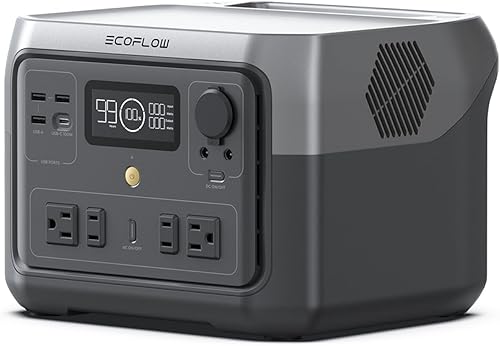
For a smaller capacity, the EcoFlow RIVER 2 Max 500 offers 499 Wh and is rated Excellent value for its size class. Its Amazon rating is 4.6 out of 5 from 1,400 ratings. Manufacturer details describe 300 W AC outlets, up to 1,000 W of power for certain loads, 1-hour AC charging, and a BMS that monitors voltage, current and temperature. Those figures need to be read in context: rated AC output is not interchangeable with a boosted or surge figure, so confirm the supported load and operating mode before relying on it.
The BLUETTI Elite 30 V2 is the smaller-capacity alternative here, with 288 Wh, 600 W AC output and nine outlets. It weighs 9.5 pounds, according to the manufacturer, and has a Premium price value rating for its size class. Its Amazon rating is 4.5 out of 5 from 1,200 ratings. The Anker SOLIX 521 has 256 Wh and 300 W rated AC output, with a 600 W peak; its size-class value rating is also Premium price, and it is rated 4.4 out of 5 from 3,100 ratings.
These are all LFP models, so they illustrate different capacity, output and value choices—not a direct LFP-versus-NMC contest. For phone charging and small electronics, capacity and ports may be the priority; for a CPAP, confirm required wattage and overnight runtime. Compare EcoFlow RIVER 2 Max 500, BLUETTI Elite 30 V2 and Anker SOLIX 521.
How to choose: match chemistry to your use
Start with the job, not the battery label. For frequent cycling—daily van use, regular solar replenishment or repeated outage practice—LFP’s cycle-life potential can make a strong case. For a station you need to carry often, an NMC model may be worth comparing if it delivers a lighter package at the capacity you need. Check the actual unit weight and dimensions: chemistry is only one contributor to portability.
Next, size the power station. Add up the watt-hours needed for the devices you expect to run, then check the station’s AC output against the highest simultaneous load and any startup surge. A 1,000 Wh unit is not automatically a fit for every 1,000 W appliance; runtime and output are different limits. For a CPAP night, include any humidifier or heated hose use and the intended hours. For refrigerators, allow for compressor cycling. Our CPAP and medical-device guide can help frame that decision.
Finally, compare cycle-life definitions, charging and operating temperature guidance, protection features, warranty terms, ports and qualitative value. Ratings can add perspective: a large number of buyer ratings gives you more feedback to scan, but averages do not establish chemistry performance. If solar charging is part of your plan, compare the station’s solar compatibility and input limits with the panel you intend to use. See our solar charging guide before pairing equipment.
Mistakes to avoid—and the bottom line
Don’t treat “lithium-ion” and NMC as synonyms without checking the chemistry. Lithium-ion is the umbrella category; NMC and LFP are specific chemistries within it. Don’t compare cycle counts unless the capacity-retention endpoint and conditions are clear. And don’t assume that a high cycle-life claim guarantees a certain number of years: calendar aging, temperature and use patterns matter too.
Another common mistake is buying by watt-hours alone. Capacity tells you stored energy, not whether the inverter can start a particular appliance. Nor does LFP guarantee a lighter, safer-to-ignore or cold-proof station. Check output, surge needs, temperature limits, protection details and weight for the exact model. When comparing customer ratings, look for recurring comments about the features that matter to you, while remembering that buyer feedback is not a controlled chemistry comparison.
For many buyers, LFP is the sensible default when long service life and thermal stability rank high, especially for frequent use or home backup. NMC can be the better fit when compactness and weight are top priorities and the specific model meets your runtime and output needs. There is no universal winner—only a better match for your load, carrying routine, climate and budget. Compare current models in our portable power station ranking, then check the current price on Amazon before deciding.
Every model mentioned, at a glance
| Value for its size | Availability | |||||||||
|---|---|---|---|---|---|---|---|---|---|---|
| BLUETTI AC180 Best overall | 8.2 | 1,152 | 1,800 | Yes | See listing | 500 | See listing | 4.51,900 ratings | Excellent value | Check price on Amazon |
| EcoFlow River 2 Max 500 | 7.9 | 499 | See listing | Yes | See listing | 220 | 13.2 | 4.61,400 ratings | Excellent value | Check price on Amazon |
| BLUETTI Elite 30 V2 Best budget | 5.8 | 288 | 600 | Yes | See listing | See listing | 9.5 | 4.51,200 ratings | Premium price | Check price on Amazon |
| Anker SOLIX 521 | 5.5 | 256 | 300 | Yes | See listing | See listing | See listing | 4.43,100 ratings | Premium price | Check price on Amazon |
| Jackery Explorer 1000 v2 | 5.9 | 1,024 | See listing | Yes | 4000 | See listing | 25 | 4.73,700 ratings | Premium price | Check price on Amazon |
Specifications as stated in the Amazon listing. Missing details: see listing. Scores use specifications and buyer ratings. How we rank.
Frequently asked questions
Is LiFePO4 the same as lithium-ion?
LiFePO4, also called LFP, is one chemistry within the wider lithium-ion battery family. NMC—nickel-manganese-cobalt—is another. Product descriptions sometimes use “lithium-ion” broadly, so look for the specific chemistry when comparing stations. The distinction can inform longevity, thermal behavior and energy density, but it does not replace checking a model’s capacity, output, weight and operating guidance.
Does LiFePO4 always last longer than NMC?
LFP is commonly selected for its longer cycle-life potential, but a cycle-life claim needs context. Check what remaining capacity defines the end of the stated life and what conditions apply. Charging habits, temperature and calendar aging also affect service life. A cycle number is a useful comparison point, not a guarantee that every battery will reach the same age or performance.
Which chemistry is safer in a portable power station?
LFP is generally more thermally stable than NMC, which can make it attractive when safety margins matter. Neither chemistry makes a station immune to damage or failure. The complete product’s design, battery management and protection systems matter, as do proper storage and operation. Follow the manufacturer’s temperature and charging instructions, and stop using equipment that appears damaged.
Is NMC better if I need a lighter power station?
NMC’s higher energy density can help a manufacturer create a lighter or more compact battery for a given capacity. That is a general tendency, not a promise about every finished power station. Enclosure, inverter and other components affect total weight. Compare the actual model’s weight, dimensions and watt-hours, then decide whether portability outweighs LFP’s potential longevity advantages.
Can I charge a LiFePO4 station in freezing weather?
Cold can affect lithium-battery performance, and charging a cold battery may be restricted. The safe operating and charging limits depend on the individual model and its controls. Check the manufacturer’s instructions for permitted temperatures before a winter trip; do not assume that LFP chemistry makes cold charging acceptable. If cold-weather charging is central to your plan, verify the exact limits before purchase.
How do I compare cycle-life claims on product pages?
Look for the number of cycles and the remaining-capacity threshold that defines the claim, then consider the conditions under which it applies. Compare charging guidance and warranty terms too. A large cycle number can be useful for frequent use, but it does not by itself predict calendar life or real-world runtime. Treat it as one part of a broader comparison.