Buying guide
Best Portable Power Stations for CPAP & Small Medical Devices
Quiet, clean backup power for CPAP nights, outages, travel and small medical equipment.
Quick picks


Best quiet compact option
Anker SOLIX
Anker SOLIX C300
- 288 Wh
- Output: see listing
Premium price
Amazon prices change constantly: tap the button for today's price.
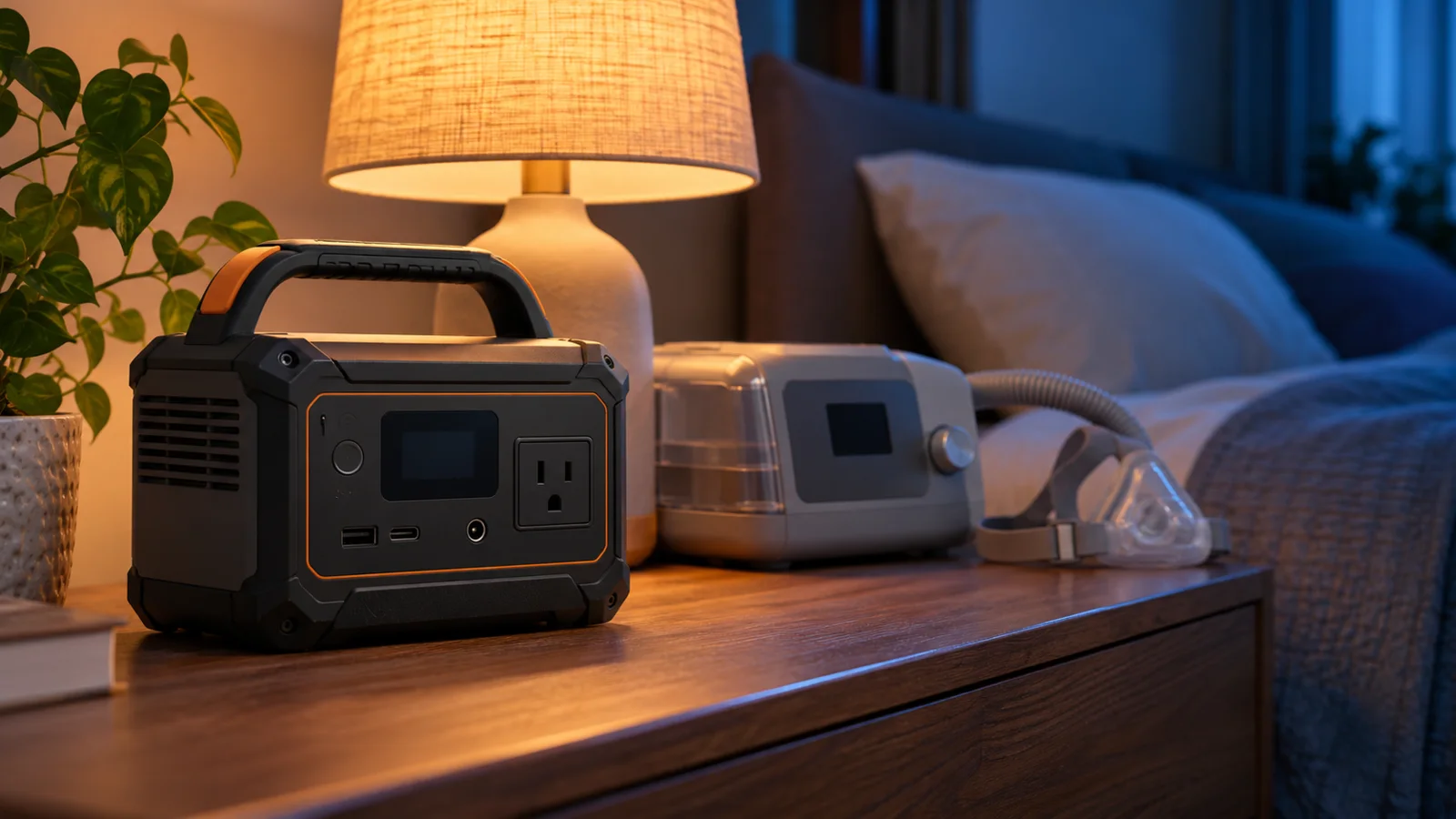
A power outage at 2 a.m. is inconvenient for most households. For someone using a CPAP machine, it can interrupt sleep and turn a routine blackout into a serious problem. The right portable power station gives you a quiet reserve for a bedside setup, a campsite, a hotel room or a hurricane-season emergency kit. The wrong one may run out sooner than expected once a heated humidifier enters the equation.
This guide ranks six suitable models by usable capacity, output, charging convenience, battery chemistry, pure sine wave availability where stated, UPS-like behavior where stated, buyer feedback and value for its size class. You will get overnight runtime estimates, a practical humidifier reality check, and a clear pick for CPAP, small medical devices, compact travel and extended backup.
We picked these models from manufacturer-listed specifications, the stated value label for each size class, and the volume and strength of Amazon buyer ratings. Runtime estimates use the standard calculation of watt-hours × 0.85 ÷ device watts. Confirm your equipment’s watt draw and the port layout on the Amazon page before ordering.
1. BLUETTI AC180: Best overall for CPAP and medical backup
The BLUETTI AC180 is the strongest all-around choice when overnight CPAP power is part of a broader emergency plan. Its 1,152 Wh LiFePO4 battery produces an estimated 979 Wh of usable energy after the 0.85 conversion factor. At a steady 30 W CPAP load, that works out to roughly 32.6 hours. At 60 W, it is about 16.3 hours. Those figures are mathematical estimates, not guarantees; pressure settings, heated tubing, humidity and inverter behavior can change the actual draw.
The unit has 1,800 W of rated AC output, two AC outlets and a 2,700 W peak figure. More important for a blackout bedside setup, BLUETTI states that its UPS provides emergency power in 20 ms. That makes it the clearest choice here for equipment that benefits from UPS-like switchover, although medical-device compatibility still belongs with your clinician and equipment manufacturer.
LiFePO4 chemistry, 0-to-80% charging in 45 minutes, up to 500 W solar input and a five-year warranty add useful emergency flexibility. The value label is Excellent value for its size class. Check the current price on Amazon. For broader outage planning, see our home-backup rankings.
2. Anker SOLIX C1000: Best for several nights and faster recovery
The Anker SOLIX C1000 is a superb fit for people who want CPAP backup plus room for phones, a router, lights or other small appliances. Its 1,056 Wh battery translates to approximately 898 Wh usable. At 30 W, the theoretical runtime is nearly 30 hours; at 60 W, it is close to 15 hours. That is enough capacity to make humidifier use less punishing than it would be on a compact station, though the humidifier can still multiply the load.
Anker lists LiFePO4 chemistry, more than 3,000 battery cycles and a 10-year lifespan. The unit has nine ports and SurgePad technology delivering up to 2,400 W for compatible appliances. AC recharging reaches 80% in 43 minutes and 100% in 58 minutes, while up to 600 W solar input is listed for off-grid replenishment. App control lets you adjust charging speed and view real-time information.
This is a particularly good blackout companion when the station must do more than power one breathing device. It does not have the stated 20 ms UPS claim of the BLUETTI AC180, so choose the AC180 if switchover is your priority. The C1000 earns Good value for its size class. Check the current price on Amazon and compare it with other sub-$1,000 options.
3. Jackery Explorer 1000 v2: Best polished large station
The Jackery Explorer 1000 v2 delivers 1,024 Wh, or approximately 870 Wh usable under the standard runtime calculation. That means about 29 hours at 30 W or 14.5 hours at 60 W. For one CPAP night, this is generous capacity. It also leaves useful reserve for a phone, tablet, communications gear or a small fan during a blackout.
Its 1,500 W AC output and 3,000 W surge peak are far beyond the needs of a typical CPAP machine. The listed port arrangement includes three pure sine wave AC ports, two USB-C ports, one USB-A port and a DC car port. Pure sine wave AC output is a sensible match for sensitive electronics, but always confirm compatibility with your particular medical device. A 30dB silent mode is listed for nighttime operation.
Jackery states that the LFP station can recharge in as little as one hour with emergency charging activated in the app, or use a 1.7-hour charging mode intended to optimize battery status. A five-year warranty is listed, along with a 4.7 Amazon rating from 3,700 ratings. The tradeoff is the Premium price value label. Check the current price on Amazon. For chemistry context, read our LiFePO4 versus lithium-ion guide.
4. Jackery Explorer 300: Best compact mainstream choice
The Jackery Explorer 300 is the compact pick for shoppers who want a straightforward reserve without moving into a 1,000 Wh-class station. Its 292 Wh capacity yields approximately 248 Wh usable. At 30 W, that equals about 8.3 hours. At 60 W, it is roughly 4.1 hours. In practice, that makes it much more convincing for a CPAP setup with humidification disabled, a lower-power configuration or a short overnight interruption than for several nights of full heated operation.
Its 4.6 Amazon rating from 11,300 ratings is the largest review volume among the candidates here, giving it a strong record of buyer interest. The capacity also suits a phone, tablet, small lamp or communications equipment during a short outage. Keep expectations realistic: CPAP power draw varies widely, and a heated humidifier can consume more energy than the blower.
The Explorer 300 carries a Fair value for its size class label. It qualifies for the under-$300 tier, but do not choose on capacity alone. Confirm that your CPAP’s AC adapter and any optional DC cable are compatible, and check the current price on Amazon. If low weight and compact storage matter most, compare small portable power stations before deciding.
5. Anker SOLIX C300: Best quiet compact option
The Anker SOLIX C300 is a capable bedside or travel station with 288 Wh and 300 W output, with a 600 W surge figure. Its estimated usable energy is 245 Wh. That produces roughly 8.2 hours at 30 W or 4.1 hours at 60 W. Like the Jackery Explorer 300, it is most attractive for lower-draw CPAP use, short outages and non-heated setups.
The C300 stands out for its stated 25dB noise level from 3.3 feet away. It includes two 140 W USB-C ports, one 15 W USB-C port, one USB-A port, two AC outlets and a 120 W car socket. The manufacturer lists 80% wall charging in 50 minutes, 100 W solar compatibility and LiFePO4 batteries designed for 3,000 cycles. A five-year warranty is also listed.
The compact design and port selection are useful when a bedside table, hotel nightstand or van shelf has limited space. Its weakness is the Premium price value label, especially against compact alternatives with similar capacity. It earns the quietest compact recommendation, not the best long-duration recommendation. Check the current price on Amazon and verify the port layout before ordering.
6. Anker SOLIX 521: Best compact LFP alternative
The Anker SOLIX 521 brings a 256 Wh LiFePO4 battery, 300 W rated AC output and a 600 W peak figure to the compact category. The standard calculation gives about 218 Wh usable. At 30 W, that is approximately 7.3 hours; at 60 W, around 3.6 hours. Those numbers position it as a short-outage or no-humidifier CPAP option rather than a robust multiday medical backup.
The listing highlights two AC outlets, a 60 W USB-C PD output and six-port charging, while the product title identifies optional solar-panel compatibility. Anker also states that the battery is rated for more than 3,000 charge cycles and includes smart temperature control. Its 4.4 Amazon rating from 3,100 ratings offers useful buyer confidence, although the rating is lower than the other Anker compact candidate here.
The SOLIX 521 carries a Premium price value label. Its LFP chemistry and 5-year full-device support are meaningful advantages, but capacity is the limiting factor for heated CPAP use. Select it when compact emergency charging and battery longevity matter more than overnight margin. Check the current price on Amazon, and see our under-$300 guide for additional compact comparisons.
How to choose a CPAP power station
Start with your actual CPAP wattage, not the station’s headline output. The runtime formula is capacity × 0.85 ÷ watts. For example, a 1,152 Wh station at 30 W works out to 32.6 hours, while the same station at 60 W lasts about 16.3 hours. A 256 Wh station at 30 W produces about 7.3 hours. These estimates include a conversion allowance, but they cannot account for every device’s power-management behavior.
Next, identify whether you can disable the heated humidifier and heated tubing. Blower-only operation usually gives a smaller load. Humidification can sharply reduce runtime, so a compact 256 Wh or 288 Wh station may no longer cover a full night at a higher draw. Ask your sleep clinician or equipment provider about safe settings, and never improvise with medical accessories.
Pure sine wave AC output is preferable for sensitive electronics. The Jackery Explorer 1000 v2 explicitly lists pure sine wave AC ports. The other models may still be compatible, but confirm the output waveform and your CPAP manufacturer’s guidance before purchase. For a station that must take over during an outage, the BLUETTI AC180 is the only candidate here with a stated 20 ms UPS response. Also consider recharge time, LiFePO4 chemistry, noise, available ports and whether you need solar replenishment. Our watt-hour sizing guide explains the math in more depth.
CPAP power mistakes to avoid
The biggest mistake is sizing from the machine’s maximum rating while assuming the same number describes every night. Your real draw depends on pressure, ramp behavior, humidification, heated tubing, mask leaks and the adapter. The second mistake is trusting a compact station’s capacity without applying the 0.85 usable-energy factor. A 256 Wh label does not mean 256 Wh reaches the appliance.
Do not assume every AC outlet provides the same waveform or that every station behaves like a medical UPS. Avoid plugging a life-critical device into a station without guidance from a clinician and the equipment manufacturer. A power station is backup equipment, not a substitute for an individualized medical continuity plan. Keep a clinician-approved alternative available where appropriate.
Do not store the station where moisture, extreme heat, blocked ventilation or loose cables create hazards. Charge it before storm season, learn its controls while the grid is available, and keep the CPAP adapter with the station. If solar charging matters, confirm connector compatibility and panel requirements rather than assuming any panel will work. For wider emergency preparation, use our hurricane and blackout checklist.
Final recommendation
For most shoppers, the BLUETTI AC180 is the clear overall choice. Its 1,152 Wh capacity gives meaningful overnight margin, its LiFePO4 battery supports repeated emergency use, its 1,800 W output handles far more than a CPAP, and its stated 20 ms UPS behavior is valuable during an outage. Its Excellent value label strengthens the recommendation.
Choose the Anker SOLIX C1000 when fast recharge, app control, solar input and several nights of reserve matter most. Choose the Jackery Explorer 1000 v2 for pure sine wave AC ports, quiet-mode operation and a polished large-capacity setup. For compact use, the Jackery Explorer 300 is the sensible mainstream option, while the Anker SOLIX C300 is the better quiet compact choice.
Whichever model you select, calculate from your actual CPAP draw and decide whether the humidifier must operate. Never rely on any power station for life-critical equipment without clinician advice. Confirm medical-device compatibility, keep a backup plan and check the current price on Amazon before ordering. See our complete portable power station ranking for broader household comparisons.
Every model mentioned, at a glance
| Value for its size | Availability | |||||||||
|---|---|---|---|---|---|---|---|---|---|---|
| BLUETTI AC180 Best overall | 8.2 | 1,152 | 1,800 | Yes | See listing | 500 | See listing | 4.51,900 ratings | Excellent value | Check price on Amazon |
| Anker SOLIX C1000 | 6.2 | 1,056 | See listing | Not stated | See listing | 600 | See listing | 4.72,100 ratings | Good value | Check price on Amazon |
| Jackery Explorer 300 | 5.2 | 292 | See listing | Not stated | See listing | See listing | See listing | 4.611,300 ratings | Fair value | Check price on Amazon |
| Anker SOLIX C300 Best lightweight | 4.5 | 288 | See listing | Not stated | 3000 | 100 | See listing | 4.61,900 ratings | Premium price | Check price on Amazon |
Specifications as stated in the Amazon listing. Missing details: see listing. Scores use specifications and buyer ratings. How we rank.
Frequently asked questions
How long will a 1,000Wh power station run a CPAP?
Using the standard calculation, a 1,000Wh station provides about 850Wh of usable energy. At a 30W draw, that equals roughly 28.3 hours. At 60W, it equals about 14.2 hours. Heated humidifiers and heated tubing can increase consumption substantially, so use your machine's actual watt draw when planning. Confirm settings and backup requirements with your clinician.
Can I use a CPAP humidifier with a portable power station?
Often, but runtime may fall sharply because heating uses more energy than the blower alone. A compact station that covers one night without humidification may run short with the heater enabled. Ask your sleep clinician or equipment provider about safe humidifier and tubing settings. Calculate both scenarios before an outage, and never treat a power station as guaranteed life support.
Does a CPAP need pure sine wave power?
Pure sine wave AC is the preferred choice for sensitive electronic equipment because it closely matches utility power. The Jackery Explorer 1000 v2 explicitly lists pure sine wave AC ports. Compatibility still depends on your CPAP model and adapter. Check the equipment manufacturer's guidance before connecting it, particularly if the device is medically essential or uses a specialized power supply.
Which power station has UPS-like switchover?
The BLUETTI AC180 is the clearest choice in this group because BLUETTI states that it provides emergency power in 20 ms. That is useful for equipment that benefits from rapid transfer during an outage. Do not assume every model has the same behavior. Confirm CPAP compatibility with the manufacturer and clinician before relying on any station as an automatic backup.
Is a 256Wh power station enough for one CPAP night?
It depends on the machine's real draw and whether heating is enabled. A 256Wh station provides approximately 218Wh after the standard 0.85 factor. That equals about 7.3 hours at 30W or 3.6 hours at 60W. Blower-only operation may fit a night for some users, while humidification can push runtime below that target. Calculate your own setup first.
What safety precautions matter most?
Never rely on a portable power station for life-critical equipment without clinician advice. Confirm electrical compatibility, keep ventilation clear, protect the station from moisture and extreme heat, and recharge it before storm season. Practice connecting the CPAP while utility power is available. Keep an approved backup plan, and follow the station and medical-device manufacturers' instructions for charging, cables and storage.