Jackery · Spec-based review
Jackery HomePower 2000 Plus v2: Serious Backup Power
A 2,048Wh LFP powerhouse for outages, appliances and extended off-grid weekends.
We may earn a commission from product links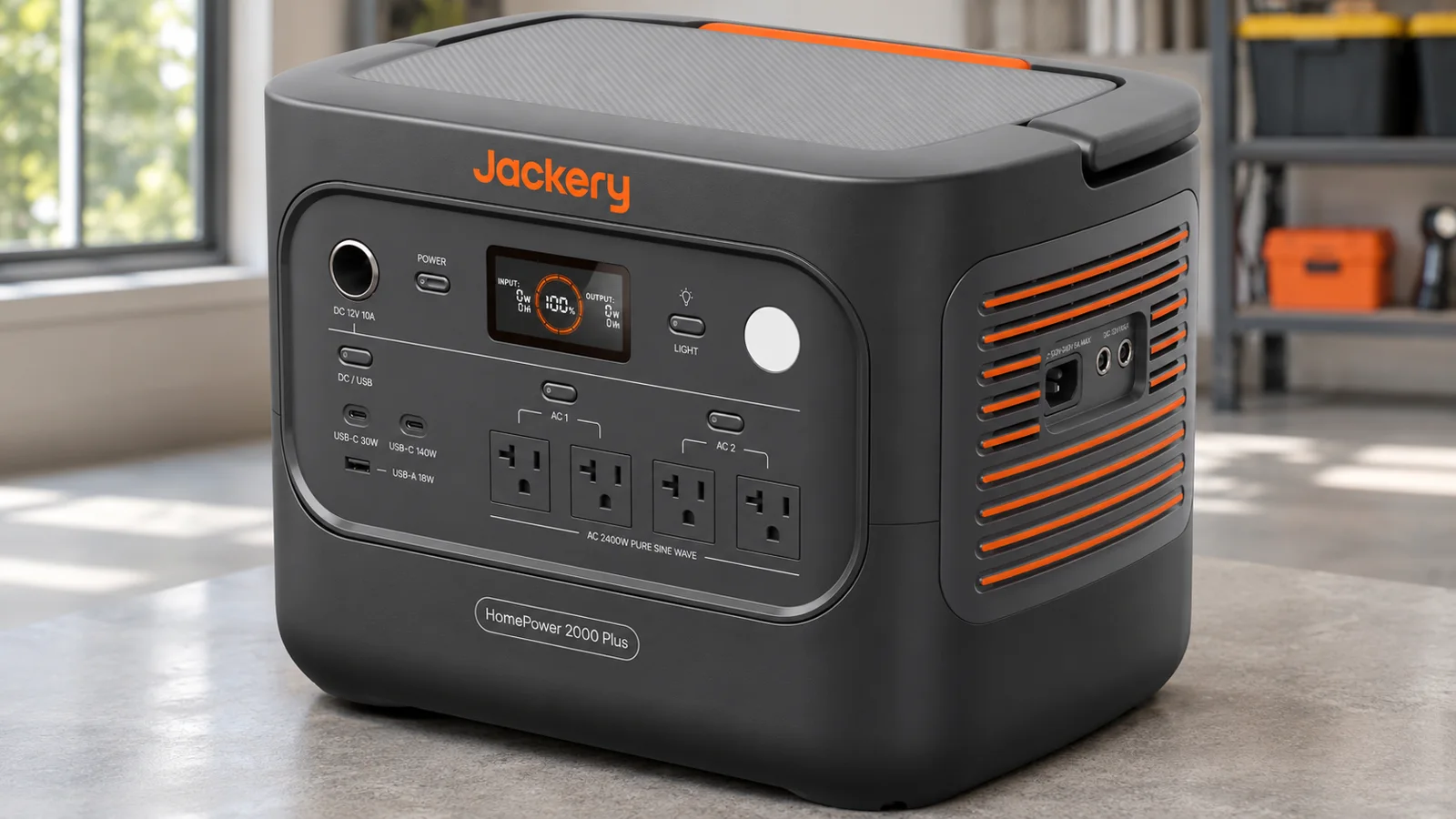

- Capacity
- 2,048 Wh
- Rated output
- 2,400 W
- Chemistry
- See listing
- Value for its size
- Fair value
- Amazon rating
- 4.7 / 5
- Buyer ratings
- 25
Specifications as stated in the Amazon listing. Check current details before buying.
How the score is calculated
This spec- and buyer-rating-based score is not a measure of independently measured performance. Value: Excellent 3, Good 2.2, Fair 1.4, Premium 0.6 points. Amazon rating: 4.0 earns 0, 5.0 earns 2.5, proportional in between. Rating volume: 1.5 × ln(1 + ratings) / ln(5,001), capped at 1.5. Output: 1.5 × rated W / Wh, capped at 1.5; unknown output earns 0.75. Stated LiFePO4: 1 point. Stated cycles, weight and solar input: 0.5/3 each, rounded together to three decimals. Missing value, rating, volume or listing details earn 0 for that criterion. The total is rounded to one decimal.
Read our full ranking methodologyThe short verdict
The Jackery HomePower 2000 Plus v2 is a strong fit for home backup and demanding camping or van-life loads, with 2,048Wh of capacity and 2,400W of AC output. Its Fair value rating and limited published port detail keep it from being an automatic best buy, but the expandable design, 6,000-cycle LFP claim and 140W USB-C output make it a capable long-term option.
Pros
- Large 2,048Wh capacity for overnight and multi-day backup
- 2,400W rated AC output handles substantial household appliances
- Expandable capacity up to 12kWh
- LFP battery chemistry with a claimed 6,000 cycles
- 140W USB-C output suits demanding laptops and mobile devices
Cons
- Fair value rather than a standout value in its size class
- A 2,048Wh battery is inherently a substantial piece of gear for short trips
- Amazon rating is based on 25 ratings, a relatively small sample
Best for
- Homeowners who need quiet backup for refrigerators, networking and essential devices
- Campers and van users running several appliances from one large battery
- Remote workers who need high-output USB-C charging and multi-day device power
Look elsewhere if
- Shoppers seeking the strongest value in the 2,000Wh class
- Buyers who need clearly specified solar-input or port-layout details before ordering
Full specifications
| Capacity | 2,048 Wh |
|---|---|
| Rated AC output | 2,400 W |
| LiFePO4 stated | See listing |
| Charge cycles | See listing |
| Weight | See listing |
| Solar input | See listing |
| Value for its size | Fair value |
Specifications as stated in the Amazon listing. Cycle-life conditions and solar compatibility vary; see the listing.
What can it power?
Choose your devices and daily run time. Battery capacity needed = watts × hours ÷ 0.85. Peak running watts assumes all selected devices run at once.
These are planning estimates, not measured runtimes. Appliance startup surges, fridge duty cycles, CPAP humidifiers and charging losses can change demand. Check your device label and the listing’s surge limit.
Runtime reference · 2,048 Wh at 85% usable energy
| Device | Running watts | Estimated hours |
|---|---|---|
| Phone | 15 W | 116.1 |
| Laptop | 60 W | 29.0 |
| Router | 40 W | 43.5 |
| CPAP | 45 W | 38.7 |
| Mini fridge | 50 W | 34.8 |
| Full fridge | 150 W | 11.6 |
| TV | 100 W | 17.4 |
| LED lights | 20 W | 87.0 |
| Coffee maker | 900 W | 1.9 |
| Microwave | 1000 W | 1.7 |
| Space heater | 750 W | 2.3 |
| E-bike charger | 500 W | 3.5 |
| Drill | 600 W | 2.9 |
Runtime estimates
Estimated usable energy is 85% of rated capacity. Actual runtime varies with load, temperature and battery age. See the device reference above for calculated estimates.
| Device | Estimated runtime |
|---|---|
| Phone charge (15 W) | 116 h |
| Laptop (60 W) | 29 h |
| LED lights + Wi-Fi router (40 W) | 44 h |
| CPAP, heated humidifier (45 W avg) | 39 h |
| Mini fridge/cooler (50 W avg) | 35 h |
| Full-size fridge (150 W avg) | 12 h |
| 55-inch TV (100 W) | 17 h |
| Drip coffee maker (900 W) | 1.9 h |
| Microwave (1,000 W) | 1.7 h |
| Space heater, low (750 W) | 2.3 h |
A blackout hits during dinner. The refrigerator needs to keep running, the Wi-Fi router needs to stay alive, and a phone or laptop still has to charge. The Jackery HomePower 2000 Plus v2 is built for that middle ground between a small emergency battery and a fuel generator: enough stored energy for essential circuits and enough output for serious household appliances.
This power station combines a 2,048 Wh battery with 2,400 W of rated AC output. It also offers expansion up to 12kWh, LFP battery chemistry and a 140 W USB-C output. The result is a substantial backup platform for outages, job sites, campsites and van builds, though its Fair value rating means you should check the current price on Amazon before choosing it over similarly sized rivals.
Who the Jackery HomePower 2000 Plus v2 is really for
This model makes sense when your power needs are too demanding for a compact station but do not justify jumping straight to a much larger system. During an outage, 2,048 Wh can cover the essentials: a refrigerator, router, lights, phones and selected kitchen use. It is also a practical scale for a campsite or van where a cooler, laptop, lighting and communications equipment may all run from the same battery.
The 2,400 W AC rating broadens the useful load range. You can think beyond electronics and include appliances such as a microwave, drip coffee maker or low heat space heater, while remembering that high-wattage heating appliances consume stored energy quickly. The expandable capacity up to 12kWh is particularly relevant for homeowners planning longer outages or a more permanent backup setup. Buyers who only need occasional phone charging will be paying for far more battery than necessary. For smaller, lighter needs, compare options in our small and lightweight power station guide.
Capacity, output and what it can run
Capacity is the HomePower 2000 Plus v2’s central strength. Its 2,048 Wh battery, multiplied by the standard 85% usable-efficiency assumption, provides a useful planning base of about 1,741 Wh for connected devices. Actual runtime varies with cycling compressors, heat, standby draw and appliance behavior, but the figures below show the scale clearly.
| Load | Estimated runtime |
|---|---|
| LED lights plus Wi-Fi router | 44 hours |
| CPAP with heated humidifier | 39 hours |
| Mini fridge or cooler | 35 hours |
| Full-size refrigerator | 12 hours |
| 55-inch TV | 17 hours |
| Microwave | 1.7 hours |
| Low space heater | 2.3 hours |
Low-draw devices stretch the battery dramatically: the computed figures are 116 hours for phone charging and 29 hours for a laptop. High-draw appliances work, but they drain the pack rapidly.
Features, battery chemistry and practical connectivity
The LFP battery is a meaningful choice for long-term ownership. Jackery states more than 6,000 LFP battery cycles, which supports a design intended for repeated backup use rather than occasional emergency storage. That does not make the battery unlimited, but it is a reassuring durability claim for households that expect regular cycling or frequent off-grid trips.
The standout connection detail is the 140 W USB-C output with AVS protocol support. That is useful for fast charging a phone, tablet or demanding laptop without relying on an AC adapter and the station’s inverter. It also suits an Apple-heavy kit, including an iPhone, MacBook and iPad. Intelligent power management and priority routing are designed to keep essential circuits running according to selected priorities during shortages, a useful concept when several loads compete for limited stored energy.
The capacity and output tell you this is a serious appliance-running platform, not just a USB battery. Confirm the port layout on the Amazon page before ordering so it matches your preferred mix of AC and device connections.
Charging, solar and long-term ownership
The HomePower 2000 Plus v2 is best viewed as a large stored-energy reserve. At 2,048 Wh, charging speed matters: a slower input can mean a long recovery window after an outage, while a faster input makes the station easier to cycle between uses. The available information establishes the battery capacity and expansion path, but not a complete charging-time or solar-input specification, so confirm those details on the Amazon page if renewable recharging is central to your plan.
Solar can be valuable for hurricane preparation, remote camps and extended blackouts, but panel performance depends on array wattage, sunlight, controller limits and conversion losses. Do not size panels from the battery capacity alone. A 2,048 Wh battery also rewards sensible load management: refrigeration and communications are priorities, while heaters and cooking appliances should be used briefly.
For ownership, the combination of LFP chemistry, a claimed 6,000 cycles and expansion to 12kWh points toward a platform that can grow with a home’s backup needs. Keep the station within its rated output and reserve stored energy for the equipment that matters most.
How it stacks up against the alternatives
The closest comparisons share the same 2,048 Wh capacity, making value and output the key distinctions. The DJI Power 2000 is rated Excellent value, while the Anker SOLIX C2000 Gen 2 is rated Fair value. The EcoFlow DELTA 3 Max earns Good value, and both the DABBSSON 2000L and Growatt Infinity 2000 Pro earn Excellent value.
Against that group, the Jackery’s 2,400 W AC output is an important advantage when your appliances push beyond ordinary electronics. Its 140 W USB-C output is also useful for modern laptops and tablets. The trade-off is value: this model is rated Fair rather than Good or Excellent, so capacity alone does not make it the strongest deal. Its expansion to 12kWh gives it a different appeal for home backup, especially if you expect your system to grow.
For broader buying context, see our 2,000 W-plus power station rankings, then check the current price on Amazon before deciding.
Frequently asked questions
How long can the Jackery HomePower 2000 Plus v2 run a refrigerator?
The computed runtime is about 12 hours for a full-size refrigerator and 35 hours for a mini fridge or cooler. Compressor cycling, ambient temperature and other connected loads affect real runtime. If the refrigerator shares power with lights, a router or chargers, the available time will be shorter.
Can it run a microwave or space heater?
Yes, its rated AC output is 2,400W, giving it the output class needed for many high-demand appliances. The computed runtime is about 1.7 hours for a microwave and 2.3 hours for a low space heater. These figures show energy use, not a recommendation to run either appliance continuously.
Is the Jackery HomePower 2000 Plus v2 expandable?
Yes. The system can be extended from its 2,048Wh base capacity to as much as 12kWh. That makes it more suitable for longer outages or a growing home-backup setup than a fixed-capacity station. Confirm the compatible expansion hardware and configuration on the Amazon page before ordering.
How long will it power a CPAP machine?
The computed runtime for a CPAP with a heated humidifier is about 39 hours. Actual runtime depends on pressure settings, humidifier temperature, mask leak and inverter behavior. Turning off the humidifier generally reduces energy demand, but keep the station's own display and connected accessories in mind.
Does it have a long-lasting battery?
Jackery states that the LFP battery supports more than 6,000 cycles. LFP chemistry is commonly selected for durability and repeated cycling. Battery life still depends on storage conditions, charging habits, temperature and operating load. Use the manufacturer's care guidance to protect long-term capacity.
Consider these alternatives

- 2,048 Wh
- Output: see listing
- LiFePO4
Excellent value


