Head to head
EcoFlow vs Jackery: Which Power Station Brand Is Better?
Two major brands. Five useful size tiers. One clear buying decision.
The short answer
EcoFlow is the stronger all-around choice if you want broader output options, more expansion features and excellent value in the mid-size tiers. Jackery makes the better case for straightforward portable backup, with especially strong buyer volume and compelling 2,000Wh-to-3,000Wh options. For most shoppers, choose EcoFlow for flexibility and Jackery for simpler, high-capacity home and outdoor backup.
EcoFlow and Jackery both cover the core power-station market, from compact camping batteries to serious blackout backup. Their lineups overlap most clearly around 1,000 Wh, then diverge: EcoFlow offers a 3,600 Wh DELTA Pro, while Jackery answers with 2,042 Wh, 3,072 Wh and 3,584 Wh models. That gives each brand a credible path from a CPAP night or campsite weekend to refrigerator, router and lighting support during an outage.
This comparison uses the listed capacities, AC outputs, manufacturer-stated features and Amazon ratings. Runtime estimates use the practical formula of capacity × 0.85 ÷ device watts. Check the current price on Amazon before buying; value labels can change as listings change. For broader shopping context, see our Best Portable Power Stations ranking.
EcoFlow vs Jackery at a glance
EcoFlow has the more varied lineup for shoppers who care about fast charging, app control, expansion and high output. Its listed models range from the 499 Wh River 2 Max 500 to the 3,600 Wh DELTA Pro. Jackery starts smaller with the 292 Wh Explorer 300, then moves through 1,024 Wh, 2,042 Wh and two roughly 3,000 Wh options. Both brands offer five listed models here, but they target slightly different buyers.
Battery chemistry is clearest on the newer models. EcoFlow explicitly lists LFP on the River 2 Max 500, RIVER 2 Pro, Delta 3 and DELTA Pro. Jackery explicitly lists LiFePO4 on the Explorer 1000 v2, Explorer 2000 v2 and HomePower models. That chemistry is generally valued for long service life, but do not assume every model shares the same cells unless the listing says so.
Ratings volume favors Jackery: the listed products total about 16,153 Amazon ratings, versus about 6,481 for EcoFlow. Ratings are not a substitute for matching capacity and output to your appliances, but that gap gives Jackery a larger pool of buyer feedback.
Comparable sizes: the numbers that matter
The closest small-to-mid-size matchup is EcoFlow’s River 2 Max 500 against Jackery’s Explorer 300, though the EcoFlow carries substantially more capacity. At roughly 1,000 Wh, EcoFlow offers two 1,024 Wh Delta 3 models with 1,800 W AC output; Jackery’s Explorer 1000 v2 has the same capacity and a 1,500 W output. At the larger end, Jackery offers more capacity in the 2,000 Wh-to-3,600 Wh range, while EcoFlow offers a higher-output 3,600 Wh flagship.
| Model | Capacity | AC output | Amazon rating |
|---|---|---|---|
| River 2 Max 500 | 499 Wh | Not listed | 4.6/5, 1,400 |
| Explorer 300 | 292 Wh | Not listed | 4.6/5, 11,300 |
| Delta 3 | 1,024 Wh | 1,800 W | 4.7/5, 1,300 |
| Explorer 1000 v2 | 1,024 Wh | 1,500 W | 4.7/5, 3,700 |
Small and 500Wh class: EcoFlow has the advantage
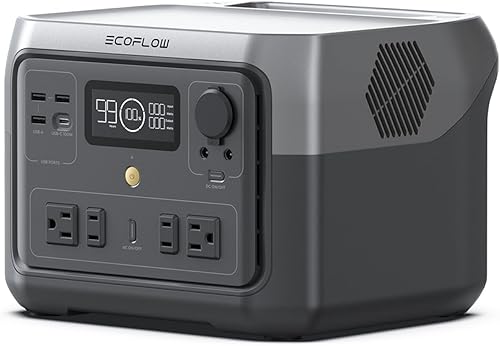
For a compact camping setup, EcoFlow’s River 2 Max 500 is the more capable listed choice. Its 499 Wh battery provides an estimated 424 Wh of usable energy after the typical 0.85 conversion factor. That works out to about 42 hours at 10 W, 8.5 hours at 50 W or 4.2 hours at 100 W. Those figures suit phones, lights, cameras, a small fan or a modest CPAP setup; actual CPAP runtime depends heavily on humidification and pressure settings.
Jackery’s Explorer 300 is much smaller at 292 Wh, or about 248 Wh by the same calculation. Expect approximately 25 hours at 10 W, 5 hours at 50 W or 2.5 hours at 100 W. That is enough for a short emergency window or lightweight campsite electronics, but it leaves less margin for a long blackout.
EcoFlow also labels the River 2 Max 500 as Excellent value for its size class, while the Explorer 300 is labeled Fair value. Jackery’s enormous 11,300-rating volume is meaningful for confidence and research, but EcoFlow wins this capacity-and-value matchup.
The 1,000Wh tier: output versus simplicity
This is the most important head-to-head tier for many buyers. EcoFlow’s Delta 3 Classic and Delta 3 each provide 1,024 Wh and 1,800 W AC output. The Delta 3 adds a 56-minute full charge claim, LFP cells, 4,000 cycles at 80% and expansion up to 5kWh with compatible Delta-series batteries. Its listed value is Premium price; the Classic is labeled Excellent value.
Jackery’s Explorer 1000 v2 matches the 1,024 Wh capacity but lists 1,500 W AC output. It includes a 100 W USB-C port, six charging ports, app control, a 30dB silent mode and a one-hour charging claim when its emergency charging function is activated in the app. Its value label is Premium price.
Runtime is similar because capacity is identical: about 870 Wh usable, or 8.7 hours at 100 W and 2.9 hours at 300 W. EcoFlow is the better fit for higher-wattage tools and expansion. Jackery is appealing if its simpler port layout and quiet-mode emphasis fit your routine.
Large backup: Jackery offers more capacity choices
Jackery has the broader selection above 2,000 Wh. The Explorer 2000 v2 stores 2,042 Wh and delivers 2,200 W, while the HomePower 3000 holds 3,072 Wh with 3,600 W output. The HomePower 3600 Plus reaches 3,584 Wh and also lists 3,600 W output. The Explorer 2000 v2 is labeled Fair value, HomePower 3000 Good value and HomePower 3600 Plus Premium price.
That capacity matters during an outage. The Explorer 2000 v2 provides roughly 1,736 Wh usable, enough for about 17.4 hours at 100 W, 8.7 hours at 200 W or 3.5 hours at 500 W. HomePower 3000 provides about 2,611 Wh usable: approximately 26 hours at 100 W or 5.2 hours at 500 W. These are energy estimates, not guarantees; refrigerators cycle rather than drawing their rated power continuously.
Jackery also lists UPS switching of 20ms or less on the Explorer 2000 v2 and HomePower 3000, useful for selected networking, security and medical equipment. Verify your device’s UPS requirements before relying on any power station for critical loads.
Flagship comparison and final buying advice
EcoFlow’s DELTA Pro is the most output-focused option here: 3,600 Wh capacity and 3,600 W AC output, expandable to 4,500 W with X-Boost and pairable for 7,200 W. It also lists app control, five charging methods and expansion with extra DELTA Pro batteries or smart generators. Its value label is Fair value. At 3,600 Wh, the estimated usable energy is about 3,060 Wh—roughly 30.6 hours at 100 W, 15.3 hours at 200 W or 6.1 hours at 500 W.
Jackery’s HomePower 3000 is labeled Good value and supplies 3,072 Wh with 3,600 W output, plus a built-in TT-30 RV port, dual 100 W PD ports and UPS switching of 20ms or less. Its listed capacity is lower than DELTA Pro, but its feature mix is attractive for RVs, home essentials and job-site electronics. HomePower 3600 Plus is the closest capacity match, though it is labeled Premium price and has fewer listed feature details here.
Choose EcoFlow for lineup flexibility, high output and expansion. Choose Jackery for larger capacity choices, strong rating volume and straightforward home-backup features. In either case, check current price, port details and voltage compatibility on Amazon before checkout.
Every model mentioned, at a glance
| Value for its size | Availability | |||||||||
|---|---|---|---|---|---|---|---|---|---|---|
| Jackery Explorer 300 | 5.2 | 292 | See listing | Not stated | See listing | See listing | See listing | 4.611,300 ratings | Fair value | Check price on Amazon |
| Jackery Explorer 1000 v2 | 5.9 | 1,024 | See listing | Yes | 4000 | See listing | 25 | 4.73,700 ratings | Premium price | Check price on Amazon |
| EcoFlow RIVER 2 Pro | 5.0 | 768 | 800 | Not stated | See listing | 220 | 17.2 | 4.51,800 ratings | Premium price | Check price on Amazon |
| EcoFlow River 2 Max 500 | 7.9 | 499 | See listing | Yes | See listing | 220 | 13.2 | 4.61,400 ratings | Excellent value | Check price on Amazon |
| EcoFlow Delta 3 Classic | 7.5 | 1,024 | 1,800 | Not stated | See listing | See listing | See listing | 4.71,300 ratings | Excellent value | Check price on Amazon |
| EcoFlow Delta 3 Best for RV | 5.4 | 1,024 | 1,800 | Not stated | 4000 | 500 | See listing | 4.71,300 ratings | Premium price | Check price on Amazon |
Specifications as stated in the Amazon listing. Missing details: see listing. Scores use specifications and buyer ratings. How we rank.
Frequently asked questions
Is EcoFlow better than Jackery?
EcoFlow is better for output flexibility, expansion and mid-size value. Jackery is better for shoppers who prioritize high-capacity choices, simple backup features and a larger volume of Amazon ratings.
Which brand has better battery chemistry?
Both brands list LFP or LiFePO4 chemistry on several models. EcoFlow explicitly states it on the River 2 Max 500, RIVER 2 Pro, Delta 3 and DELTA Pro; Jackery states it on the Explorer 1000 v2, Explorer 2000 v2 and HomePower models.
Which is better for a blackout?
For longer outages, choose a larger model such as EcoFlow DELTA Pro or Jackery HomePower 3000. Jackery’s Explorer 2000 v2 and HomePower 3000 list UPS switching of 20ms or less. Confirm compatibility with your specific refrigerator, medical device or networking equipment.
Which brand is better for camping or van life?
EcoFlow’s River 2 Max 500 is the stronger small-size value choice, while Jackery’s Explorer 2000 v2 offers more capacity for extended trips. Size your station from the actual watt draw and hours required, then check the current price on Amazon.