Buying guide
Best Solar Generators: Power Stations That Pair Best With Solar Panels
A solar generator is only as useful as its panel input. Here are the power stations that make the most of the sun.
Quick picks


Best for large appliances
BLUETTI
BLUETTI Elite 100 V2
- 1,024 Wh
- 1,800 W
Good value

Best compact solar setup
Anker SOLIX
Anker SOLIX C300
- 288 Wh
- Output: see listing
Premium price

Amazon prices change constantly: tap the button for today's price.
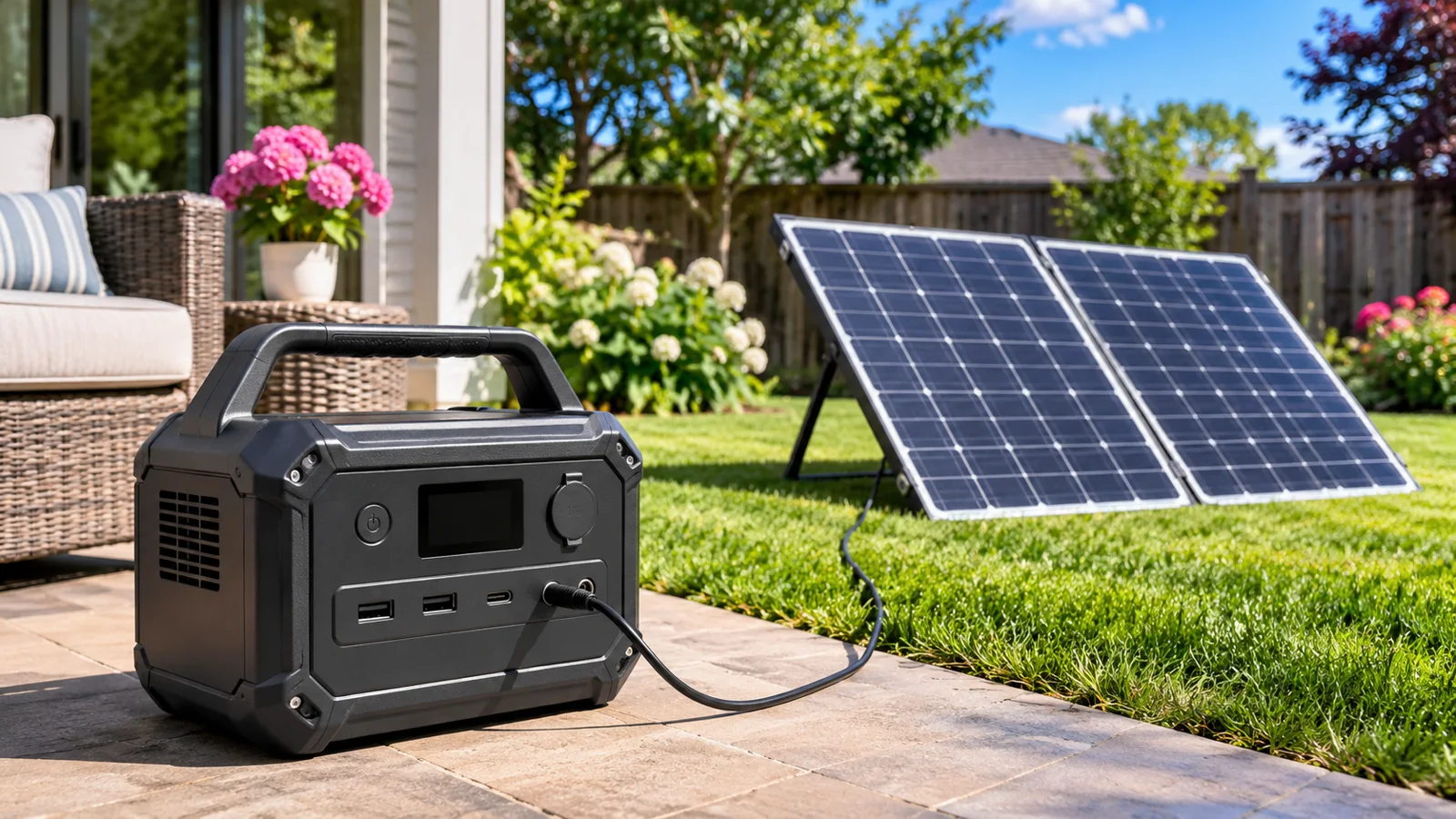
A solar generator is a two-part system: a battery power station and one or more solar panels. The battery stores energy for the refrigerator at night, the CPAP after sunset or the laptop when clouds roll in. The panels put that energy back. The strongest pairings balance solar input, battery size, charging speed and the jobs you actually need to power.
This ranking separates genuinely solar-ready options from portable batteries that merely happen to accept solar charging. You will find clear picks for camping, emergency backup, small electronics, high-output appliances and budget trips. I also translate watt-hours into practical runtimes, so a capacity number becomes a useful expectation rather than a marketing headline.
The ranking uses manufacturer-listed specifications, the stated value for each size class and the volume and strength of Amazon buyer ratings. Runtime estimates use a practical 85% usable-energy assumption: watt-hours multiplied by 0.85, divided by device watts. Solar production varies with panel size, weather, shade, season and location. No product claims here depend on physical product testing.
1. BLUETTI AC180: Best Overall Solar Generator
The BLUETTI AC180 is the clearest all-around solar generator here because its important solar numbers are unusually well matched. You get a 1,152 Wh LiFePO4 battery, 1,800 W rated AC output and a built-in MPPT charge controller accepting up to 500 W from solar panels. BLUETTI gives a 2.8-to-3.3-hour full solar-charge estimate under suitable conditions. That is a serious renewable-input ceiling for a station that can still move between a campsite, a workshop and a blackout shelter.
At 1,800 W, it has the output headroom for many kitchen appliances and job-site tools, while the 2,700 W boost mode helps with some higher-demand loads. A 1,152 Wh battery provides about 979 Wh after the practical 85% conversion assumption: roughly 9.8 hours at 100 W, 4.9 hours at 200 W or 1.6 hours at 600 W. Actual appliance cycling can extend those figures.
The AC180 earns an Excellent value label for its size class and carries a 4.5 Amazon rating from 1,900 ratings. Its UPS response is listed at 20 milliseconds, useful for keeping selected home-office essentials from dropping during an outage. For solar-first emergency backup, camping with appliances or a portable work setup, this is the most balanced choice. See our overall power station ranking for alternatives outside the solar category.
2. Anker SOLIX C1000: Best Solar Value
The Anker SOLIX C1000 is the value leader for buyers who want a substantial battery without moving into a larger, more cumbersome system. Its 1,056 Wh capacity is close to the 1kWh sweet spot, and the manufacturer specifies up to 600 W of fast solar input. A full solar recharge is listed at 1.8 hours under the right conditions. That input ceiling matters: a large battery is far more useful away from the grid when the panels can replenish it during a meaningful stretch of daylight.
Its 2,400 W SurgePad output is designed to handle a broad range of appliances, and nine ports make it practical for a family charging station or a van workspace. The battery is rated for more than 3,000 cycles, with a stated 10-year lifespan. The app can display real-time information and adjust charging speed, which helps when you want to prioritize solar harvest, quiet operation or battery preservation.
Use the C1000 for a refrigerator, lights, routers, laptops and small kitchen loads during a blackout. With roughly 898 Wh of practical AC energy, it can support a 100 W load for about 9 hours or a 500 W load for about 1.8 hours, before accounting for cycling behavior. It earns Good value for its size class and a 4.7 Amazon rating from 2,100 ratings. Check solar charging guidance before selecting panels.
3. BLUETTI Elite 100 V2: Best for High-Output Solar Backup
The BLUETTI Elite 100 V2 is aimed at buyers who care about both serious AC output and rapid solar replenishment. Its 1,024 Wh LiFePO4 battery feeds 1,800 W of rated output, with 2,700 W lifting power and 11 ports. More importantly for a solar-generator setup, its listed solar charging figure reaches 1,000 W. The stated 70-minute full-charge figure applies when using that 1,000 W solar charging capability in favorable conditions, not a small folding panel.
That distinction makes this a strong match for a fixed campsite array, an off-grid cabin or a prepared blackout kit with multiple panels. A single 100 W panel will not exploit its maximum input, while a properly sized array can put meaningful energy back into the battery during the usable sun window. Its 25-pound weight and 17-liter size also make the 1kWh class easier to move than many larger backup systems.
The battery provides about 870 Wh under the 85% usable-energy rule. That works out to roughly 8.7 hours at 100 W, 4.3 hours at 200 W or 1.7 hours at 500 W. It also lists instant outage switching, 30dB operation and a solar cable in the box. The model earns Good value and a 4.5 Amazon rating from 1,800 ratings. It is the pick when panel capacity and high-output appliances matter more than the smallest possible footprint.
4. EcoFlow RIVER 2 Pro: Best Mid-Size Solar Generator
The EcoFlow RIVER 2 Pro occupies a useful middle ground: more reserve than a compact 300 Wh station, less battery to carry than a 1kWh model. Its 768 Wh LFP battery, 800 W AC output and listed 220 W solar input suit weekend camping, remote work and moderate outage loads. EcoFlow states a solar recharge time as fast as 4.5 hours. That is a sensible pairing for a portable panel rather than a large permanent array.
The battery gives about 653 Wh of practical energy through AC conversion. Expect approximately 6.5 hours at 100 W, 3.3 hours at 200 W or 1.1 hours at 600 W. The 800 W output is enough for many electronics and smaller appliances, while the listed 1,600 W appliance capability can help with selected loads through the station’s power-management system. Match the actual appliance startup and continuous wattage carefully.
This is also one of the more transport-friendly choices in the roundup at 17.2 pounds, with a built-in handle. EcoFlow lists more than 3,000 cycles before the battery reaches 80% of its original capacity, plus a five-year warranty. The tradeoff is value: it carries a Premium price label for its size class. It remains an appealing solar choice for people who will carry the station frequently and want LFP chemistry, fast wall charging and a manageable 220 W panel pairing.
5. Anker SOLIX C300: Best Compact Solar Generator
The Anker SOLIX C300 is the most clearly defined small solar setup in this group. Its 288 Wh LFP battery supplies 300 W continuously, with 600 W surge capability. Anker specifically pairs it with a 100 W solar panel and identifies compatible panel equipment, making the panel-to-station match easier to plan than a vague “solar-ready” claim. The station also accepts 140 W two-way USB-C charging and offers seven device-charging ports.
With about 245 Wh of practical energy, it can run a 20 W communications or lighting load for roughly 12 hours, a 50 W load for about 4.9 hours or a 100 W load for about 2.4 hours. Those are useful numbers for phones, cameras, laptops, CPAP accessories and campsite lighting, but not for sustained high-wattage heating or cooling. The 120 W car socket and multiple USB-C outputs make it especially convenient for electronics-heavy travel.
Its 25dB operating level, 3,000-cycle LFP rating and five-year warranty strengthen the camping case. The compromise is value: Premium price for its size class. Choose it when compactness, quiet charging and a straightforward 100 W solar pairing matter more than maximum AC output. For a cheaper small station, compare the Anker SOLIX 521 and Jackery Explorer 300.
6. The Remaining Solar Options: Small Budgets and Familiar Names
The Anker SOLIX 521 is a strong under-$300-tier option. It has a 256 Wh LiFePO4 battery, 300 W rated AC output and 600 W peak output. Its product name identifies it as a solar generator, and the battery is rated for more than 3,000 cycles. That gives about 218 Wh of practical energy: around 2.2 hours at 100 W or 4.4 hours at 50 W. It earns Premium price for its size class, but its 4.4 Amazon rating from 3,100 ratings and five-year full-device support add confidence.
The Jackery Explorer 300 carries 292 Wh and a 4.6 Amazon rating from 11,300 ratings. It qualifies for the under-$300 tier and earns Fair value for its size class. Its practical reserve is about 248 Wh, enough for roughly 2.5 hours at 100 W. Choose it for simple portable power, but confirm the solar-panel and input arrangement on Amazon before ordering.
The Jackery Explorer 1000 v2 steps up to 1,024 Wh, 1,500 W AC output and 3,000 W surge peak, with a LiFePO4 battery, 100 W USB-C and a five-year warranty. Its app lists one-hour super charging and a 30dB silent mode. It earns Premium price and a 4.7 Amazon rating from 3,700 ratings. Confirm the solar input specification before building a panel array.
7. How to Choose a Solar Generator: Input, MPPT and Battery Size
Start with the load, then size the battery and solar array. Add the watt-hours your devices need overnight or between charging windows. A 100 W device running for five hours needs 500 Wh before conversion losses. Using the practical 85% rule, a 1,000 Wh station provides about 850 Wh for AC loads. Refrigerators and other compressor appliances cycle, so their average draw can be much lower than their startup wattage.
Next, inspect solar input. The panel’s wattage is only half the story; the power station’s maximum solar input determines how quickly it can accept energy. A 1,000 W-capable station can benefit from a large array, while a 100 W-capable compact station has no reason to carry an oversized panel system. MPPT, or maximum power point tracking, helps the station draw useful energy as panel voltage and current change with sunlight and temperature. The AC180 explicitly lists a built-in MPPT controller.
Plan around usable sun rather than the entire daylight period. A panel rated at 200 W will not continuously deliver 200 W through morning haze, heat, clouds and changing angles. Shade on one panel can damage an otherwise good charging window. For panel wiring, stay within the station’s listed voltage and current limits. Solar-input numbers are more important than a vague “solar compatible” label. Our buying guide and watt-hour sizing guide cover the planning details.
8. Common Mistakes and Final Recommendation
The most common mistake is buying a large battery and a tiny panel, then expecting the sun to refill it quickly. A 1kWh station paired with a 100 W panel may need a long, bright charging window. The opposite mistake is choosing panels whose voltage or current exceeds the station’s limits. Verify the electrical range, connector and panel compatibility before ordering. Do not confuse AC output with solar input: 1,800 W of appliance power does not mean the unit accepts 1,800 W of solar.
Do not size only for average watts. Refrigerators, pumps, heaters and power tools can have startup surges. Do not assume an LFP battery removes every limitation; chemistry improves longevity and stability, but heat, charging conditions and proper storage still matter. Finally, remember that solar panels cannot provide dependable overnight power without stored battery capacity.
For most buyers, the BLUETTI AC180 is the best solar generator here because its 1,152 Wh battery, 1,800 W output, MPPT controller and 500 W solar ceiling form a coherent system, and its value rating is Excellent. Choose the Anker SOLIX C1000 for Good value and faster 600 W solar replenishment, or the Elite 100 V2 when a 1,000 W solar array and high output are priorities. For compact travel, choose the C300. Check the current price on Amazon, then match the panel and station as one system.
Every model mentioned, at a glance
| Value for its size | Availability | |||||||||
|---|---|---|---|---|---|---|---|---|---|---|
| BLUETTI AC180 Best overall | 8.2 | 1,152 | 1,800 | Yes | See listing | 500 | See listing | 4.51,900 ratings | Excellent value | Check price on Amazon |
| Anker SOLIX C1000 | 6.2 | 1,056 | See listing | Not stated | See listing | 600 | See listing | 4.72,100 ratings | Good value | Check price on Amazon |
| BLUETTI Elite 100 V2 Best for camping | 6.6 | 1,024 | 1,800 | Not stated | See listing | 1000 | 25 | 4.51,800 ratings | Good value | Check price on Amazon |
| Anker SOLIX C300 Best lightweight | 4.5 | 288 | See listing | Not stated | 3000 | 100 | See listing | 4.61,900 ratings | Premium price | Check price on Amazon |
| Anker SOLIX 521 | 5.5 | 256 | 300 | Yes | See listing | See listing | See listing | 4.43,100 ratings | Premium price | Check price on Amazon |
| EcoFlow RIVER 2 Pro | 5.0 | 768 | 800 | Not stated | See listing | 220 | 17.2 | 4.51,800 ratings | Premium price | Check price on Amazon |
| Jackery Explorer 300 | 5.2 | 292 | See listing | Not stated | See listing | See listing | See listing | 4.611,300 ratings | Fair value | Check price on Amazon |
| Jackery Explorer 1000 v2 | 5.9 | 1,024 | See listing | Yes | 4000 | See listing | 25 | 4.73,700 ratings | Premium price | Check price on Amazon |
Specifications as stated in the Amazon listing. Missing details: see listing. Scores use specifications and buyer ratings. How we rank.
Frequently asked questions
What makes a power station a solar generator?
A solar generator is a power station used with solar panels. The battery stores energy and the solar input replenishes it. Look for a stated solar-input limit, compatible connector and voltage range, and preferably an MPPT controller. The phrase alone does not tell you how quickly the station can charge. A small panel may technically work while taking much longer than expected to refill the battery.
How many solar panels do I need for a 1,000Wh power station?
The answer depends on the station's maximum solar input and your available sun. A 100W panel provides a modest charging stream, while several panels can approach the input ceiling of models such as the Anker SOLIX C1000 or BLUETTI Elite 100 V2. Stay within the station's voltage and current limits. Panel ratings are ideal maximums, not guaranteed continuous output.
Is LiFePO4 the best battery chemistry for solar generators?
LiFePO4 is a strong choice for frequent solar use because the models here commonly pair it with long cycle ratings and robust battery-management features. It does not make a station unlimited or immune to heat and poor storage. Capacity, solar input, output and warranty still matter. For occasional emergency use, the complete system can be more important than chemistry alone.
Can a solar generator run a refrigerator during a blackout?
It can, provided the station has enough continuous output and startup capacity, and the battery is large enough for the expected outage. A refrigerator cycles rather than drawing its maximum continuously, but startup demand can be significant. The BLUETTI AC180, Anker SOLIX C1000 and BLUETTI Elite 100 V2 offer the strongest output headroom in this roundup. Keep the refrigerator closed to reduce runtime demand.
What does MPPT do in a solar power station?
MPPT stands for maximum power point tracking. It adjusts the electrical operating point so the station can harvest useful energy as sunlight, panel temperature and conditions change. That can improve practical charging compared with a basic fixed-input approach. MPPT does not override the station's maximum voltage, current or wattage limits. Always configure panels within the manufacturer's permitted range.
Should I buy the biggest solar input available?
Not automatically. A high solar-input ceiling is valuable only if you can carry, place and afford enough panels to use it. It also adds planning requirements around wiring and limits. A compact 100W pairing may be ideal for phones and weekend camping, while a 500W or 1,000W system makes more sense for outage preparation or an off-grid cabin. Match input to your charging window and loads.
