Buying guide
Portable Power Station vs Gas Generator: Which One Should You Buy?
Quiet, clean battery power or brute-force fuel power? Here is how to choose for outages, camping, work and emergency backup.
Quick picks

Best overall battery example
BLUETTI
BLUETTI AC180
- 1,152 Wh
- 1,800 W
- LiFePO4
Excellent value

Best fast-charging 1kWh option
Anker SOLIX
Anker SOLIX C1000
- 1,056 Wh
- Output: see listing
Good value


Best quiet UPS-style option
BLUETTI
BLUETTI Elite 100 V2
- 1,024 Wh
- 1,800 W
Good value
Amazon prices change constantly: tap the button for today's price.
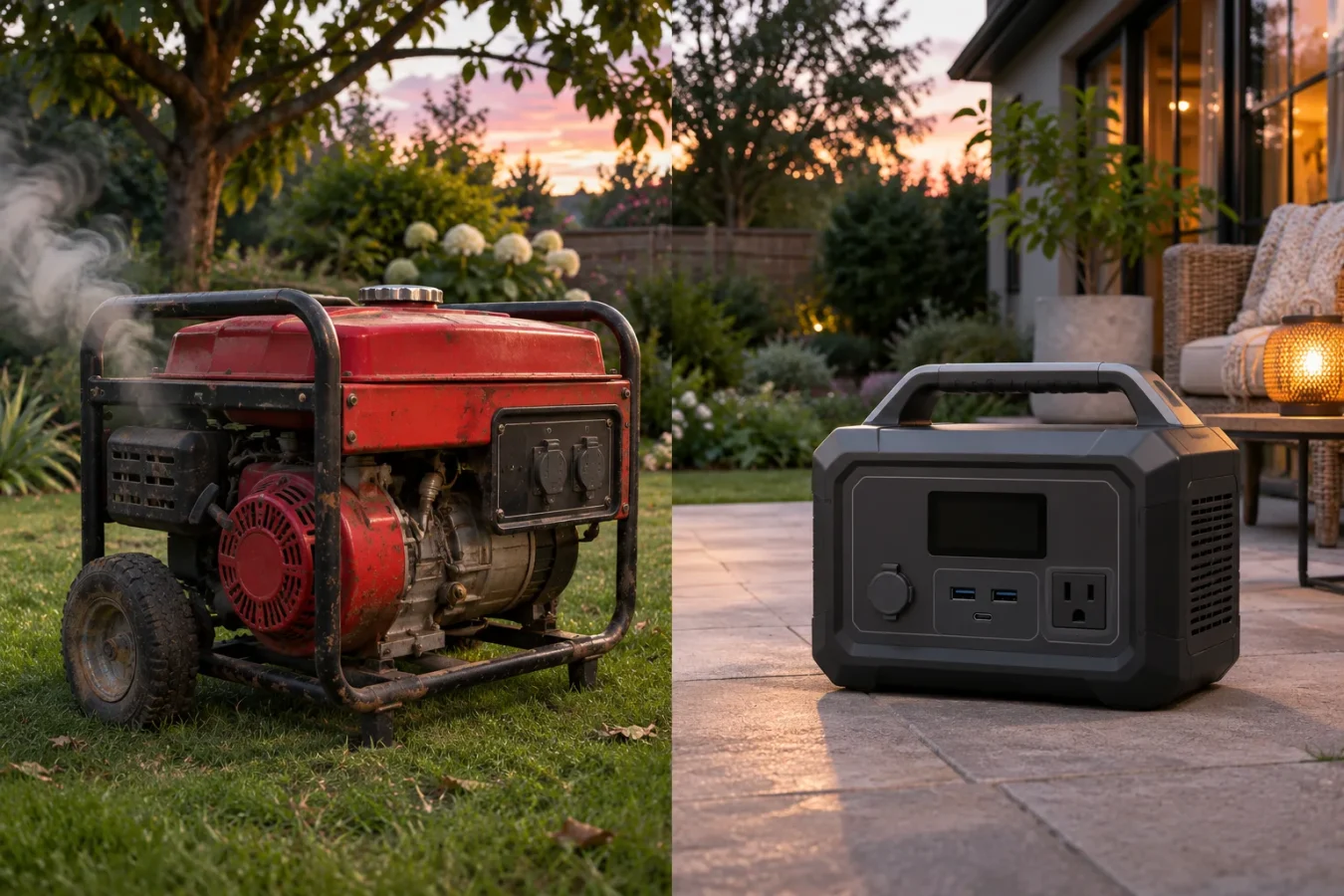
A blackout arrives with a refrigerator full of food, a dark driveway and a weather alert on your phone. A gas generator answers with serious wattage and a fuel can. A portable power station answers with silence, instant startup and no exhaust pipe. Neither is automatically better. The right choice depends on what you need to run, how long you need it running and where the equipment will sit.
This guide compares portable power stations and gas generators on the things that matter after the lights go out: usable runtime, starting and running wattage, noise, indoor-air safety, fuel storage, maintenance, recharge options and long-term value. You will also see five battery examples, including the BLUETTI AC180, Anker SOLIX C1000 and OUPES Mega 1, so the numbers have practical context.
Our buying judgments use manufacturer-listed specifications, stated value for each size class and the volume of Amazon buyer ratings. For battery runtime estimates, the standard calculation is capacity in watt-hours multiplied by 0.85, divided by device wattage. Check the current price on Amazon before ordering.
The short answer: battery power for convenience, gas for endurance
Choose a portable power station when quiet operation, clean indoor-adjacent backup and simple ownership matter most. It starts at the press of a button, produces no combustion exhaust and can keep a phone, router, CPAP machine, laptop, lights or small refrigerator running without waking the house. It is especially attractive for apartments, bedrooms, campsites, remote work and overnight medical-device use.
Choose a gas generator when you need sustained high output for many hours or days. A fuel generator can be refilled rather than recharged, making it the stronger answer for extended outages, large refrigerators, sump pumps, well pumps, electric heaters and demanding job-site tools. It is also less dependent on sunlight or grid recharge.
The dividing line is wattage. Battery stations commonly excel at clean, moderate loads. Gas generators generally win when multiple large appliances run together. Battery capacity is measured in watt-hours; generator capability is usually discussed in running watts, surge watts and fuel consumption. A 1,000 Wh battery station has roughly 850 Wh available under the standard 0.85 efficiency assumption. At 100 W, that is about 8.5 hours before recharge, not an unlimited supply.
For a deeper sizing exercise, compare this guide with our practical watt-hour sizing guide and our complete buying guide.
Noise, fumes and the indoor-use question
This is the clearest advantage for a portable power station: it has no gasoline engine and no carbon monoxide exhaust. That makes it suitable for use inside a home when operated according to the manufacturer’s instructions. You can place a battery unit near a router, workstation or CPAP setup without filling the room with engine noise and fumes.
A gas generator must remain outdoors, far from doors, windows and vents. Never run one in a garage, basement, shed, porch, tent, vehicle or other enclosed or partially enclosed space. Carbon monoxide is invisible and odorless. Opening a door or raising a garage door does not make indoor operation safe. Use working carbon monoxide alarms inside the home and follow local fire and generator-clearance rules.
Quiet is not merely a comfort feature. During a hurricane or overnight blackout, a loud engine can disturb sleep and make conversation difficult. The Jackery Explorer 1000 v2 advertises a 30dB silent mode, while the BLUETTI Elite 100 V2 states 30dB operation. Those figures are useful reference points, although operating mode and load affect sound.
Battery stations still need ventilation for heat and must stay dry. Do not cover cooling vents or operate any electrical equipment where water can reach it. For more emergency planning, see our hurricane and blackout checklist.
Runtime: fuel tank versus watt-hours
Gas generators win the refill argument. As long as you have approved, fresh fuel and the generator is rated for the load, runtime can continue through a long outage. That matters when the grid may stay down for several days and solar conditions are poor. The tradeoff is fuel handling, storage rotation, engine noise and exhaust safety.
Portable power stations have a finite battery reservoir. Use this formula: runtime in hours = watt-hours × 0.85 ÷ device watts. A 1,024 Wh station running a 60 W load provides about 14.5 hours. A 1,152 Wh station running a 100 W load provides about 9.8 hours. Actual results vary with conversion losses, temperature, battery condition and the station’s own operating draw.
Load management stretches battery time. A refrigerator does not draw its maximum wattage continuously, but its compressor can demand a starting surge. A CPAP machine’s result depends on pressure, humidifier and heated-tube settings. A 1,000 Wh-class station is excellent for essentials, but it is not a substitute for unlimited fuel when powering electric heat, air conditioning or a well pump.
Recharge changes the calculation. The Anker SOLIX C1000 advertises 100% AC charging in 58 minutes and up to 600 W solar input. The BLUETTI AC180 advertises full AC charging in one hour and up to 500 W solar input. Solar can extend a battery system, but clouds, shade, panel position and daylight hours control the result. See our solar charging guide for planning details.
Wattage and surge: where gas generators pull ahead
Before buying either type, write down every appliance you may run at the same time. Separate running watts from startup watts. Refrigerators, freezers, pumps, compressors and some power tools can demand a brief surge well above their normal draw. The power source must handle both.
A portable station’s continuous AC output is a hard ceiling. The BLUETTI AC180 is rated at 1,800 W and can reach 2,700 W through its stated boost mode. The BLUETTI Elite 100 V2 is also rated at 1,800 W with 2,700 W lifting power. The OUPES Mega 1 is rated at 2,000 W with a 4,500 W surge peak. Those numbers are substantial for a battery unit, but they still do not make an electric space heater, central air conditioner or large well pump practical for long periods.
Gas generators are usually the better choice for high continuous loads and large motor starts. They can keep producing power while fuel is available, rather than exhausting a fixed battery. However, never select by peak watts alone. Use running wattage for the sustained load and confirm that the surge rating covers startup.
Power quality also matters for electronics and medical equipment. Look for a pure sine wave AC output and, for a computer or networking setup, consider UPS behavior. The AC180 advertises emergency backup response in 20 milliseconds, while the Elite 100 V2 describes instant switching for a WiFi router and PC. Confirm compatibility with sensitive equipment before an outage.
Battery examples: the strongest all-around choices
1. BLUETTI AC180 — Excellent value for its size class. This is the most balanced example in the group. Its 1,152 Wh LiFePO4 battery, 1,800 W output, 2,700 W boost mode and nine outlets cover a broad mix of blackout essentials, campsite appliances and remote-work equipment. It advertises 0–80% charging in 45 minutes, full AC charging in one hour and up to 500 W solar input. Its stated 20ms UPS function adds appeal for routers and computers. Amazon buyer rating: 4.5 out of 5 from 1,900 ratings.
2. Anker SOLIX C1000 — Good value for its size class. The 1,056 Wh battery is close to the 1kWh sweet spot, while SurgePad technology delivers 2,400 W and nine ports support several devices at once. It advertises 80% charging in 43 minutes and 100% in 58 minutes. The stated 3,000-cycle, 10-year lifespan claim and app-based charging controls make it attractive for frequent use. Up to 600 W solar input is another advantage. Amazon buyer rating: 4.7 out of 5 from 2,100 ratings.
For more models in this capacity range, compare the BLUETTI AC180 review and the Anker SOLIX C1000 review.
Battery examples: compact, quiet and expandable
3. BLUETTI Elite 100 V2 — Good value for its size class. This unit delivers 1,024 Wh and 1,800 W of AC output, with 2,700 W lifting power and 11 ports. The stated 25-pound weight and 17-liter size make its portability unusually concrete for this class. It advertises 30dB operation, 70-minute fast full charging through its stated charging methods and instant switching for a router or PC. That combination suits a quiet home office, CPAP night, campsite or small emergency-load panel. Amazon buyer rating: 4.5 out of 5 from 1,800 ratings.
4. Jackery Explorer 1000 v2 — Premium price for its size class. Its 1,024 Wh LiFePO4 battery and 1,500 W AC output, with a 3,000 W surge peak, cover many household essentials. It includes three AC ports, two USB-C ports, one USB-A port, a DC car port and LED lights. The product advertises one-hour charging, 100 W USB-C input and output, app control and a 30dB silent mode. Its 4.7 out of 5 rating from 3,700 Amazon ratings is the highest rating volume among these examples.
5. OUPES Mega 1 — Fair value for its size class. This is the high-output and expansion play: 1,024 Wh, 2,000 W output, 4,500 W surge peak and 13 outputs. Its optional B2 extra battery can bring the stated system capacity to 5,120 Wh. It advertises 0–80% AC charging in 36 minutes and more than 3,500 cycles at 80% capacity. Amazon buyer rating: 4.5 out of 5 from 1,500 ratings. See the Elite 100 V2 review, the Explorer 1000 v2 review and the OUPES Mega 1 review.
Cost, maintenance and fuel storage
Purchase price is only one part of ownership. A gas generator may look powerful for its capacity, but budget for fuel containers, fuel rotation, oil, filters, spark-plug service and occasional maintenance. Gasoline degrades over time. Fuel storage also introduces spill, fire and local-regulation concerns. A generator that sits untouched for years may not be ready when a storm arrives unless it is maintained and started according to the manufacturer’s schedule.
A portable power station has no engine oil, spark plug or gasoline tank. Its maintenance is simpler: keep it charged appropriately, store it in a suitable dry environment, protect it from extreme conditions and follow the manufacturer’s charging guidance. Battery systems can still age, and capacity declines with use and time. The candidates here use stated LiFePO4 chemistry where specified, a chemistry commonly selected for durability and stable cycling.
Value labels help compare battery units within their own size class. The AC180 is rated Excellent value, the Anker C1000 and Elite 100 V2 are Good value, the OUPES Mega 1 is Fair value and the Jackery Explorer 1000 v2 carries a Premium price. Those labels are relative, not a promise that one product is cheapest on a particular day. Check the current price on Amazon and compare included cables, charging methods, output, warranty terms and expansion options.
For a broader shortlist, visit our best portable power stations under $1,000 guide and our LiFePO4 buying guide.
How to choose: match the source to the outage
Start with the load, not the product brand. For a communication-and-comfort kit, list a phone charger, LED lamps, WiFi router, laptop, CPAP machine and perhaps a small refrigerator. Add their running watts, then investigate startup surges. A 1,000 Wh-class battery station can be a strong fit for this category, especially when silence and indoor-adjacent operation are priorities.
For a whole-home emergency plan, identify the specific circuits you want powered. Electric resistance heat, central air conditioning, electric water heaters and well pumps can overwhelm a mid-sized battery station. A properly sized gas generator may win, provided it is installed and operated safely. If you want battery backup for electronics but fuel-powered endurance for major appliances, a hybrid setup can be sensible.
Camping changes the priorities. Quiet hours, no fumes and easy USB or AC charging favor a power station. Job sites may favor gas when saws, compressors and grinders run hard for long stretches. Van builds and RVs often benefit from battery power because it avoids idling an engine or running a loud generator near sleeping areas.
Ask four final questions: What is the largest startup surge? How many hours must the load run? Can you recharge from the wall, a vehicle or solar? Where will the equipment operate? Use our home-backup guide, our camping guide or our RV and van-life guide to narrow the scenario.
Mistakes to avoid, then the final recommendation
The first mistake is confusing watt-hours with watts. Watt-hours describe stored energy; watts describe how much power the station can deliver now. The second is ignoring startup surge. A refrigerator may fit within a station’s running output but fail at compressor startup. The third is assuming a battery will run an electric heater all night. High-wattage heating drains a 1,000 Wh-class battery quickly.
Another mistake is treating a gas generator as an indoor appliance. It is not. Carbon monoxide can kill without warning. Keep the generator outdoors, follow clearance guidance, use carbon monoxide alarms and never improvise with a garage, shed or open doorway. Also avoid storing fuel casually or letting old gasoline sit indefinitely.
Our recommendation is straightforward. Buy a portable power station if your priorities are quiet operation, clean backup near living spaces, simple maintenance, electronics, CPAP, networking, camping or moderate appliance loads. Among these examples, the BLUETTI AC180 is the most balanced starting point because of its 1,152 Wh capacity, 1,800 W output, rapid charging, UPS feature and Excellent value label. The Anker C1000 is a compelling fast-charging alternative, while the OUPES Mega 1 makes more sense when expansion and high output matter.
Buy a gas generator when extended runtime and heavy loads outweigh noise, fumes, fuel handling and maintenance. For many households, the smartest answer is hybrid: battery power for quiet overnight essentials, plus a safely operated gas generator for long outages and large appliances. Compare more options in our home backup rankings and our 2026 portable power station rankings.
Every model mentioned, at a glance
| Value for its size | Availability | |||||||||
|---|---|---|---|---|---|---|---|---|---|---|
| BLUETTI AC180 Best overall | 8.2 | 1,152 | 1,800 | Yes | See listing | 500 | See listing | 4.51,900 ratings | Excellent value | Check price on Amazon |
| Anker SOLIX C1000 | 6.2 | 1,056 | See listing | Not stated | See listing | 600 | See listing | 4.72,100 ratings | Good value | Check price on Amazon |
| OUPES Mega 1 | 5.8 | 1,024 | 2,000 | Not stated | 3500 | See listing | 27.8 | 4.51,500 ratings | Fair value | Check price on Amazon |
| BLUETTI Elite 100 V2 Best for camping | 6.6 | 1,024 | 1,800 | Not stated | See listing | 1000 | 25 | 4.51,800 ratings | Good value | Check price on Amazon |
| Jackery Explorer 1000 v2 | 5.9 | 1,024 | See listing | Yes | 4000 | See listing | 25 | 4.73,700 ratings | Premium price | Check price on Amazon |
Specifications as stated in the Amazon listing. Missing details: see listing. Scores use specifications and buyer ratings. How we rank.
Frequently asked questions
Can a portable power station replace a gas generator?
Sometimes, but not universally. A battery station can replace a gas generator for phones, lights, routers, laptops, CPAP machines, refrigerators and moderate loads. Gas remains stronger for extended outages, electric heating, large pumps, central air conditioning and other demanding equipment. Compare both running and startup watts, then calculate battery runtime from watt-hours before choosing.
Can I run a portable power station indoors?
A battery power station produces no combustion exhaust, so it can generally operate indoors when used according to the manufacturer’s instructions. Keep it dry, leave cooling vents clear and use the correct cables. Never treat this rule as permission to operate a gas generator indoors, in a garage, in a vehicle or in any partially enclosed space.
How long will a 1,000Wh power station last?
Use 1,000 multiplied by 0.85, then divide by the load in watts. That gives about 8.5 hours at 100W, 4.25 hours at 200W or 1.7 hours at 500W. Real runtime varies with conversion losses, the station’s own draw, temperature, battery condition and whether the appliance cycles rather than drawing power continuously.
Which is safer during a hurricane: a battery station or gas generator?
A battery station avoids gasoline storage and carbon monoxide exhaust, making it simpler around occupied living spaces. A gas generator can provide longer high-power operation, but it must remain outdoors with generous clearance from doors, windows and vents. Use working carbon monoxide alarms inside the home, follow local rules and never run an engine-powered generator in an enclosed area.
Is a gas generator cheaper over the long term?
That depends on usage. Gas generators provide strong output and refillable runtime, but ownership includes fuel, oil, filters, spark plugs, storage and periodic maintenance. Battery stations avoid engine service and fuel handling but have finite capacity and battery aging. Compare the intended load, outage frequency, recharge options and the product’s value label rather than judging by purchase price alone.
Should I buy both a portable power station and a gas generator?
For frequent outages, a hybrid setup can be excellent. Use the battery station for silent overnight essentials, electronics, communications and indoor-adjacent backup. Use the gas generator outdoors for large appliances and prolonged outages when fuel is available. Size each device for its own job, maintain both according to manufacturer guidance and keep carbon monoxide safety central to the generator plan.
