Brand profile
OUPES Portable Power Stations: Lineup, Specs & Values
Two 1,024Wh power stations. One high-output platform, with different priorities.
OUPES keeps this tracked lineup refreshingly simple: the Mega 1 and Mega 1 Lite both sit in the 1,024 Wh class and both offer a 2,000 W rated AC output with a 4,500 W surge rating. That puts them in the useful middle ground between compact camping batteries and large home-backup systems. They can cover everyday electronics, kitchen appliances, power tools, and many CPAP setups without stepping up to a much larger unit.
The important split is feature emphasis. The Mega 1 focuses on expansion, a broad output selection, and fast partial charging. The Mega 1 Lite adds a much lighter listed weight, 140 W USB-C ports, app control, a sub-20ms UPS claim, and specified solar input. Both use LiFePO4 cells and list more than 3,500 cycles to 80% capacity. Check the current price on Amazon, then confirm the US voltage, plug layout, included accessories, and any current listing changes before buying.
The OUPES lineup: one size tier, two interpretations
Both tracked OUPES models belong to the 1,000 Wh class. Their 1,024 Wh batteries provide an estimated 870 Wh of usable energy when applying the standard 0.85 conversion. That works out to roughly 8.7 hours at 100 W, 14.5 hours at 60 W, or 52 minutes at 1,000 W, before the connected device’s own behavior and surge demands are considered.
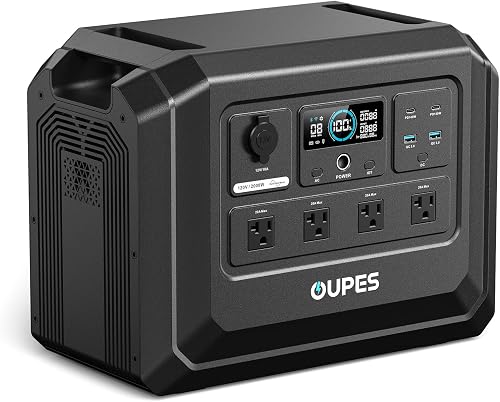
The OUPES Mega 1 lists 2,000 W AC output, four AC outlets, two 100 W USB-C ports, four 18 W USB-A ports, two DC5521 ports, and a car-lighter port. It can connect to an OUPES B2 extra battery for a listed 5,120 Wh total capacity. The OUPES Mega 1 Lite keeps the same headline capacity and output but lists nine versatile ports, dual 140 W USB-C ports, app control, UPS functionality, and up to 800 W solar input. In short, Mega 1 is the expansion-oriented option; Lite is the more feature-rich portable option.
OUPES Mega 1: best for expansion and broad device coverage
The Mega 1 makes the strongest case for a home-outage kit that may grow later. Its 2,000 W rated output can cover many refrigerators, microwaves, coffee makers, hair dryers, and job-site tools, provided each device stays within the output limit and does not demand an unusual startup surge. The listed 4,500 W peak rating gives more headroom for brief startup loads, but it does not turn the battery into a continuous 4,500 W power source.
Its 13-output layout is unusually practical on paper. Four AC outlets leave room for several household devices, while the USB and DC ports handle phones, lights, routers, and other low-draw gear. The 1,400 W fast-charge mode reaches 80% in a listed 36 minutes; a 700 W slow-charge mode is also available. The expansion path to 5,120 Wh is the headline differentiator for longer blackouts or off-grid use. The trade-off is value: its listed value for this size class is Fair, so buyers should compare the current Amazon price with similarly sized options from EcoFlow, BLUETTI, and Anker SOLIX.
OUPES Mega 1 Lite: best for lighter carry and modern controls
The Mega 1 Lite is the more compelling choice when portability and charging flexibility matter more than battery expansion. Its listed weight is 26.7 pounds, a meaningful detail for a trunk, campsite, tailgate, or van where the station may be moved often. It still provides 1,024 Wh and 2,000 W of rated AC output, so its core power class is unchanged.
The Lite’s strongest additions are specific and useful. Dual 140 W USB-C ports can charge compatible laptops and other devices without a separate AC adapter. App control lets owners monitor usage, change between 1,400 W and 700 W charging, and toggle output ports remotely. The listed sub-20ms UPS switchover is aimed at keeping a CPAP, router, or computer running during an outage, although buyers should confirm compatibility with their exact equipment. Solar input is listed at up to 800 W through an Anderson port. The compromise is that expansion to 5,120 Wh is not listed for this model. Its value label is also Fair, so check the current Amazon price before choosing it over the Mega 1 or a rival such as Anker SOLIX C1000.
Who should buy each OUPES power station?
Choose the Mega 1 if your priority is a larger future system. The B2 expansion claim makes it the better fit for multi-day emergency planning, a fixed backup corner in the home, or off-grid use where 1,024 Wh may eventually feel limiting. Its four AC outlets and 13-output layout also suit households or crews charging many different devices at once. The LiFePO4 battery is listed at more than 3,500 cycles to 80% capacity, with a stated service life of up to 10 years.
Choose the Mega 1 Lite if you regularly carry the unit and want the shortest path from battery to device. Its 26.7-pound listed weight, 140 W USB-C ports, app, UPS claim, and 800 W solar-input specification target road trips, laptop-heavy work, CPAP nights, and solar-supported camping. For either model, 870 Wh of estimated usable energy is enough for a 60 W device for about 14.5 hours, but a 1,500 W appliance would draw that reserve in roughly 35 minutes. For more capacity, compare larger systems in our home-backup guide.
Value, trade-offs, and what to verify before buying
Both models are labeled Fair value for their size class. That does not mean poor value; it means the feature package and capacity should be weighed against current competition rather than bought on headline wattage alone. OUPES brings strong output for a 1,024 Wh station, LiFePO4 chemistry, fast AC charging, and useful connectivity. The Lite adds a notably portable form factor and more modern controls, while the Mega 1 offers the clearer expansion story.
Before checkout, verify the US Amazon listing’s voltage and plug configuration, the exact number and type of included cables, the current port layout, and whether the advertised solar-input hardware is included or sold separately. Confirm that your CPAP or sensitive electronics accept the listed UPS behavior. Check the current price on Amazon because value can change. Also compare the current listings for EcoFlow RIVER 2 Pro, BLUETTI AC180, and Jackery Explorer 1000 v2 if you do not need 2,000 W output or expansion.
Every model mentioned, at a glance
| Value for its size | Availability | |||||||||
|---|---|---|---|---|---|---|---|---|---|---|
| OUPES Mega 1 | 5.8 | 1,024 | 2,000 | Not stated | 3500 | See listing | 27.8 | 4.51,500 ratings | Fair value | Check price on Amazon |
| OUPES Mega 1 Lite | 5.7 | 1,024 | 2,000 | Not stated | 3500 | 800 | 26.7 | 4.676 ratings | Fair value | Check price on Amazon |
Specifications as stated in the Amazon listing. Missing details: see listing. Scores use specifications and buyer ratings. How we rank.
Frequently asked questions
How much usable energy do the OUPES Mega 1 models provide?
Using 1,024Wh multiplied by 0.85, estimated usable energy is about 870Wh. That is roughly 8.7 hours at 100W or 14.5 hours at 60W.
Which OUPES model is better for home backup?
The Mega 1 is the better fit if you may add the listed B2 extra battery and reach 5,120Wh. The Mega 1 Lite is attractive for smaller backup needs, especially where UPS behavior and portability matter.
Can the OUPES Mega 1 Lite run a CPAP?
Its listing includes a sub-20ms UPS claim and specifically mentions CPAP use. Confirm your CPAP’s startup draw, heated-humidifier settings, and compatibility with the US listing before purchase.
What is the main advantage of the Mega 1 Lite?
It lists a 26.7-pound weight, dual 140W USB-C ports, app control, a sub-20ms UPS switchover, and up to 800W solar input. Those features suit mobile work, camping, and compact emergency kits.
Are OUPES power stations a good value?
Both tracked models are labeled Fair value for their size class. Compare the current Amazon price, included accessories, US port configuration, and features against similar models before deciding.