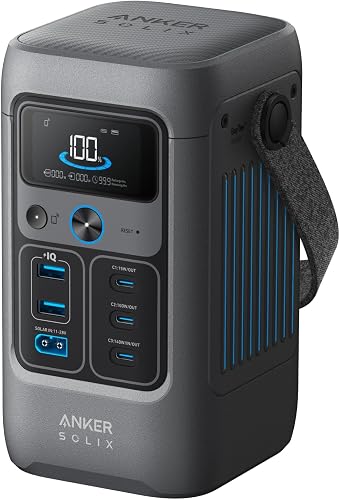
Brand profile
Anker SOLIX Portable Power Stations
A broad lineup, from pocket-friendly USB-C power to serious outage backup.
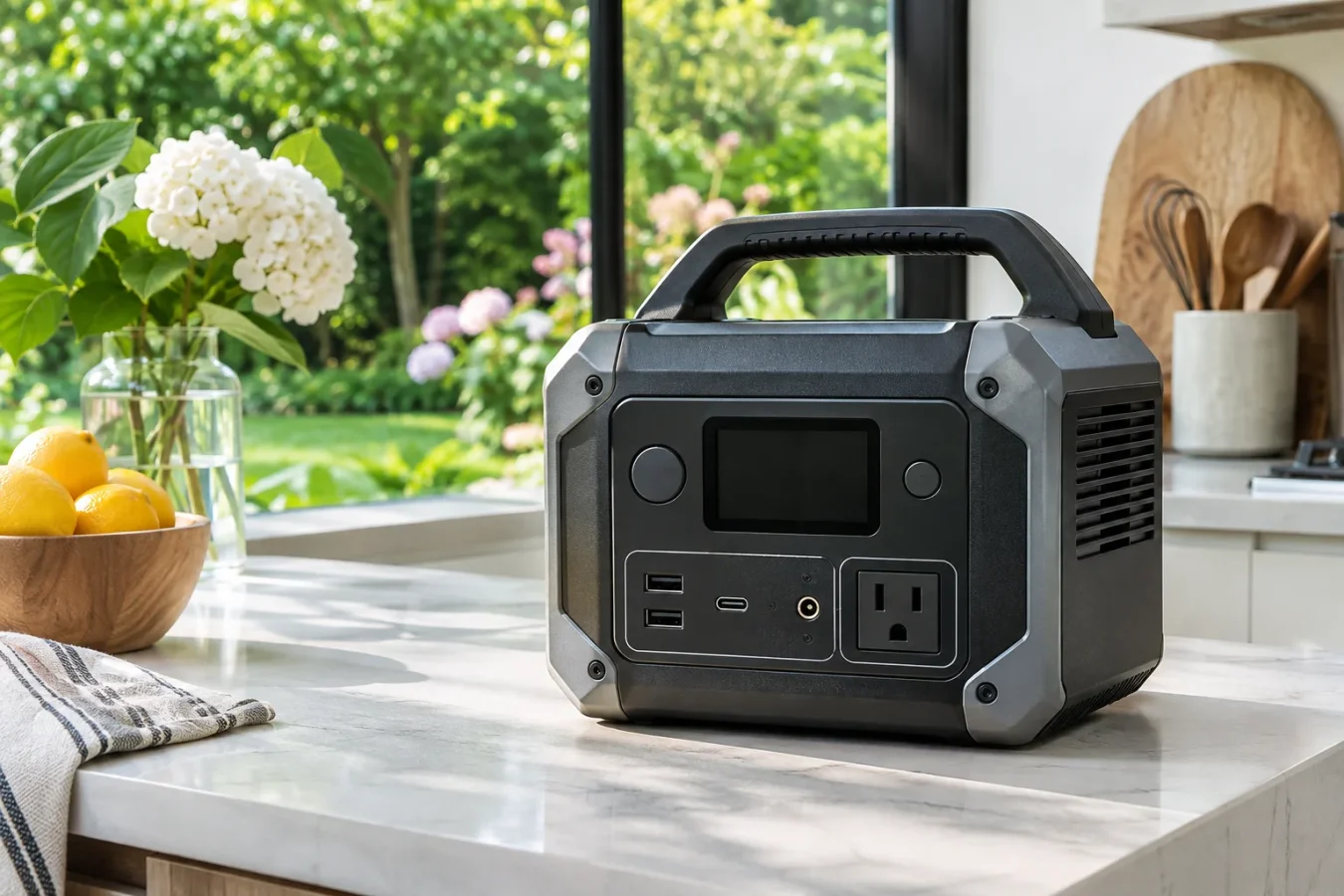
Anker SOLIX covers nearly every portable-power job. The compact C200 DC, C300 DC and 521 focus on phones, laptops, cameras and other light loads. The C1000 steps into true household backup territory, while the C2000 Gen 2, S2000 and F3000 target refrigerators, tools, RV equipment and longer outages. Capacity ranges from 192 Wh to 3,072 Wh, and rated AC output runs from 200 W to 6,000 W.
The important split is not just size. Some models emphasize AC outlets; others are DC-first USB-C hubs. Solar support varies, too. Use the numbers below to match the station to your actual loads, then check the current price on Amazon. For more context, see our portable power station buying guide and 2026 power station rankings.
The compact tier: C200 DC, SOLIX 521, C300 DC and C300
These four stations are built for personal electronics and light-duty camping. The C200 DC is the smallest at 192 Wh and 200 W. It has five ports, including 140 W and 100 W USB-C, but no AC outlets. That makes it a strong fit for a laptop, camera kit, phones or a CPAP setup that can run from USB-C. Its listed value is Fair for its size class.
The SOLIX 521 adds 256 Wh, 300 W AC output, two AC outlets, two USB-A ports and 60 W USB-C PD. Its LFP battery and 4.4 rating from 3,100 Amazon ratings are reassuring on paper, but its listed value is Premium. The C300 DC offers 288 Wh, 300 W output and two 140 W USB-C ports, with Good value. The standard C300 has the same capacity and AC rating, seven ports, 25dB operation and 100 W solar support, but Premium value. Choose it for AC flexibility; choose the DC versions for efficient USB-C travel power.
The 1kWh class: Anker SOLIX C1000
The C1000 is the lineup’s practical middle ground: 1,056 Wh, a 4.7 rating from 2,100 Amazon ratings and Good value for its size class. It is large enough for blackout essentials but still aimed at road trips, campsites and RV use rather than whole-home electrical service. Anker lists nine ports and SurgePad technology delivering 2,400 W, giving it considerably more headroom than the compact models.
Its listed charging story is especially strong. UltraFast AC charging reaches 80% in 43 minutes and 100% in 58 minutes. The listing also says the unit accepts up to 600 W solar input, but because that detail is not in the Amazon.com title, confirm the exact US solar-input specifications before buying. An app provides charging controls and real-time statistics. Based on 1,056 Wh and the standard 0.85 conversion assumption, expected runtime is about 2.25 hours at 400 W, 4.5 hours at 200 W or 9 hours at 100 W. See our Anker SOLIX C1000 review for its place among similarly sized stations from BLUETTI and EcoFlow.
The 2kWh class: C2000 Gen 2 versus S2000
The C2000 Gen 2 and S2000 occupy similar capacity territory but serve different priorities. C2000 Gen 2 stores 2,048 Wh and supplies 2,400 W rated output with a 4,000 W peak. The listing highlights 58-minute AC charging, 800 W alternator charging, expansion to 4kWh and support for most RV air conditioners, power tools and multiple devices. It also lists a 230-hour low-power standby claim and a 30.5-hour refrigerator claim. Its value is Fair for its size class.
The S2000 has slightly less capacity at 2,010 Wh and lower output at 1,500 W, but its listed strengths are compact dimensions, a 16.2kg weight, 10 W idle draw, 400 W solar input, app controls and a sub-10ms UPS switchover. It has seven outlets but no 12V DC port. Its LFP battery is listed with 10,000 cycles, and its value is Premium. Pick C2000 Gen 2 for high-wattage tools and RV loads; pick S2000 for quieter home-office backup and efficient everyday essentials. Compare both with C2000 Gen 2 coverage and S2000 coverage.
The large-format option: Anker SOLIX F3000
The F3000 is the most capable station in this tracked lineup. Its 3,072 Wh battery and 6,000 W rated output are designed for demanding backup, job-site equipment, major RV loads and extended outages. The listing describes 120/240V output, pairing two units for 240V appliances, 2,400 W solar recharging and 3,600 W pass-through charging from a 120V generator. Those are substantial capabilities, but buyers should verify the exact US connection hardware and installation requirements before planning to run a home’s 240V circuits.
An expansion system can take total capacity to 24kWh, with the listing claiming up to 96 hours of outage energy. At the base 3,072 Wh capacity, the standard runtime formula suggests about 6.5 hours at 400 W, 3.3 hours at 800 W or 1.7 hours at 1,600 W. Real loads vary, and high startup demands matter. F3000 carries Premium value for its size class, so it makes the most sense when you need its output, expansion path or solar capability—not merely extra phone-charging capacity. It is closer to a home-backup platform than a casual campsite battery. Compare it with F3000 coverage and larger options from Jackery.
Who should buy Anker SOLIX—and what to double-check
Choose the C200 DC for a very light USB-C kit, the C300 DC for more USB-C power, or the 521 when two AC outlets matter. The standard C300 is the compact choice for buyers who want AC, seven ports and solar support. Move to the C1000 for refrigerator backup, several electronics at once or a more comfortable CPAP night. Choose C2000 Gen 2 for high-output tools and RV appliances, S2000 for efficient, quiet office or home essentials, and F3000 for serious outage planning.
Before ordering, confirm the US plug and voltage configuration, included charging accessories, solar-panel compatibility, input limits, AC surge behavior and the exact port layout. The C300 and C300 DC listings specifically exclude certain USB-C solar panels; the C200 DC listing also names excluded panels. The C300 DC listing says no wall charger is included. Verify warranty and support terms on the Amazon page rather than relying on regional listing text. Finally, check your appliance’s running and startup watts. Capacity estimates use Wh × 0.85 ÷ watts; a 1,000 W load on the C1000, for example, works out to roughly 0.9 hours before additional real-world variation.
Every model mentioned, at a glance
| Value for its size | Availability | |||||||||
|---|---|---|---|---|---|---|---|---|---|---|
| Anker SOLIX 521 | 5.5 | 256 | 300 | Yes | See listing | See listing | See listing | 4.43,100 ratings | Premium price | Check price on Amazon |
| Anker SOLIX C1000 | 6.2 | 1,056 | See listing | Not stated | See listing | 600 | See listing | 4.72,100 ratings | Good value | Check price on Amazon |
| Anker SOLIX C300 Best lightweight | 4.5 | 288 | See listing | Not stated | 3000 | 100 | See listing | 4.61,900 ratings | Premium price | Check price on Amazon |
| Anker SOLIX C300 DC | 6.4 | 288 | 300 | Not stated | See listing | 100 | See listing | 4.51,700 ratings | Good value | Check price on Amazon |
| Anker SOLIX C200 DC | 5.3 | 192 | 200 | Not stated | See listing | 100 | See listing | 4.41,000 ratings | Fair value | Check price on Amazon |
| Anker SOLIX C2000 Gen 2 Best for home backup | 6.0 | 2,048 | 2,400 | Not stated | See listing | See listing | 41.7 | 4.7746 ratings | Fair value | Check price on Amazon |
| Anker SOLIX S2000 | 4.9 | 2,010 | 1,500 | Not stated | See listing | 400 | 35.7 | 4.7492 ratings | Premium price | Check price on Amazon |
| Anker SOLIX F3000 | 4.2 | 3,072 | 6,000 | Not stated | See listing | 2400 | See listing | 4.4258 ratings | Premium price | Check price on Amazon |
Specifications as stated in the Amazon listing. Missing details: see listing. Scores use specifications and buyer ratings. How we rank.
Frequently asked questions
Which Anker SOLIX is best for camping?
The C300 or C300 DC suits light camping and electronics. The C300 adds AC outlets and listed 100W solar support; the C300 DC emphasizes high-output USB-C and is more attractive when you do not need AC.
Which model is best for a blackout?
The C1000 is the practical starting point for a refrigerator, CPAP and small electronics. Choose C2000 Gen 2, S2000 or F3000 when you need more capacity, higher output or longer backup.
Do all Anker SOLIX stations support solar charging?
Solar is listed for the 521, C300, C300 DC, C200 DC, C2000 Gen 2, S2000 and F3000. The C1000 listing describes solar charging in its bullet points, but confirm the exact US input specification on Amazon.
What is the difference between C300 and C300 DC?
Both list 288Wh and 300W output. The C300 has two AC outlets and seven total charging ports, while the C300 DC replaces AC outlets with a DC-focused port arrangement including two 140W USB-C ports. The DC version also lists no wall charger in the box.
Are Anker SOLIX power stations good value?
Value varies by model. The C300 DC and C1000 are listed as Good value for their size classes. The 521, C300, S2000 and F3000 are listed as Premium; the C200 DC and C2000 Gen 2 are Fair. Check the current price on Amazon before deciding.