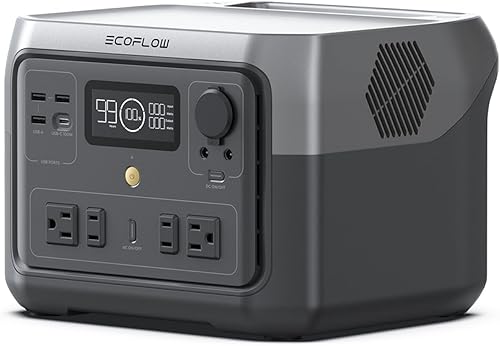
Head to head
Anker SOLIX vs EcoFlow: Which Power Station Brand Is Better?
Anker SOLIX brings strong compact options; EcoFlow stands out for value and higher-output choices.
The short answer
EcoFlow has the edge for value across comparable sizes, especially with the River 2 Max 500 and Delta 3 Classic. Anker SOLIX offers a broader spread of compact models and strong buyer ratings, but several of its small stations carry a premium value label. For backup power near 1,000Wh or above, compare output and expansion needs—not just capacity—before choosing.
Anker SOLIX and EcoFlow both cover the essentials: grab-and-go power for phones and laptops, mid-size stations for camping, and larger batteries for outages. Their lineups take different routes. Anker gives shoppers several compact DC-focused choices, while EcoFlow’s listed range stretches from the RIVER 2 Max 500 to a 3,600 Wh DELTA Pro.
In this comparison, value labels, Amazon ratings and listed product features help separate the brands by size. The right pick depends on what you need to run: a phone and laptop at camp, a fridge during a blackout, or heavier equipment at home or on a job site. Check the current price on Amazon, then match the station’s output and capacity to your actual loads.
Brand comparison: breadth, batteries, value and ratings
Across the products compared here, each brand has five options, but their coverage differs. Anker SOLIX clusters four models between 192 Wh and 288 Wh, then jumps to the 1,056 Wh C1000. EcoFlow spans 499 Wh to 3,600 Wh, with a 768 Wh RIVER 2 Pro, two 1,024 Wh Delta 3 models and the DELTA Pro at the top end. That gives EcoFlow more choice for larger backup loads in this selection; Anker offers more small-format choices.
LiFePO4 or LFP chemistry is explicit for four listed Anker models: the 521, C300, C300 DC and C200 DC. EcoFlow’s RIVER 2 Pro, River 2 Max 500, Delta 3 and DELTA Pro also identify LFP chemistry in their product details. Value is mixed, not a brand-wide sweep: EcoFlow gets Excellent value labels on the River 2 Max 500 and Delta 3 Classic, while Anker’s comparable C300-size choices range from Good to Premium.
The five Anker ratings add up to 9,800 Amazon ratings; EcoFlow’s five add up to 6,481. Both Delta 3 models rate 4.7 from 1,300 ratings, matching the C1000’s 4.7 from 2,100.
Compact tier: Anker’s 192–288Wh choices
Anker is the clear compact-lineup specialist in this matchup. The SOLIX C200 DC packs 192 Wh and 200 W output into a DC-focused design with five device ports. It earns a 4.4 rating from 1,000 Amazon ratings and carries a Fair value label. For a campsite kit built around phones, tablets and USB-C laptops, that port mix may be more relevant than having AC outlets.
At 288 Wh, the SOLIX C300 DC steps up to 300 W and seven ports, including two 140 W two-way USB-C ports. It has a Good value label and a 4.5 rating from 1,700 ratings. The AC-equipped SOLIX C300 also has 288 Wh, seven ports and a 4.6 rating, but carries a Premium price label. The SOLIX 521 is another 256 Wh, 300 W option, with two AC outlets and a 4.4 rating from 3,100 ratings; its value label is Premium. EcoFlow has no listed model in this compact range. Choose among the Ankers by port needs and value, and check the current price on Amazon.
Mid-size matchup: 499Wh versus 768Wh
This tier belongs to EcoFlow in the products compared. The River 2 Max 500 offers 499 Wh, 1,000 W output and an Excellent value label. Its listing highlights 11 device connections, one-hour AC charging and LFP cells. For weekend camping or a short outage, its capacity is a useful middle ground: larger than the Anker compact stations, without jumping to a full-size home-backup unit.
The RIVER 2 Pro moves up to 768 Wh and 800 W rated AC output, with a 4.5 rating from 1,800 ratings. Its product details describe LFP cells and 11 outlets. EcoFlow claims a 70-minute AC recharge and solar charging; confirm the charging setup and port layout on the Amazon page before ordering.
Neither EcoFlow option beats the C1000 on raw capacity, but both fill the gap between Anker’s compact units and its 1,056 Wh station. If your priority is more runtime for a small fridge, lights or several devices, this extra capacity can matter. If you need to carry mostly USB-powered gear, compare the compact Anker models instead of paying for capacity you may not use.
Around 1,000Wh: value versus rated output
This is the closest capacity matchup, and the numbers point in different directions. Anker’s SOLIX C1000 has 1,056 Wh and a Good value label. EcoFlow offers two 1,024 Wh choices: the Delta 3 Classic, labeled Excellent value, and the Delta 3, labeled Premium price. All three rate 4.7, though the C1000 has 2,100 ratings and each Delta 3 has 1,300.
| Model | Capacity | Rated AC output | Value label |
|---|---|---|---|
| Anker SOLIX C1000 | 1,056 Wh | Not given in title | Good |
| EcoFlow Delta 3 Classic | 1,024 Wh | 1,800 W | Excellent |
| EcoFlow Delta 3 | 1,024 Wh | 1,800 W | Premium |
EcoFlow’s listed Delta 3 output is a meaningful advantage for higher-wattage appliances. The standard Delta 3 also offers expansion up to 5kWh and lists 4,000 cycles at 80%; the Classic does not share those listed details here. Anker highlights fast recharging and app control for the C1000. Check the current price on Amazon and choose based on output, expansion and features—not capacity alone.
Large backup: EcoFlow DELTA Pro
EcoFlow goes much bigger with the DELTA Pro: 3,600 Wh capacity and 3,600 W rated AC output. That is a different class from Anker’s largest station in this comparison, the 1,056 Wh C1000. For a blackout plan involving several household devices or heavier equipment, the DELTA Pro’s capacity and output make it the more substantial starting point. Its Amazon rating is 4.6 from 681 ratings, and its value label is Fair.
EcoFlow describes expansion with extra DELTA Pro batteries or smart generators, along with app control over Wi-Fi or Bluetooth. It also lists multiple charging methods. For a van build, job site or extended outage, those options may matter as much as the base capacity. Remember that battery capacity is not the same as runtime: a rough estimate is watt-hours multiplied by 0.85, divided by the device’s watts. A 100 W load on a 3,600 Wh station works out to about 30.6 hours by that rule of thumb, before real-world variation.
Anker’s C1000 remains the more compact scale of backup in this comparison, but it cannot match the DELTA Pro’s listed capacity or output. If you are planning to power essential circuits, check your appliances’ starting and running wattage and confirm the system’s expansion requirements before buying.
Which brand should you buy?
Choose Anker SOLIX if you want a compact power station and value a choice of DC-focused port layouts. Its C200 DC and C300 DC offer clear USB-C-centered options, while the C300 adds AC outlets and the 521 pairs a compact capacity with two AC outlets. The C1000 is a well-rated step up, with a Good value label and listed app control. Be selective: the compact models marked Premium may be less appealing if value per size is your main concern.
Choose EcoFlow if you want stronger value among the listed mid-size and 1,000 Wh stations, or need more output and expansion options. The River 2 Max 500 and Delta 3 Classic are both labeled Excellent value. The standard Delta 3 adds 1,800 W output and expansion potential, while the DELTA Pro serves much larger backup plans.
For either brand, size the station around the equipment you actually expect to run. A CPAP, laptop and lights call for a different setup than a refrigerator or power tools. Compare continuous output, usable capacity, ports and recharge options; ratings are helpful context, not a substitute for matching those details to your needs. For a broader shortlist, see our best portable power stations.
Every model mentioned, at a glance
| Value for its size | Availability | |||||||||
|---|---|---|---|---|---|---|---|---|---|---|
| Anker SOLIX 521 | 5.5 | 256 | 300 | Yes | See listing | See listing | See listing | 4.43,100 ratings | Premium price | Check price on Amazon |
| Anker SOLIX C1000 | 6.2 | 1,056 | See listing | Not stated | See listing | 600 | See listing | 4.72,100 ratings | Good value | Check price on Amazon |
| Anker SOLIX C300 Best lightweight | 4.5 | 288 | See listing | Not stated | 3000 | 100 | See listing | 4.61,900 ratings | Premium price | Check price on Amazon |
| EcoFlow RIVER 2 Pro | 5.0 | 768 | 800 | Not stated | See listing | 220 | 17.2 | 4.51,800 ratings | Premium price | Check price on Amazon |
| Anker SOLIX C300 DC | 6.4 | 288 | 300 | Not stated | See listing | 100 | See listing | 4.51,700 ratings | Good value | Check price on Amazon |
| EcoFlow River 2 Max 500 | 7.9 | 499 | See listing | Yes | See listing | 220 | 13.2 | 4.61,400 ratings | Excellent value | Check price on Amazon |
Specifications as stated in the Amazon listing. Missing details: see listing. Scores use specifications and buyer ratings. How we rank.
Frequently asked questions
Is Anker SOLIX or EcoFlow better for value?
EcoFlow has the stronger value labels among the comparable mid-size and 1,000Wh options here: the River 2 Max 500 and Delta 3 Classic are labeled Excellent value. Anker’s C1000 is labeled Good value, while its compact models range from Fair to Premium. Check the current price on Amazon.
Which brand has the better compact power station?
Anker SOLIX offers more compact choices in this comparison, including DC-focused models at 192Wh and 288Wh and AC-equipped options at 256Wh and 288Wh. Pick by port needs, output and value label rather than assuming one model fits every camping setup.
Which brand is better for home backup?
EcoFlow has the larger listed option: the DELTA Pro provides 3,600Wh capacity and 3,600W rated AC output. Near 1,000Wh, the Delta 3 models list 1,800W output, while the Anker C1000 offers 1,056Wh. Size your system to the appliances and loads you need to support.
Do Anker SOLIX and EcoFlow use LiFePO4 batteries?
Several models from both brands explicitly identify LiFePO4 or LFP chemistry in their product details, including the Anker 521, C300, C300 DC and C200 DC, and EcoFlow RIVER 2 Pro, River 2 Max 500, Delta 3 and DELTA Pro. Check the individual model details when comparing chemistry.